
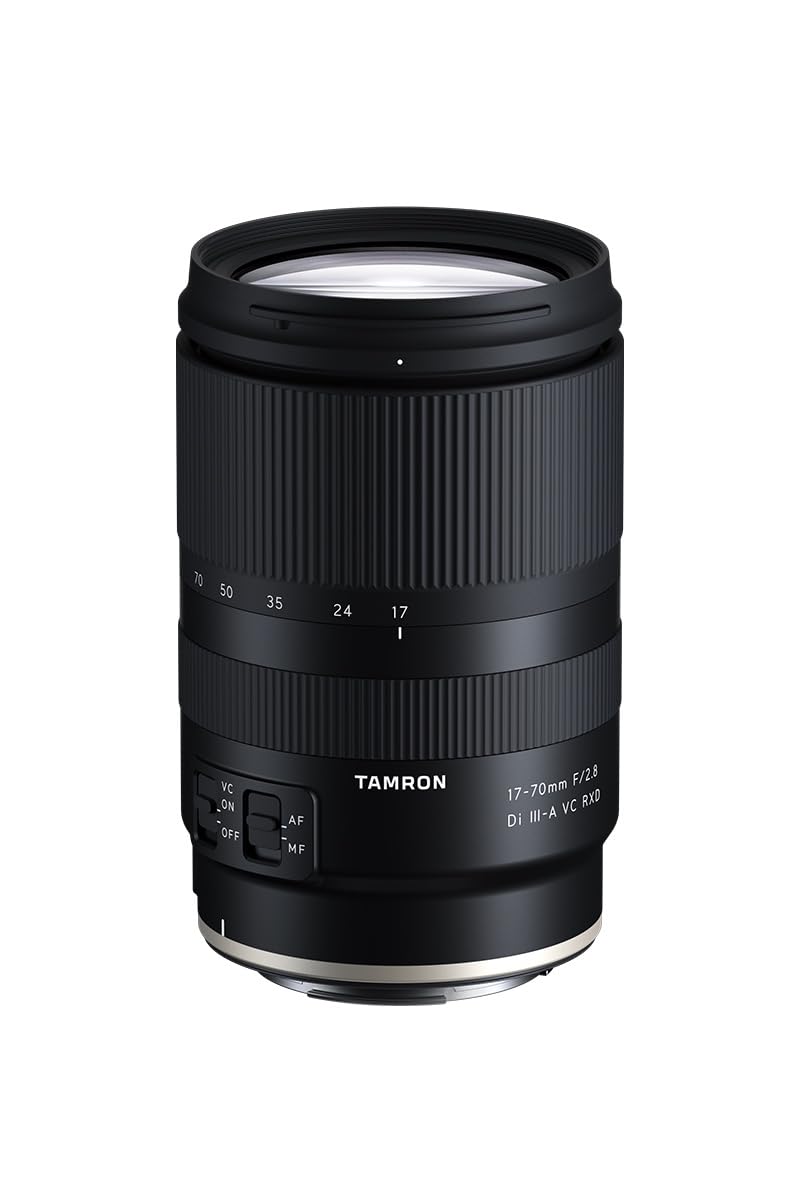
The Tamron 17-70mm F/2.8 Di III-A VC RXD is a standard zoom lens designed for APS-C mirrorless cameras, and this version is for Canon’s RF mount. It covers a versatile focal range equivalent to roughly 27-112mm in full-frame terms, making it suitable for a wide variety of subjects. The constant F/2.8 aperture is a key feature, allowing consistent exposure and shallow depth of field throughout the zoom range. Tamron has included Vibration Compensation (VC) to help with handheld shooting, and the RXD stepping motor provides quiet and reasonably fast autofocus, which is beneficial for both stills and video.
In real-world use, this lens is often chosen by photographers who want a single lens that can handle everything from landscapes to portraits. The 17mm wide end is useful for interiors and group shots, while the 70mm telephoto end provides some reach for close-ups. The fast F/2.8 aperture makes it a good option for low-light situations and for achieving blurred backgrounds. For event photography, the constant aperture is a significant advantage, as you can zoom without losing light. Videographers appreciate the smooth autofocus and the added stability from VC, though the lens does exhibit some focus breathing.
Build quality is solid, with a mix of metal and plastic that feels durable but not premium. The lens is weather-sealed, which is a plus for outdoor use, though it’s not fully waterproof. The zoom ring is smooth, and the focus ring is responsive, but the lens lacks a dedicated aperture ring, which some users might miss. At around 525g, it’s not the lightest lens, and it’s noticeably larger than a typical kit lens, which could be a consideration for those prioritizing portability.
Optically, the lens performs well in the center wide open, with good sharpness and contrast. Stopping down improves edge performance. There is some vignetting and distortion, but these are automatically corrected in most cameras. Chromatic aberration is visible in high-contrast situations but is generally controlled. The VC system provides about 3-4 stops of stabilization, which is helpful but not class-leading. Autofocus is quick and accurate for most subjects, though it can hunt in very low light. The lens is not parfocal, so focus may shift slightly when zooming, which is something to note for video work.
Compared to a typical 18-55mm kit lens, the Tamron offers a faster aperture and a longer reach, but it’s heavier and more expensive. Compared to a prime lens like a 35mm F/1.8, it’s less sharp and slower, but far more versatile. It competes with other standard zooms like the Sigma 17-70mm F/2.8-4, which has a variable aperture but is slightly lighter and cheaper. The Tamron’s constant aperture is a clear advantage for low light.
This lens is suitable for enthusiasts and semi-professionals who need a reliable, fast standard zoom for a wide range of subjects. It’s a good choice for travel, events, and everyday photography. However, it’s not for those who prioritize absolute image quality above all else, as primes will outperform it. It’s also not ideal for anyone who wants a compact, lightweight setup, as it adds noticeable bulk. And for professional sports or wildlife shooters, the reach and autofocus speed may not be sufficient.
Overall, the Tamron 17-70mm F/2.8 for Canon RF is a practical lens that fills a gap in the Canon RF APS-C lineup. It offers a useful focal range and a fast aperture at a reasonable price, though it makes some compromises in size and weight. It’s a solid option for those who want one lens to cover most situations without breaking the bank.