
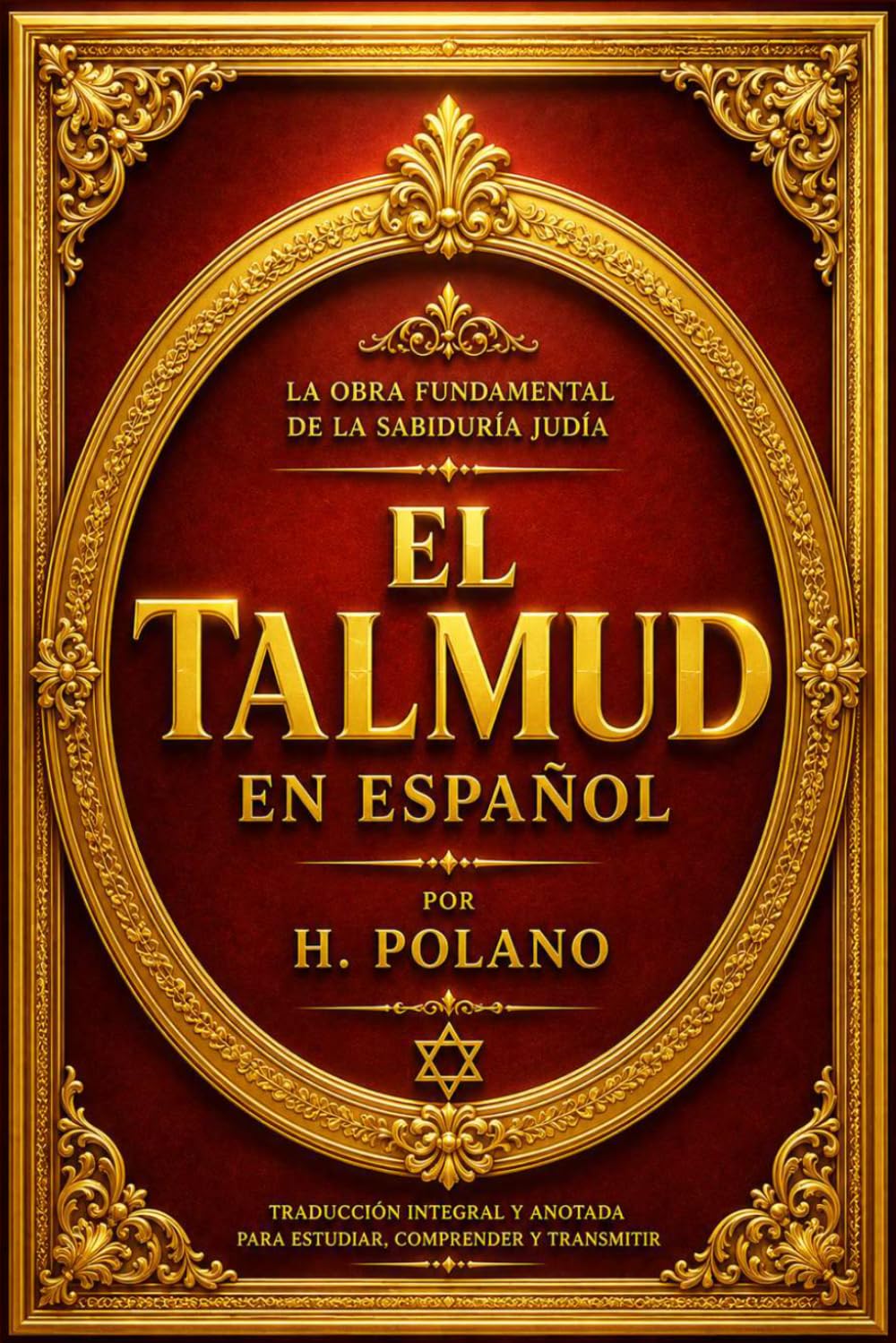
This Spanish-language volume presents itself as a complete collection of Talmudic material: rabbinic teachings, ancient Jewish traditions, laws, customs, narratives and what the cover describes as the intellectual heritage of the tradition. For readers who have encountered the Talmud only by reputation, the appeal is obvious — a single, accessible edition in Spanish rather than a shelf of tractates in Hebrew and Aramaic with a commentary apparatus. The question worth asking is what such a volume actually delivers in practice.
In real-world use, a book like this tends to serve two kinds of readers. The first is the curious non-specialist who wants a sense of what the Talmud contains — its style of argument, its blend of law and story, its recurring concerns with commerce, ritual, damages, family life and ethics. The second is a Spanish-speaking student or layperson in a Jewish study context who wants a reference to consult alongside a course, a study group or a weekly reading. For both, the format matters: a single bound collection is easier to carry and browse than a multi-volume set, and the Spanish translation lowers the entry barrier considerably.
Functionally, the book is organized around the familiar categories the subtitle names: teachings, traditions, laws, customs and narratives. That structure is sensible for a general readership, because it groups material thematically rather than strictly by tractate, which makes casual reading more feasible. The prose is in Spanish throughout, and the translation aims at readability rather than literal fidelity to the original dialects — a reasonable choice for an introductory audience, though it means nuances of the argumentative structure can flatten in translation. Expect a substantial physical volume; this is not a pocket edition, and the density of the material means it rewards slow, selective reading rather than a linear cover-to-cover approach.
One limitation deserves honest mention: the word “complete” in the title should be read with caution. The Talmud is enormous, and any single-volume Spanish edition is necessarily a selection, an anthology or a condensation, even when it presents itself as comprehensive. Readers hoping for a full scholarly translation with critical apparatus, variant readings and detailed source notes will likely be disappointed. The book is better understood as an accessible overview and sampler — useful for orientation and for encountering the tradition’s characteristic voices, less useful as a research tool. There is also the matter of commentary: traditional Talmud study is inseparable from the surrounding rabbinic discussion, and a popular edition typically simplifies or omits that layering. The result is more readable but less representative of how the text is actually studied in yeshiva settings.
Compared with alternatives, the trade-offs become clearer. A bilingual edition with facing Hebrew/Aramaic and Spanish, or a multi-volume scholarly translation, offers greater accuracy and depth but demands far more money, shelf space and prior knowledge. General introductions to Judaism or to rabbinic literature cover the historical context and methodology better, though they quote the Talmud only in fragments. This volume sits between those poles: more primary material than an introduction, less rigor than an academic edition. For many readers that middle ground is exactly right; for others it will feel either too simplified or too unwieldy.
Who is it for? Adults with an interest in Jewish thought, comparative religion or ancient legal traditions who want a readable Spanish entry point; study groups looking for a shared text; and readers who prefer to browse thematically rather than follow a structured curriculum. Who is it not for? Academic researchers needing precise citations, bilingual students working on the original languages, and readers seeking a strictly Orthodox or denominationally framed commentary will find it insufficient. Those with no prior exposure may also benefit from reading a short historical introduction first, since the anthology format assumes some context.
Realistic expectations are worth setting. This is a book to dip into over months, not to finish in a week. Some sections will feel repetitive or remote to a modern reader; others — the ethical maxims, the stories, the disputes about fair dealing — remain strikingly immediate. The translation reads smoothly enough for sustained engagement, and the thematic arrangement helps navigation, though an index or glossary would have strengthened it as a reference work. As an editorial product, it is a serviceable, reasonably priced gateway to a vast tradition, valuable precisely because it does not pretend to replace serious study. Readers who approach it as an invitation rather than a substitute will get the most from it.