
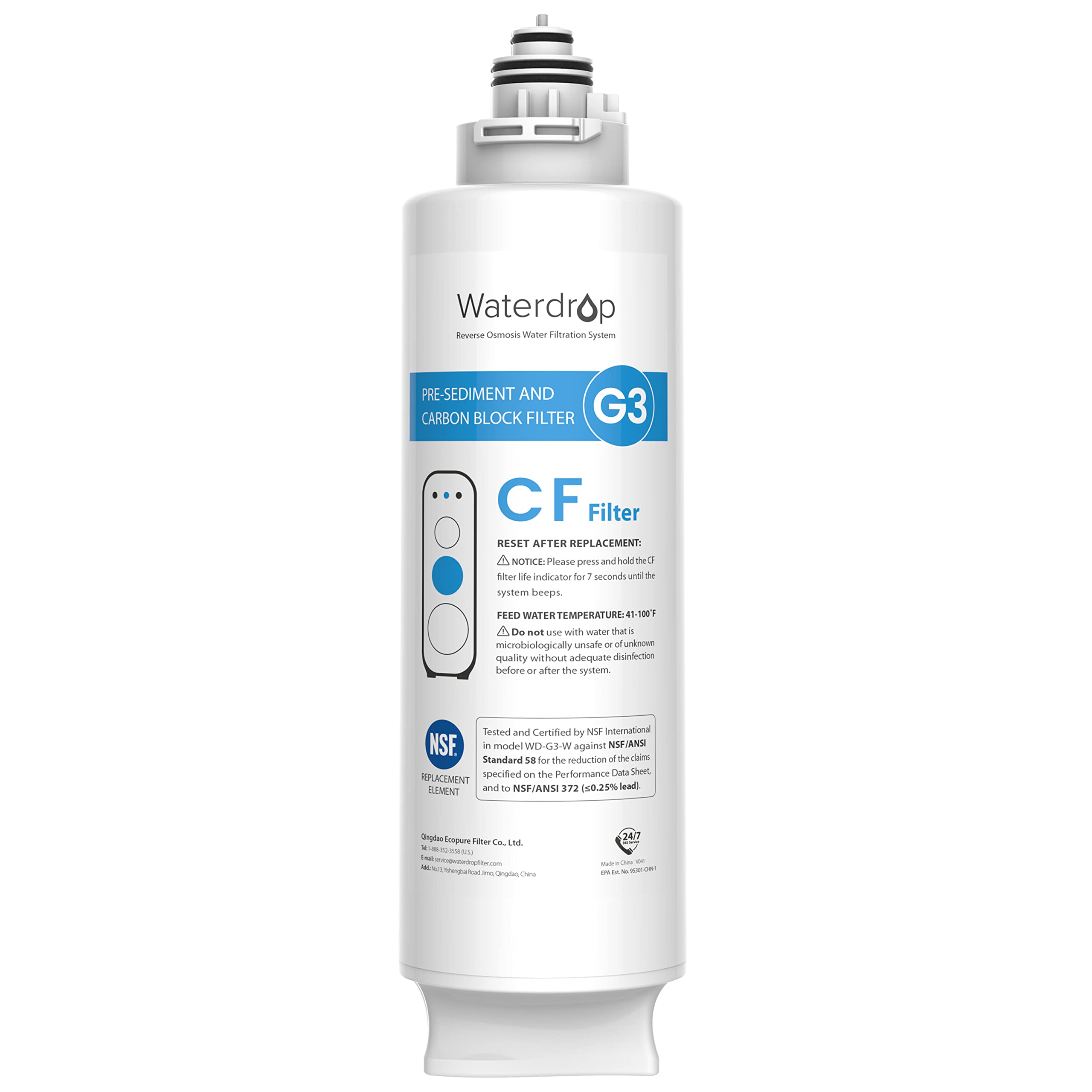
The Waterdrop G3-N1CF is a replacement filter cartridge for three of the company’s under-sink reverse osmosis systems: the G3-W, G3P600, and G3P800. It is not a standalone product. If you don’t already own one of those systems, this filter is irrelevant to you. For everyone else, it’s the consumable that keeps the system running, and how you think about it should be shaped by that fact.
In practice, this is a filter you buy every six months or so, install in a few minutes, and otherwise forget about. The G3 series uses a twist-and-lock cartridge design, and the N1CF is the composite pre/post filter element in that stack. Waterdrop rates it for roughly six months of typical household use, or about 3,600 gallons depending on the model it’s paired with. Actual lifespan depends heavily on your incoming water quality. Households on heavily mineralized or sediment-heavy municipal water will likely find themselves replacing it closer to the five-month mark, while cleaner source water may stretch it slightly. There’s no sensor that tells you the filter is spent; you’re relying on the system’s indicator light or your own calendar discipline.
The functional job here is straightforward. This cartridge handles the pre-filtration and final polishing stages of the RO process, catching sediment and larger particulates before they reach the RO membrane and improving taste in the final stage. It is not the membrane itself and it is not the carbon block that does the heavy lifting on chlorine and organics, though it works alongside both. Expect it to protect the more expensive membrane downstream, which is the main economic argument for replacing it on schedule rather than waiting until flow slows noticeably.
Installation is genuinely easy. The cartridge seats with a quarter-turn, and the system’s design means you don’t need to disconnect water lines or haul the unit out from under the sink. Most people will manage it in under five minutes. That said, the first few gallons after a swap will run slightly cloudy or taste flat as the cartridge wets out, which is normal and not a defect.
Where this product deserves scrutiny is on cost and compatibility. Replacement filters are where RO systems make their margin, and the G3-N1CF is no exception. Per-year filter costs for the G3 line run meaningfully higher than for simpler two-stage carbon systems, and this cartridge is only one part of that ongoing expense. Waterdrop also sells a combined filter pack that bundles this with the other cartridges, which is usually the more sensible purchase if you’re replacing everything at once.
Compatibility is narrow by design. It fits the G3-W, G3P600, and G3P800 and nothing else. If you own a different Waterdrop model, or a system from another brand, this cartridge will not work, and the model numbers are similar enough that it’s worth double-checking before ordering. Buying the wrong filter is a common and avoidable mistake.
Compared with generic or third-party RO filters, the G3-N1CF is priced at a premium, and the case for staying OEM is mostly about fit and warranty rather than dramatic performance differences. Aftermarket cartridges exist for some RO platforms at lower cost, but they vary widely in quality and certification, and using one can complicate warranty claims. Compared with a whole-house carbon filtration setup, this filter is a smaller-scale solution tied to a single tap. Neither approach is inherently better; they serve different needs and budgets.
Realistic performance expectations matter here. This filter will not transform bad-tasting water into something remarkable on its own; the RO membrane and carbon stages do most of that work. What it does is keep the system functioning as designed and protect the components that are costlier to replace. If you notice a drop in flow or a change in taste before the six-month mark, that’s a signal to replace it early rather than a sign the filter is faulty.
Who is this for? Owners of a G3-W, G3P600, or G3P800 who want to keep their system under warranty and running to spec, and who are comfortable with a recurring consumable cost. It’s also a reasonable buy for anyone who values the simplicity of a twist-in cartridge over systems that require disassembly.
Who is it not for? Anyone without one of those three systems, first and foremost. Also, budget-conscious buyers who haven’t yet purchased an RO system should factor in the ongoing filter cost before committing to the G3 line, because this cartridge is a recurring expense, not a one-time purchase. And if you’re looking for a filter that improves water quality on its own, outside an RO system, this isn’t that product.