
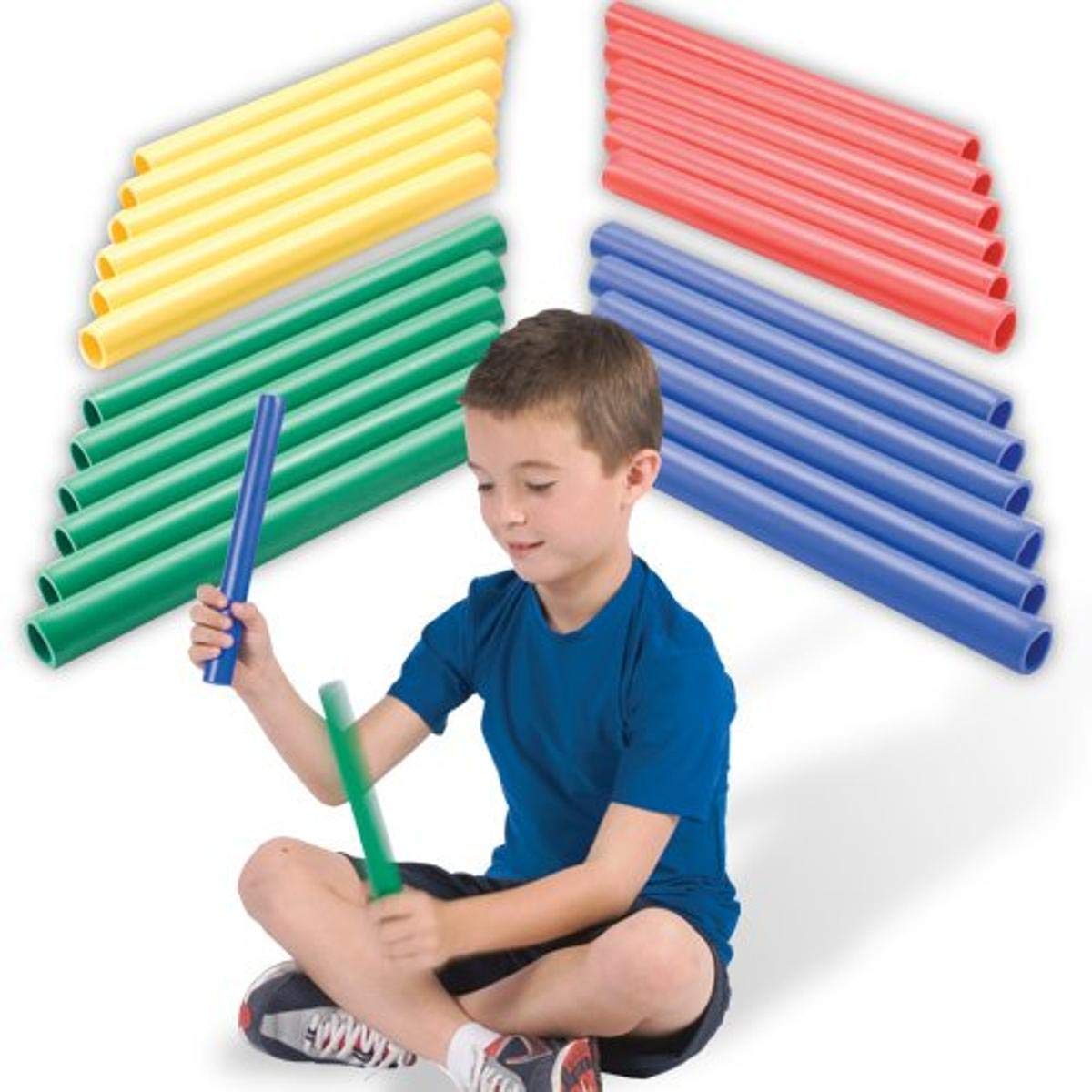
Lummi sticks occupy a specific niche in music education and group activities: they are short, thick wooden dowels used for rhythm games, call-and-response exercises, and simple percussion work. A 24-pack is clearly aimed at classrooms, therapy sessions, or large group settings rather than individual players, and that framing matters when judging whether the set makes sense for a given buyer.
The core appeal of lummi sticks is that they are forgiving. Unlike drumsticks, which demand technique and can produce a harsh sound when mishandled, these are designed to be struck together, against a floor, or against a partner’s sticks in coordinated patterns. The result is a satisfying clack that carries reasonably well in a room without being piercing. In practice, teachers use them for steady-beat exercises, echo patterns, and movement games where students pass, tap, or trade sticks on cue. The 24-count format supports a full class of roughly two dozen students, or a smaller group with spares for the inevitable dropped or misplaced stick.
Functionally, the set is straightforward. Each stick is a solid wooden cylinder, typically sanded smooth with rounded ends, and the pack is sized so that every participant gets a matched pair. That consistency is more important than it sounds: mismatched lengths or weights make synchronized tapping feel uneven, and a uniform set removes that variable. The wood construction also means the sticks are durable enough to survive regular handling by children, though they are not indestructible. The finish is generally smooth enough to avoid splinters, but buyers should expect a natural wood product rather than a lacquered, sealed instrument.
Where the set earns its keep is in group coordination. Because the sticks are short and light, they are easy for younger children to grip and control, and the sound is loud enough to be heard across a gym or cafeteria without amplification. That makes them useful beyond music class: physical education teachers use them for rhythm-based movement activities, and music therapists use them for motor-skill and turn-taking exercises. The 24-pack also works for adult team-building or drum-circle warmups, though adults may find the sticks small in hand.
There are trade-offs worth naming. The most obvious is that these are rhythm tools, not melodic instruments. A buyer expecting to produce pitched notes or a range of tones will be disappointed; the sound is essentially one timbre, varied only by how and where the stick is struck. Second, the wood is the product, so wear is real. Repeated striking against hard floors will dent and eventually splinter the ends, and a set used heavily in a gym setting will show that wear within a school year. Third, the 24-pack assumes a group; for a single user or a small family, it is far more sticks than needed, and the per-unit value only makes sense when the whole set is in use.
Compared with alternative rhythm tools, the closest comparison is a set of rhythm sticks or claves. Claves are longer, harder, and produce a sharper, more resonant tone, but they are also less forgiving for young hands and more expensive per pair. Plastic rhythm sticks are cheaper and more weather-resistant, but they sound thinner and can crack under heavy use. Lummi sticks sit between those options: warmer and more durable than plastic, less precise and less resonant than claves. For classroom use, that middle ground is often the practical choice.
The set is well suited to elementary music teachers, preschool and daycare programs, music therapists, and activity leaders who need a durable, uniform rhythm tool for a group of up to about two dozen people. It is less suitable for serious percussion students who need tonal control, for adults wanting a full-sized instrument, or for anyone who only needs one or two pairs. Buyers should also check the actual stick dimensions and wood type before ordering, since listings in this category vary, and a set that arrives shorter or lighter than expected will change how it handles in fast patterns.
Overall, the 24-pack is a sensible bulk purchase for group rhythm work, provided the buyer understands it as a classroom supply rather than a musical instrument. It does one job reliably and without fuss, and the main questions are whether the group is large enough to justify the count and whether the wood will hold up to the intensity of use. For a music room or activity closet, that is a reasonable trade.