
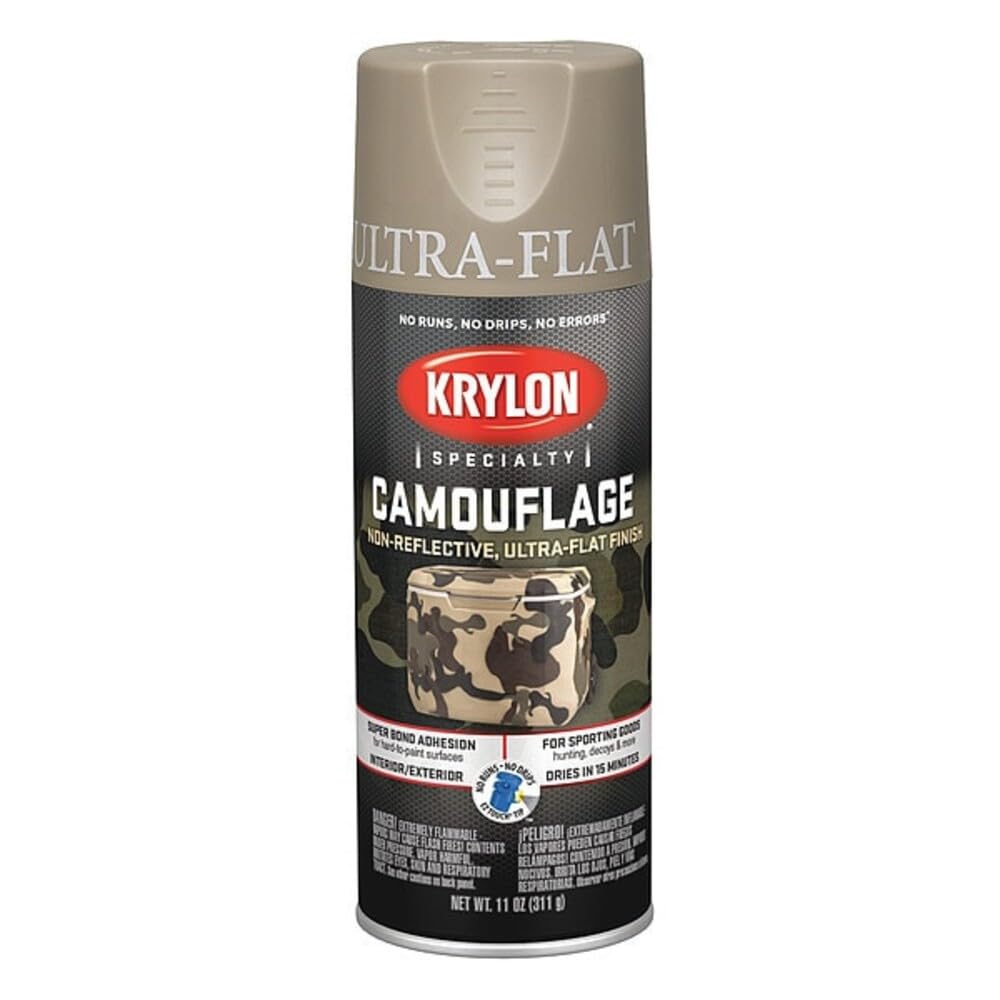
Krylon’s Camouflage line sits in a specific niche: matte, earth-toned coatings meant to reduce glare and blend into natural surroundings. The khaki shade in the 11-ounce aerosol can is the middle ground of that lineup—lighter than olive drab, darker than sand, and close enough to dry grass and dusty soil that it earns its place on hunting gear, trail cameras, tree stands, and the occasional backyard project that needs to disappear into the landscape. It is not a general-purpose paint, and treating it like one usually leads to disappointment.
The most common real-world use is refinishing gear that has become too shiny or too scratched to be useful. Hunters spray it on metal boxes, tripod legs, blind frames, and old rifle stocks. Homeowners use it on downspouts, utility boxes, and fencing that they want to recede visually. The ultra-flat finish is the entire point—there is essentially no sheen, which matters when a glint of reflected sunlight can spook game or draw attention to something you would rather not advertise. The khaki tone reads as a flat, slightly greenish tan in daylight and shifts depending on the surface underneath, which is worth knowing before committing to a full coat.
Functionally, this is a standard solvent-based aerosol with the usual characteristics of that category. It covers reasonably well on prepared surfaces, dries to the touch in roughly 10 to 15 minutes, and can be handled after about an hour under good conditions. Full cure takes longer, often 24 hours or more, and the finish remains soft enough during that window that handling it aggressively will leave marks. Adhesion is best on bare metal, properly sanded wood, and cured painted surfaces; glossy plastics and previously waxed or oiled surfaces need scuffing and cleaning or the paint will flake. The can sprays a fairly wide pattern, which helps on larger flat areas but makes precise work on small parts fussy. Multiple light coats work far better than one heavy pass, and heavy passes are where runs and uneven texture appear.
Where this product earns its keep is in low-gloss, low-visibility applications. Where it falls short is almost everywhere else. The ultra-flat finish is porous compared with satin or gloss, so it holds dirt, dust, and fingerprints more readily, and it offers less resistance to moisture and abrasion. On something like a frequently handled tool or a surface exposed to rain, the paint will show wear faster than a gloss enamel would. Touch-ups are easy, but the repaired area often looks slightly different in tone until it weathers in. The khaki itself is also less neutral than photos suggest—on some metals it dries warmer and browner than the cap indicates, so testing on a scrap piece is genuinely worth the five minutes.
Compared with a conventional flat enamel or a dedicated automotive trim paint, the Camouflage line trades durability and chemical resistance for a more convincing matte, natural tone. A standard flat black or flat olive hardware-store enamel will hold up better to handling and weather, but it will not match natural surroundings as convincingly. Conversely, a higher-end two-part coating or cerakote-style finish will outperform this in every durability metric, at several times the cost and with far more application effort. For the price of a single can, this sits in a reasonable middle: cheap enough to experiment with, capable enough for light-duty outdoor use, not a substitute for a proper protective coating on anything that sees hard use.
It is a good fit for hunters and outdoors people touching up gear, for homeowners camouflaging utility fixtures and fencing, and for hobbyists building terrain, props, or models who want a believable dry-grass tone. It is a poor fit for anyone expecting a durable, washable, weatherproof finish on high-traffic items, for painting flexible plastics that will bend, or for precise detail work on small components. Those users are better served by a satin enamel, a flexible plastic paint, or an airbrush setup. Used within its limits and with proper surface prep, the khaki ultra-flat does what it claims: it makes things look less like painted metal and more like part of the background.