
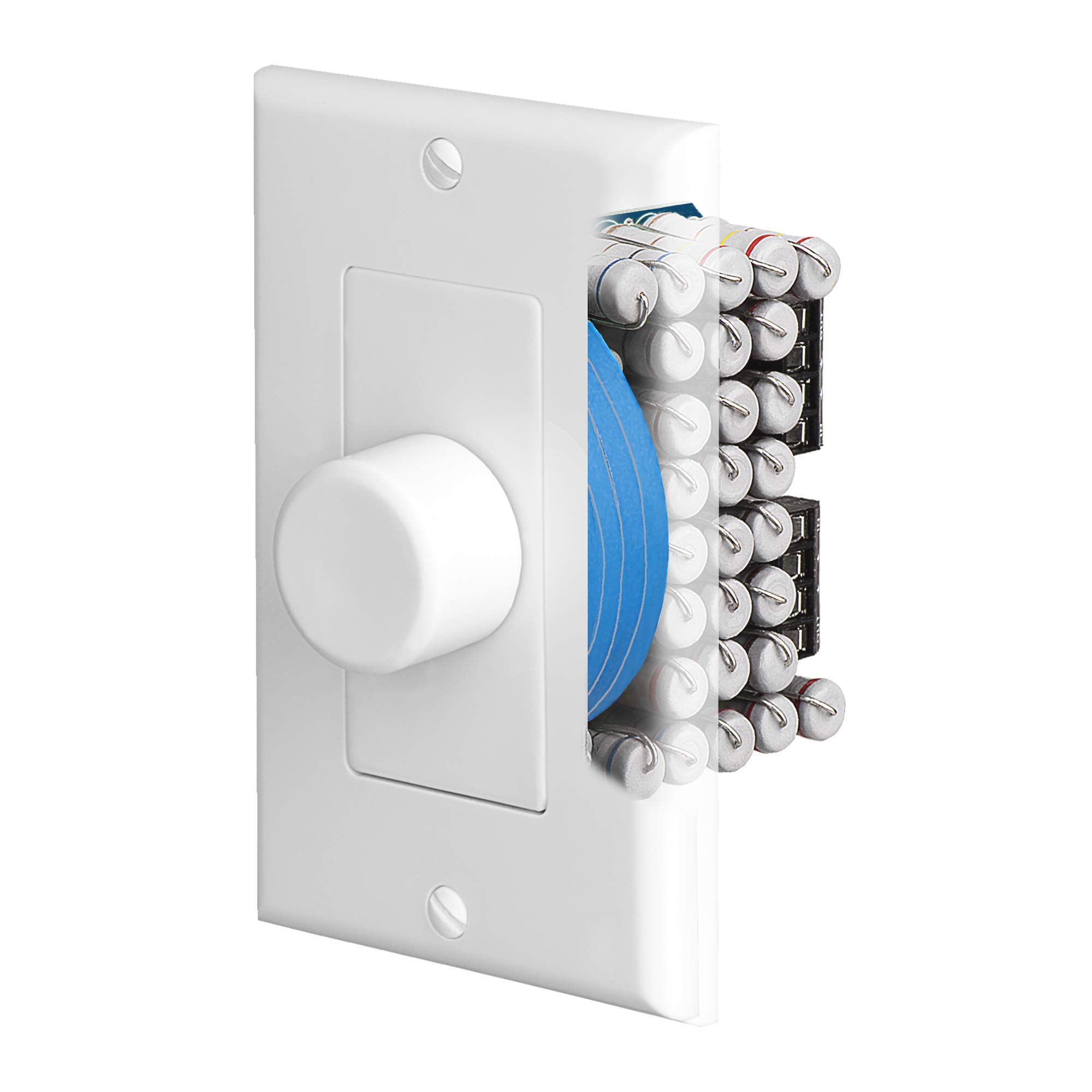
An in-wall volume control is one of those parts of a multi-room audio system that nobody thinks about until it fails or buzzes. The OSD Audio VKR120 is a resistor-based rotary attenuator rated at 150 watts per channel, designed to sit in a wall box and give you local level control over a pair of speakers fed from a remote amplifier. It is a straightforward piece of hardware, and the review really comes down to whether its design choices suit how you plan to use it.
The VKR120 is an impedance-matching design, which matters more than the wattage rating for most buyers. Impedance matching uses transformer taps to present a relatively stable load to the amplifier even when several volume controls are wired to the same output. In a typical house, that means a single stereo amp in a closet feeding speakers in a kitchen, a dining room, and a patio, each with its own wall control. Without matching, paralleling three or four pairs of 8-ohm speakers can drag the load below what the amp is comfortable driving. The VKR120’s matching circuitry lets you run multiple zones off one amp within its stated limits, and the rotary knob gives continuous attenuation rather than stepped detents.
The resistor-based attenuation is the other defining feature. Instead of an autoformer, the VKR120 drops level using resistors, which is a simpler and generally less expensive approach. The practical consequence is heat. Resistor attenuators dissipate the energy they remove as warmth, and at high listening levels with the control turned well down, the unit can get noticeably warm behind the wall plate. That is normal for the category, but it is worth knowing before you bury one in a tight, unventilated box. The 150W rating refers to the amplifier power the control can handle, not how loud it will play; it is a ceiling, not a target.
Installation follows the usual pattern for this product type. The control fits a standard single-gang box and terminates with screw terminals for amplifier input and speaker output, plus a ground connection. You need to be comfortable running speaker cable through walls and identifying the correct polarity, because a miswired control will produce thin, out-of-phase sound rather than an obvious failure. The white plate and knob are generic enough to blend into most walls, though the plastic feels ordinary rather than premium. There is no IR repeater, no app control, and no display, which is the point: it is a passive device that works when the network is down and does not need a manual.
Where the VKR120 makes sense is the traditional distributed audio install: a rack or closet amplifier, several rooms, and a desire for simple local knobs. It is a reasonable fit for a homeowner or installer wiring a whole-house system on a budget, and the impedance matching gives it flexibility that a plain non-matching control lacks. It is less suitable for anyone expecting audiophile-grade transparency. Resistor attenuation can introduce a small amount of coloration and, at low settings, a slightly compressed feel compared with a good autoformer-based control. If your priority is sound quality at low volumes in a critical listening room, a transformer-based unit from a specialist brand is the better comparison, at a higher price. The VKR120 is also a poor choice for very high-power amplifiers near its 150W limit or for setups where the control will be turned down most of the time while the amp runs hard, since that is exactly the heat-generating scenario.
Build quality is adequate for the price rather than impressive. The knob turns with reasonable smoothness, the terminals accept typical 14- to 16-gauge wire, and the plate screws down flush. Long-term reliability will depend on how hard the resistors are worked; running one near its rating in a closed box is not a recipe for a long life. Buyers should also confirm their amplifier’s minimum impedance and total speaker load before daisy-chaining several of these, because impedance matching helps but does not make load calculations disappear.
Overall, the VKR120 is a functional, no-frills solution for multi-room audio where local knob control and impedance matching matter more than refinement. It does its job without drama, costs less than transformer-based alternatives, and asks only that you respect its thermal limits and plan your speaker loads. For a basic distributed system, that is a fair trade. For a high-end or heavily used zone, spend more.