
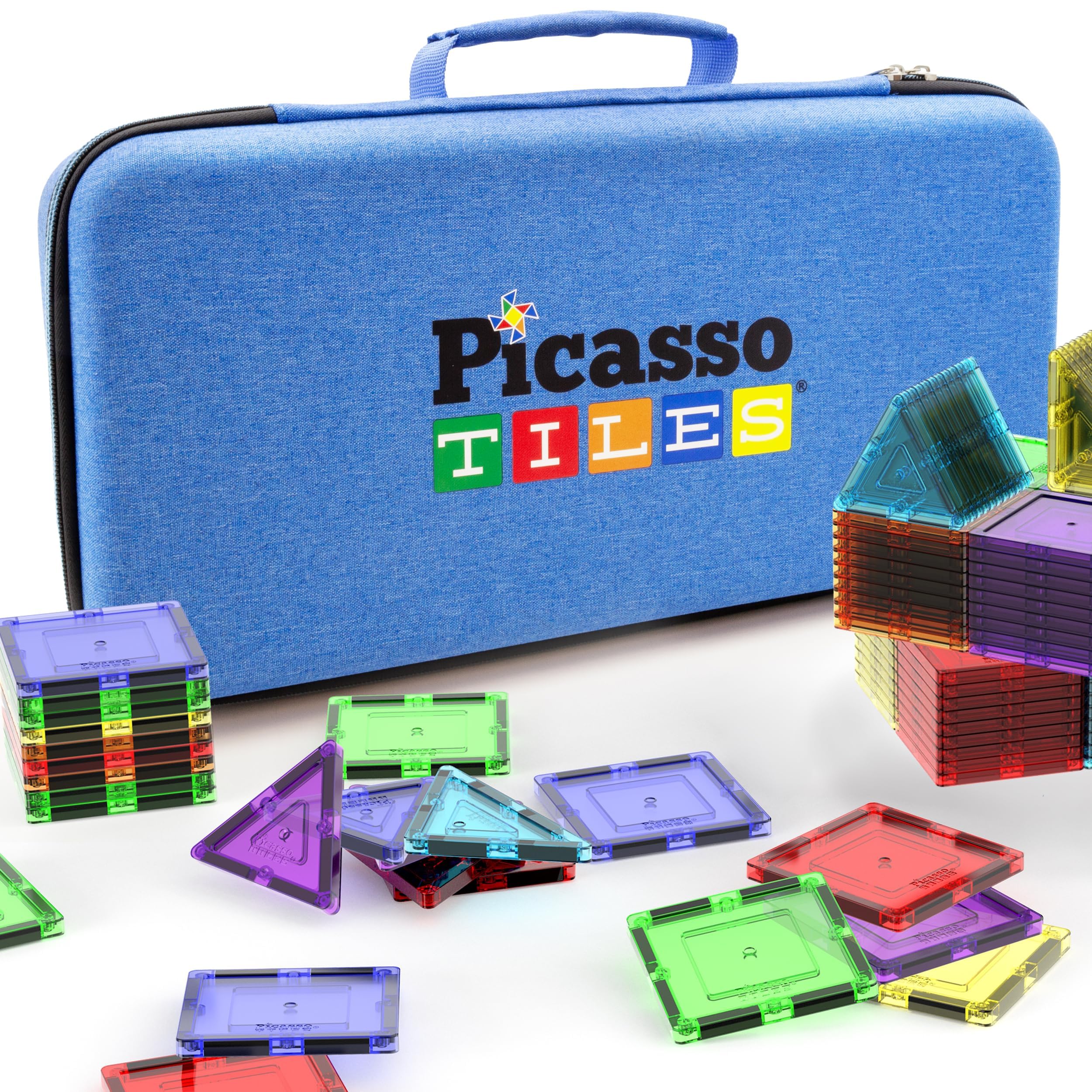
The PicassoTiles Magnetic Storage Carrying Case is a fairly straightforward accessory: a soft-sided bag designed to hold magnetic building tiles and keep them organized when they leave the playroom. It is not a toy in itself, and it does not add anything to the play experience. Its value depends entirely on how often the tiles travel, and whether the household already has a storage method that works.
The case is aimed at the families who routinely haul tile sets to grandparents’ houses, restaurants, or on road trips. Anyone who has carried a loose pile of magnetic tiles in a tote bag knows the problem: the pieces stick to each other, to the bag’s zipper, and occasionally to a metal table leg, and the set arrives as a clump rather than a collection. A dedicated case with compartments addresses that specific annoyance.
Functionally, the bag uses a soft fabric body with zippered closure and internal dividers or elastic loops, depending on the version. The magnetic tiles themselves do much of the work here, since they cling to the case’s structure and stay in place rather than sliding around. That is a clever bit of passive organization, though it also means the case’s usefulness is tied to the strength of the tile magnets rather than to any clever engineering in the bag. The exterior handle is sized for a child or an adult hand, and the whole thing is light enough that a preschooler can carry it without much trouble.
In real use, the case works best as a grab-and-go container for a moderate number of tiles. It holds a reasonable stack of standard square and triangular pieces, and the zippered closure keeps everything contained during transport. Parents who have used it describe it as a way to make a tile set portable without repacking it every time. It also doubles as a storage bin at home, which is arguably its more common role.
There are trade-offs worth naming. The soft fabric construction offers little protection against crushing, so a heavy suitcase stacked on top of it in the car is a real risk. The case is not rigid, and the zipper is the kind of light-duty hardware that will not survive years of aggressive tugging from a determined toddler. Capacity is also finite: larger tile collections will overflow it, and families with several hundred pieces will likely need a second bag or a different storage approach. The magnetic cling that keeps tiles organized can also make loading and unloading slightly fiddly, since pieces snap together as they go in rather than dropping neatly into slots.
Compared with a rigid plastic storage bin, the carrying case wins on portability and loses on protection and capacity. A clear plastic tote is cheaper, holds more, and is easier to wipe clean, but it is awkward to carry and does not travel well. Compared with a generic canvas tote or a zip-up pencil case repurposed for tiles, the PicassoTiles case is more purpose-built, with dimensions that match the tiles and a handle that makes sense for kids. It sits in a middle ground: more specialized than a plain bag, less durable than a hard case.
Realistic expectations matter here. This is a modest accessory, not a premium piece of luggage. Seams and fabric will show wear after regular use, and the bag is best treated as a semi-disposable organizer rather than a long-term investment. For the price, that is a reasonable proposition, provided the buyer is not expecting rugged construction.
The case suits families with a single moderate tile set who want to move it between rooms or take it on car trips and visits. It is also a sensible add-on for households that have already bought a PicassoTiles set and want a matching storage solution. It is less suitable for families with very large collections, for anyone who needs crush protection, or for households that already have a workable bin-and-shelf system. Parents looking for a toy that engages a child will not find that here; this is purely an organizational tool, and its appeal is practical rather than playful.