
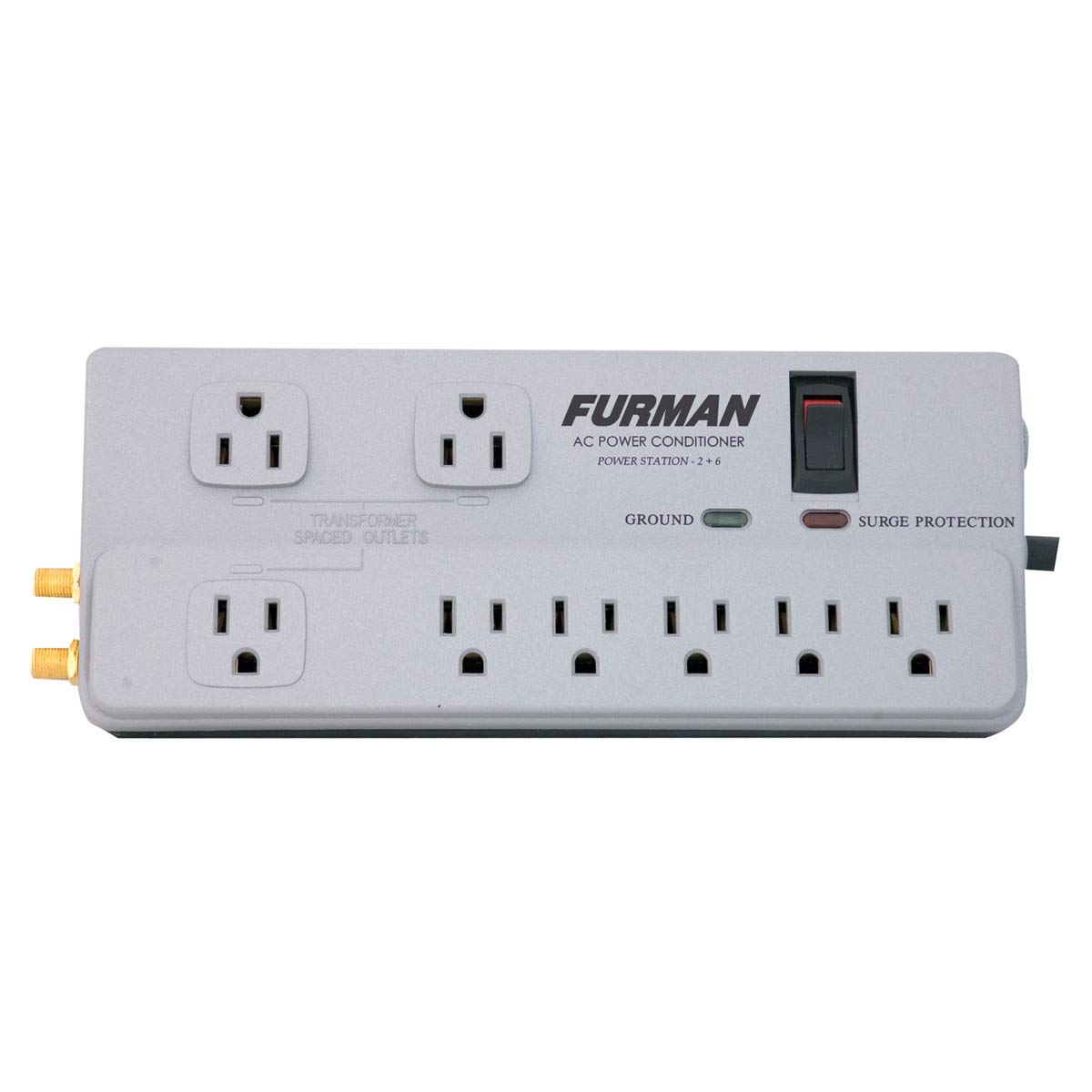
The Furman PST-2+6 Power Station sits in a category that most people never think about until something goes wrong: power distribution for audio and video gear. It is a rack-mountable power conditioner with eight outlets, and it is aimed at musicians, home studio owners, and AV installers who want more than a cheap surge strip behind the desk. Whether it earns its price depends heavily on what you are plugging into it and what you expect it to solve.
In practice, the PST-2+6 is usually bolted into a small equipment rack or mounted under a desk where a home studio lives. Two of its outlets sit on the front panel, which is genuinely useful for temporary connections like a guitar amp, a laptop charger, or a lamp, while the remaining six are on the rear for permanent gear. Furman rates the unit for 15 amps total, which is the practical ceiling for a standard household circuit. That number matters more than most spec sheets suggest: a modest home studio with a computer, interface, monitors, and a couple of synths can approach that limit, and the PST-2+6 will not magically expand it.
The features that distinguish it from a generic power strip are the conditioning elements. Furman uses what it calls Linear Filtering Technology, which is essentially a set of filters designed to reduce noise on the AC line, plus surge suppression rated at 45,000 amps peak and a clamping voltage that engages quickly during spikes. There is also a 15-amp circuit breaker rather than a fuse, so a trip is resettable without hunting for replacements. The front panel includes a diagnostic indicator that shows whether the outlet is wired correctly, which is a small but genuinely helpful detail in older buildings where grounded outlets are not guaranteed. None of this is exotic; it is the baseline you should expect from a product in this class.
What the PST-2+6 does not do is regulate voltage. If your building suffers from brownouts or sustained overvoltage, this unit will pass those conditions through. Devices like Furman’s own voltage regulators or a UPS with automatic voltage regulation address that problem directly, and they cost considerably more. The PST-2+6 is a conditioner and surge suppressor, not a power regenerator. Buyers who expect it to stabilize a fluctuating line will be disappointed, and that distinction is worth understanding before purchase.
The noise-filtering claim is also worth calibrating. In a typical home with a computer, LED lighting, and a refrigerator on the same circuit, the PST-2+6 can reduce audible hum and hash in a signal chain, particularly with guitar amps and older analog gear. But it will not eliminate ground loops caused by interconnected equipment, and it will not fix a noisy interface that is picking up interference through a USB cable. Those problems require different solutions. Treat the conditioning as a modest improvement rather than a cure, and the product makes more sense.
Build quality is a point in its favor. The chassis is steel, the rack ears are included, and the outlets grip plugs firmly, which is more than can be said for many consumer strips. The unit runs cool in normal use and does not introduce its own noise into the room. The front outlets are spaced adequately for wall warts, though a bulky adapter can still block an adjacent outlet, a common frustration in this form factor.
Compared with a basic surge protector, the PST-2+6 costs several times more for the same outlet count. The premium buys rack mounting, the front-panel access, the diagnostic circuit, and the filtering. Compared with a full power conditioner from a company like Furman’s higher tiers or from competitors such as Panamax, it sits at the entry level: fewer features, no voltage regulation, but adequate protection for modest rigs. For a small home studio or a living-room AV rack, that is a reasonable place to land. For a commercial install with expensive consoles and strict power requirements, it is undersized.
The PST-2+6 suits people who have a rack or a permanent gear setup and want organized, protected power with a bit of noise filtering. It does not suit anyone looking for voltage regulation, battery backup, or a solution to ground-loop hum. It is also overkill for a single computer and monitor, where a quality surge strip is sufficient. The honest summary is that this is a competent, well-built entry-level conditioner whose value depends entirely on whether your setup actually needs rack-mounted, filtered power distribution.