
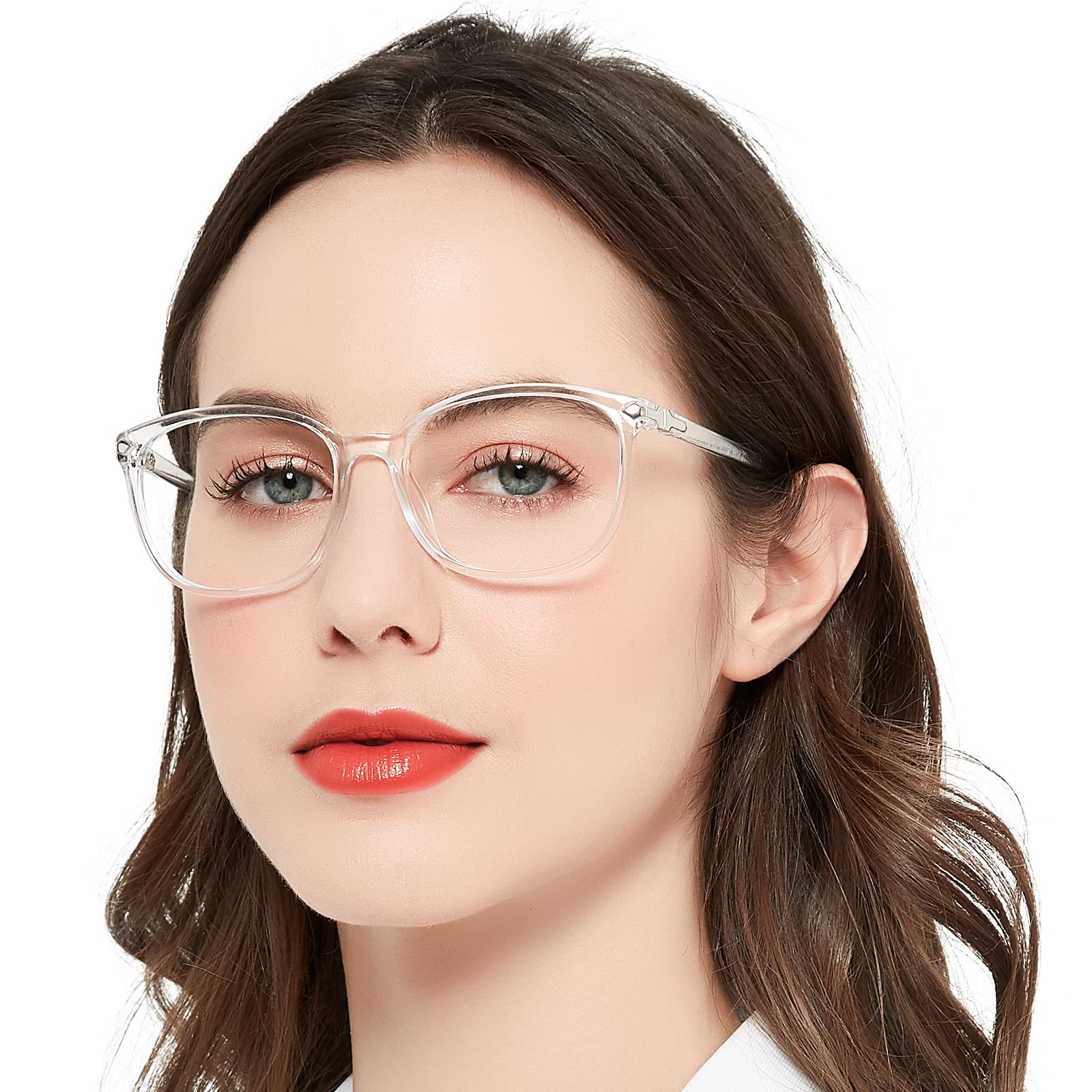
MARE AZZURO’s blue light blocking reading glasses occupy a crowded but useful corner of the eyewear market: readers that double as screen glasses. This particular model pairs a square, slightly oversized frame in transparent acetate with blue light filtering lenses, and it’s offered in an unusually broad magnification range from 1.0 up to 6.0 diopters. The version under review here is the transparent frame at 2.75 power, a middle-of-the-road strength that suits people who spend long stretches reading or working at a monitor.
What stands out first is the power range. Most drugstore and online readers stop at 3.0 or 3.5, so the availability of 4.0, 5.0, and 6.0 options is genuinely relevant for people with stronger prescriptions who want an off-the-shelf backup pair. That said, higher-power readers are where fit and lens quality matter most, and buyers at the top of the range should temper expectations accordingly.
The frame is a square shape with a fairly generous lens area, which gives a wider field of view than narrow rectangular readers. The transparent colorway reads as modern and is less visually heavy than black or tortoise, though it also shows smudges and dust more readily. The temples are standard plastic, and the hinges are the simple pin type found on most budget readers rather than spring hinges. That’s a real trade-off: the glasses will fit most faces, but they won’t flex to accommodate wider heads, and repeated opening and closing tends to loosen pin hinges over time.
On the blue light question, the lenses carry a noticeable tint, more so than some competitors that aim for a nearly clear look. In practice this means colors on a screen shift slightly warm, which some users find comfortable in the evening and others find distracting when doing color-sensitive work such as photo editing. The filtering is a coating and lens material combination typical of this price tier, not a certified medical-grade filter, so it should be treated as a comfort feature rather than a clinical tool. Anyone expecting a documented reduction in eye strain from a specific wavelength cutoff should look at brands that publish transmission data.
Real-world use cases are straightforward. These work well as a dedicated desk pair for reading email, documents, or a book at the end of the day, and the square shape gives enough lens height to glance between a monitor and a printed page without repositioning. Because the frame is lightweight plastic, they’re comfortable for an hour or two at a time, but the lack of adjustable nose pads means fit is fixed. People with a low or narrow nose bridge may find the glasses sit too close to the face or slide down during longer sessions. The included nose pads are molded into the frame, not soft silicone.
Compared with dedicated computer glasses, which often come with anti-reflective coatings, adjustable frames, and documented blue light specs, these readers are a simpler proposition. They’re closer to a conventional pair of reading glasses with a warm tint added. Against plain readers from a pharmacy, the advantage is the blue light filtering and the broader power selection; the disadvantage is that optical quality control on budget readers is variable, and lens clarity at the edges can be less consistent than with an optician-fitted pair. Buyers who need precise prescription correction, astigmatism handling, or progressive lenses should not expect this product to substitute for that.
The 2.75 strength reviewed here is a common step for people who’ve moved past 2.5 but don’t yet need 3.0, and it’s a sensible choice for extended reading. One caveat: because magnification and blue light filtering are combined in a single lens, the tint slightly reduces overall light transmission. In a dimly lit room, that can make text feel a bit duller than with clear readers, and some users will prefer a separate pair for low-light reading.
As for suitability, these glasses make sense for casual screen users, readers who want a spare pair for the office or bedside table, and anyone who needs a stronger magnification than typical retail readers offer. They’re less appropriate for people who need spring hinges or adjustable nose pads for comfort, for those doing color-critical work, or for anyone who wants clinically documented blue light protection. The transparent frame is a style choice that will appeal to some and look a little plain to others, and the plastic build reflects the price point rather than premium construction.
Overall, the MARE AZZURO readers are a reasonable, functional option in a category where fit and lens consistency vary widely. The wide power range is the strongest argument in their favor, and the blue light tint is a modest comfort add-on rather than a headline feature. Buyers should expect a lightweight, serviceable pair of readers with a warm-tinted lens and a fixed fit, and they’ll likely be satisfied if that’s what they’re after.