
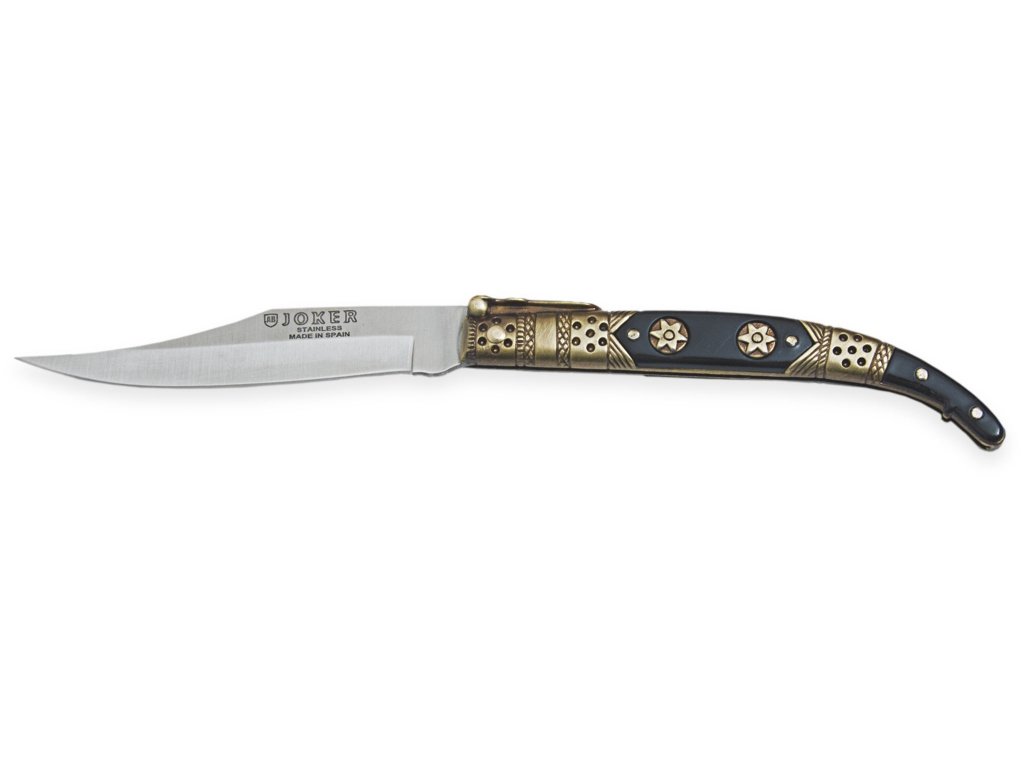
The Joker Classic N103C is a small folding knife aimed at people who spend time outdoors but don’t want to carry a large fixed blade. With a 3.93-inch stainless steel 420 blade, a Zamak handle with ABS scales, and a listed weight of 80 grams, it sits in the budget-to-midrange pocket knife segment, positioned for fishing, hunting, camping, and hiking. Joker is a Spanish manufacturer with a long history in cutlery, and the Classic line reflects that utilitarian heritage rather than a tactical or premium focus.
In practice, this is the kind of knife that ends up in a tackle box, a daypack, or a glove compartment. The blade length is substantial enough for food prep at camp, cutting line, trimming kindling, or opening packages, but the overall package stays light enough that it doesn’t drag on a belt or weigh down a pocket. The 420 stainless steel is a modest alloy: it offers reasonable corrosion resistance and is easy to sharpen, but it won’t hold an edge as long as higher-carbon or powder metallurgy steels. For occasional outdoor tasks and saltwater-adjacent fishing use, that trade-off is acceptable; for sustained heavy cutting, expect to touch up the edge regularly.
The Zamak handle is worth discussing because it defines the knife’s character. Zamak is a zinc alloy, and here it is combined with ABS scales. The result is a handle that feels solid and has some heft relative to the blade, which can aid control during precise cuts. It is also resistant to rust, which suits fishing and damp environments. The downside is that Zamak is heavier than aluminum or polymer-only handles, and the 80-gram figure, while light in absolute terms, is not ultralight for a folder of this size. The ABS scales add grip but can feel plasticky compared to textured G10 or wood, and over years of hard use, the pivot area is the spot to watch for loosening or play.
Functionally, the N103C is a straightforward back-lock or slip-joint style folder (depending on the specific variant), with a nail nick for opening. That means one-handed opening is not the design intent; this is a two-handed knife. For a fishing or camping tool, that is not a dealbreaker, but anyone used to modern flipper tabs or thumb studs will notice the slower deployment. The absence of a pocket clip on many Classic models is another practical consideration: it carries loose in a pocket or sheath rather than clipped to a waistband. The blade shape is a general-purpose drop point or clip point style, suitable for slicing and utility work rather than heavy prying or batoning, which the folder construction does not support anyway.
Real-world use cases line up with the marketing: cutting fishing line and bait, preparing food at a campsite, whittling, opening packaging, and light hiking tasks. It is not a survival knife, and it should not be treated as one. The folding mechanism and relatively thin blade stock mean it is a cutting tool, not a chopping or batoning instrument. In wet conditions, the 420 steel will develop spots if left uncleaned, so a quick wipe and occasional oiling are sensible habits. The Zamak handle holds up well to moisture, but the pivot and lock interface still benefit from care.
Compared with a modern one-hand-opening folder in the same price range, such as a budget liner-lock with G10 scales and a clip, the Joker Classic trades speed and carry convenience for a more traditional feel and a corrosion-resistant handle. Compared with a fixed-blade camp knife, it trades strength and food-prep ergonomics for portability and legality in more jurisdictions. It also compares reasonably to traditional Spanish folders and simple slip-joint pocket knives, where the emphasis is on simplicity and ease of maintenance rather than fidget-friendly operation.
Who is this for? Anglers who want a rust-resistant, simple folder for line and bait work; campers who need a light utility blade for food and small tasks; and traditionalists who prefer a two-handed folder with a metal handle. Who is it not for? Anyone expecting one-handed deployment, a pocket clip, or a knife that can handle hard bushcraft tasks. It is also not the best choice for someone who wants a premium edge-holding steel, since 420 will need frequent sharpening under sustained use. As an editorial observation, the N103C makes most sense as a secondary or task-specific knife rather than a do-everything primary carry. Its strengths are simplicity, corrosion resistance, and a usable blade length at a modest weight; its limitations are the dated opening method, the plasticky feel of the ABS scales, and steel that prioritizes toughness and sharpenability over edge retention. For the intended fishing and light camping role, those compromises are reasonable, provided expectations are set accordingly.