
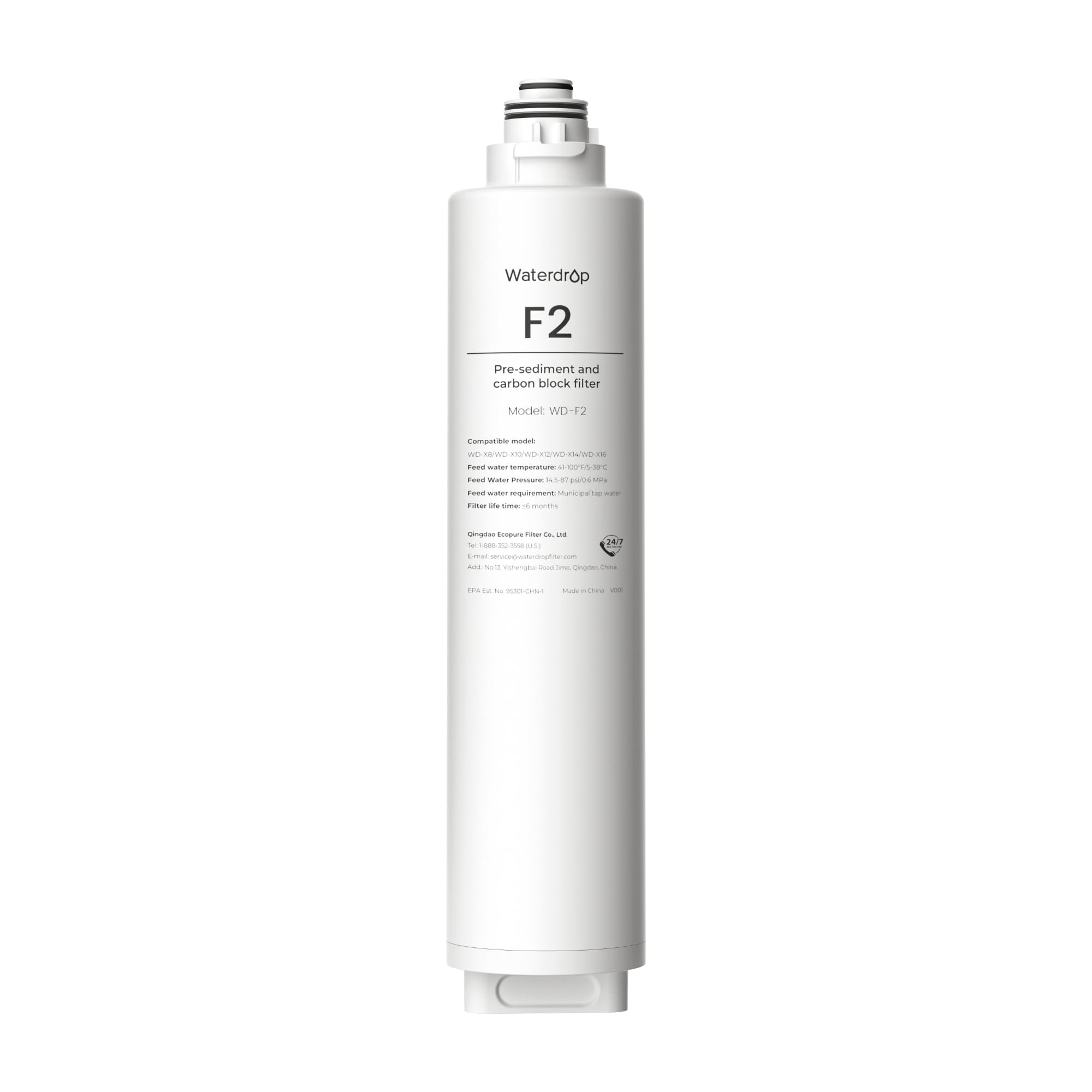
The Waterdrop F2 is a replacement filter cartridge intended for the company’s X8, X12, and X16 reverse osmosis systems. It is not a standalone water treatment device, so its practical value depends almost entirely on whether you already own one of those systems and how heavily you use it. Waterdrop rates the cartridge for roughly six months, which is the usual interval for the sediment and carbon stages that protect the RO membrane and polish the finished water.
In a typical household, the F2 sits in the pre- and post-filtration path of the system. Water passes through it before reaching the membrane, where it catches particulates and reduces chlorine that would otherwise degrade the membrane, and in some configurations it also serves as a final polishing stage before the water leaves the faucet. That means the filter is doing quiet, unglamorous work: it is not the component that removes dissolved solids, and it will not change the TDS reading on its own. What it does affect is taste, odor, and the longevity of the more expensive membrane downstream.
The six-month lifetime figure is a guideline, not a guarantee. Households with high sediment levels, heavy daily consumption, or water with noticeable chlorine will likely need to replace it sooner. A family of four drawing several gallons a day may find the cartridge exhausted well before the calendar suggests, while a single person using the system mainly for drinking water might stretch it slightly. The honest way to judge replacement timing is by flow rate and taste rather than by the date on the box.
Functionally, the F2 is a straightforward drop-in replacement. Installation on the compatible X-series systems is tool-free in most cases, involving a quarter-turn or a simple push-to-connect fitting depending on the model, and takes only a few minutes. There is no membrane housing to open and no complex reassembly. The cartridge is sealed and disposable, which keeps the process clean but also means there is nothing serviceable about it.
Two trade-offs are worth flagging. First, the F2 is proprietary to Waterdrop’s X-series, so it offers no cross-compatibility with generic housings or other brands’ systems. Once you are on the platform, you are locked into Waterdrop’s replacement schedule and pricing. Second, the six-month interval adds up: over several years, the cumulative cost of replacement cartridges can approach a meaningful fraction of what the system itself cost, and that ongoing expense is easy to overlook at purchase. Buyers comparing a dedicated RO system with a simpler under-sink carbon filter should weigh this. A basic carbon block filter costs less to maintain and handles chlorine and taste well, but it does not reduce dissolved solids, so it is not a substitute if you need true RO purification. Conversely, if you already need RO, the F2’s maintenance burden is modest compared with systems that require separate sediment, carbon, and membrane purchases on staggered schedules.
Performance expectations should be realistic. The F2 will not dramatically alter water chemistry; its job is to protect the membrane and make the output palatable. Users sometimes expect a new cartridge to fix slow flow or poor taste caused by a failing membrane, and it will not. If the system’s output has dropped sharply, the membrane or another stage is the more likely culprit. The F2 is a maintenance item, and treating it as a tune-up rather than a repair is the right mental model.
Who is this for? It is suitable for existing owners of the X8, X12, or X16 who want a manufacturer-matched replacement and are comfortable with a recurring purchase every six months. It is also reasonable for people who value a simple, sealed cartridge over the fiddlier process of changing loose filter media. It is not suitable for anyone without a compatible Waterdrop system, for households hoping to avoid subscription-style maintenance costs, or for buyers who want a universal filter they can source from multiple manufacturers. Those users would be better served by a system built around standard-sized cartridges.
Overall, the F2 is a competent, unremarkable consumable. It does what a pre- and post-filter is supposed to do, installs easily, and carries the usual caveats of proprietary replacement parts: convenience in exchange for lock-in. The right question is not whether the cartridge is good in isolation, but whether the X-series system it belongs to fits your long-term maintenance budget.