
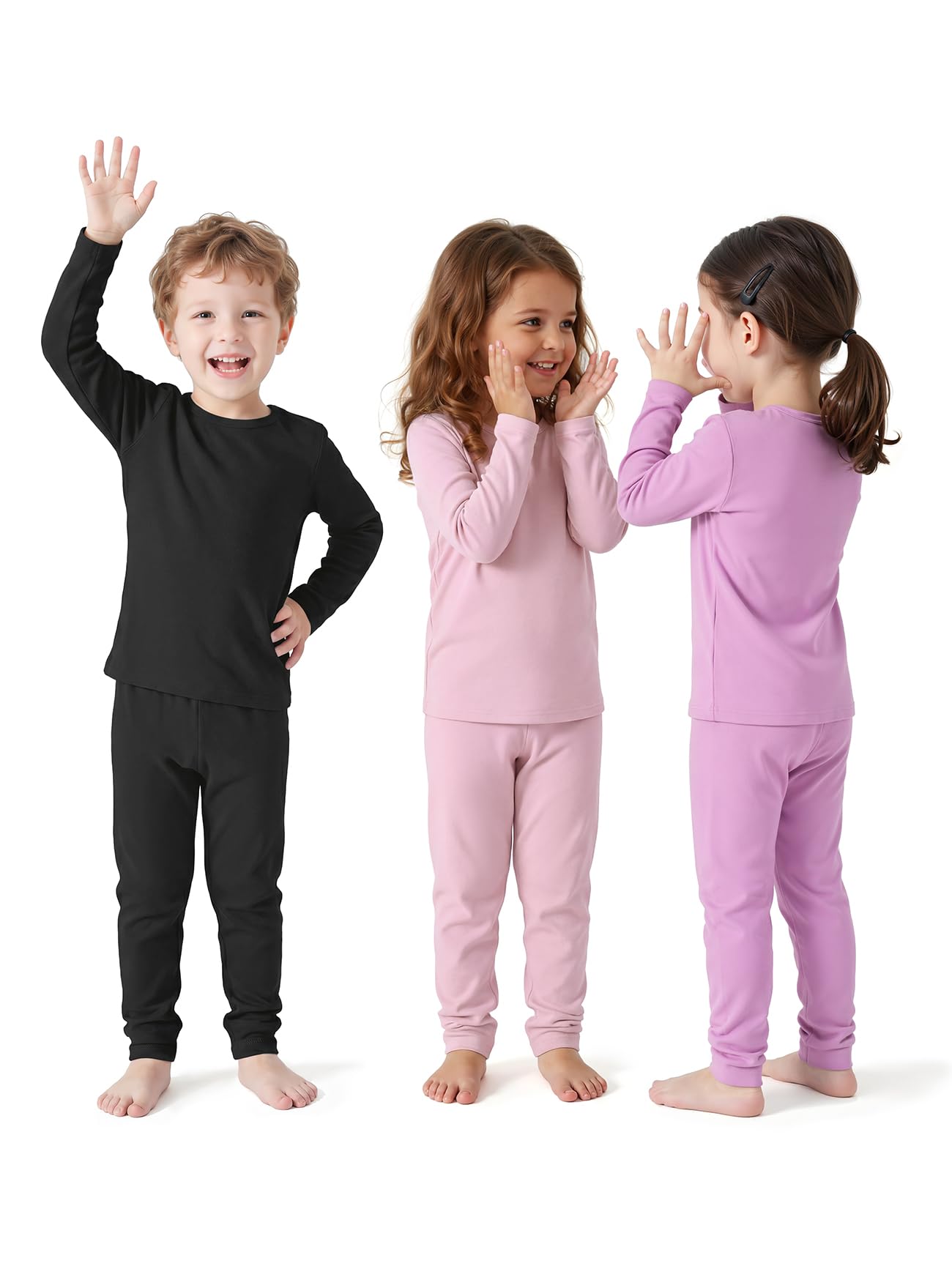
Thermal underwear for toddlers occupies an awkward corner of the clothing market. Kids in the 2T–5T range grow fast enough that spending much on any single garment feels wasteful, yet cheap base layers often pill, lose shape, or trap sweat in ways that make a child miserable. This three-pack of toddler thermal sets in black, purple, and pink sits squarely in the budget tier, and it is worth understanding what that price point actually buys before ordering.
The intended use case is straightforward: a thin insulating layer worn under everyday clothes or snow gear during cold months. Parents typically reach for sets like these for preschool commutes, outdoor play in late fall and early spring, or as a second layer under a snowsuit. Because the pack includes three colorways, the practical appeal is rotation—one on the child, one in the wash, one in the drawer. That logic holds up reasonably well, though the sizing label needs some interpretation.
One detail that causes confusion: the listing spans 2T through 5T but the variant here is labeled 2XL. In practice, that corresponds to the upper end of the range rather than a true adult-style 2XL, so buyers should treat it as roughly the 4T–5T bracket and check any size chart carefully. Toddler sizing varies widely between brands, and a set that fits a stocky four-year-old may swim on a slim one of the same age.
Functionally, these are conventional knit base layers. The fabric is a synthetic blend rather than wool or cotton, which means it wicks moisture and dries faster than cotton but does not offer the same warmth-to-weight ratio as merino. The seams are flat-ish and the waistbands are elastic, both of which matter for comfort under jeans or snow pants. The legs and sleeves are long, and the fit is intended to be close to the body—base layers only insulate well when they sit against the skin rather than bagging.
Realistic expectations matter here. This is not a garment built for extended sub-freezing exposure on its own. It works as a mid-layer or under-layer in moderate cold, and it performs adequately for car rides, playground time, and indoor-to-outdoor transitions. In genuinely harsh conditions, a wool base layer or a fleece mid-layer will outperform it noticeably. Parents who ski or spend full days outdoors in winter should probably look at merino or a dedicated performance brand instead.
Durability is the area where budget thermal sets most often stumble, and there is little reason to expect these to be the exception. Synthetic knits at this price tend to develop pilling at friction points—underarms, inner thighs, and where the fabric rubs against outer clothing. Expect the fabric to soften and thin somewhat over a season of regular wear and washing. Following care instructions and avoiding high heat in the dryer will extend their life, but these are consumable items rather than hand-me-downs.
Fit and sizing deserve a caveat. The close-cut design is correct for insulation, but it also means less tolerance for growth spurts. A child at the top of a size range may find the set tight and restrictive within weeks, while a child at the bottom may have sleeves and legs that need rolling. Buying a size up helps with longevity but undermines the snug fit that makes a base layer effective. It is a trade-off inherent to the category, not unique to this product.
Compared with alternatives, the clearest contrast is against single sets from dedicated outdoor brands. Those typically cost more per set but offer better seam construction, more consistent sizing, and fabrics that hold up across multiple seasons and multiple children. Against plain cotton long johns, these synthetic sets dry faster and handle moisture better, which is an advantage for active toddlers who sweat. The three-pack format is the main differentiator—it solves the laundry-rotation problem at a price that makes replacing a worn set less painful.
Who is this for? Parents of 2–5 year olds who need an affordable, rotating supply of base layers for ordinary cold-weather days—daycare, errands, moderate outdoor play. It suits families who accept that toddler clothes are short-lived and prefer to spend less per item. Who is it not for? Families planning serious winter sports, parents who want a base layer to survive multiple children, or anyone whose child is sensitive to synthetic fabrics against the skin. For those cases, wool or a higher-end performance layer is the better route.
Overall, this is a serviceable, no-frills option that does what a budget base layer should: it adds a layer of warmth, comes in enough colors to rotate, and does not invite anxiety about stains or lost pieces. The limitations—synthetic fabric, likely pilling, tight sizing tolerance—are the normal costs of the price bracket. Buy it with those expectations and it will perform fine for a season or two of ordinary winter use.