
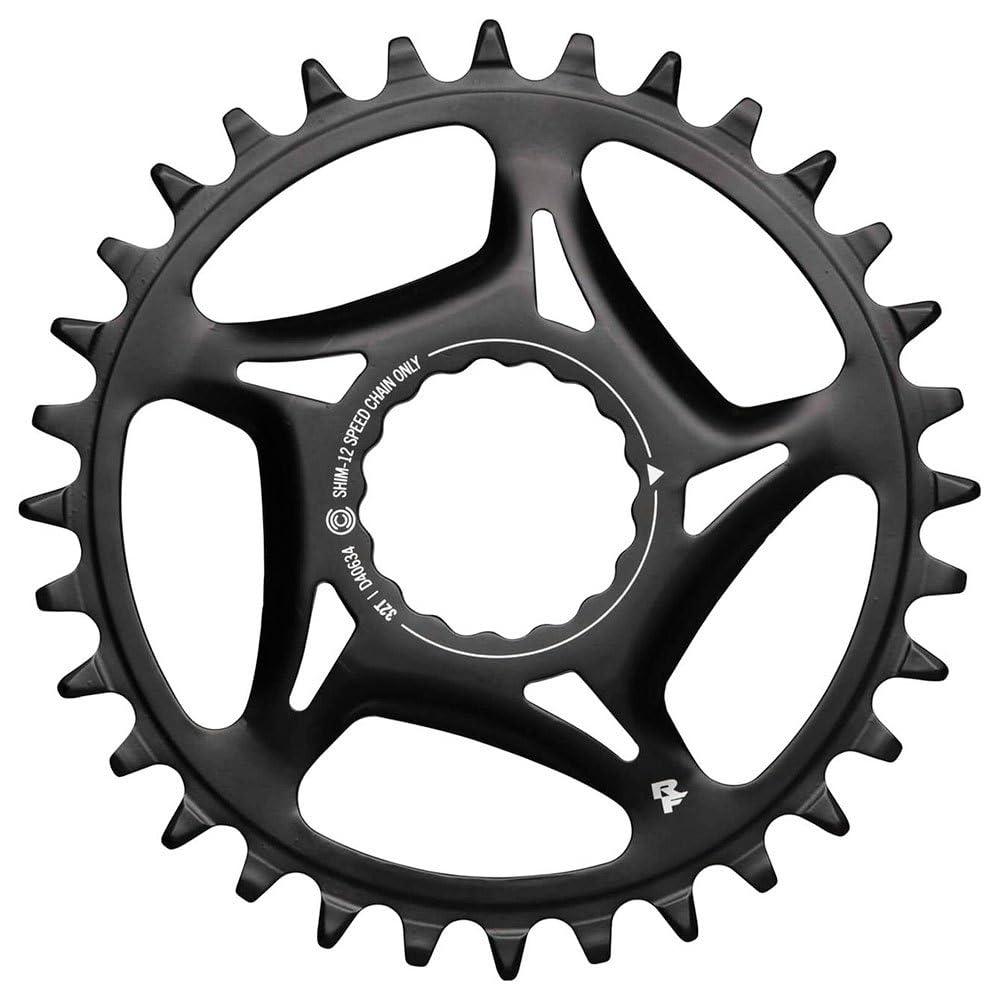
Race Face’s 34T direct mount steel chainring sits in a fairly specific corner of the mountain bike parts market. It is a replacement ring for riders running Shimano 12-speed drivetrains who want the simplicity of a direct mount interface and the durability of steel rather than aluminum. It is not a flashy upgrade, and Race Face doesn’t position it as one. That alone makes it worth examining on practical terms.
The direct mount design is the central feature here. Instead of bolting to a four-arm spider, the ring mounts directly onto a compatible Race Face crank spindle interface, which removes a set of bolts and the spider itself from the equation. In practice, this means fewer fasteners to check, less chance of a loose chainring bolt ruining a ride, and a cleaner chainline. The 34T size is a reasonable middle ground for trail riding, sitting between the easier-spinning 30T and 32T rings and the taller 36T options. For riders on rolling terrain who want a bit more top-end without giving up too much climbing ability, 34T is a common choice.
The steel construction is the other defining characteristic. Steel rings are heavier than aluminum, and there is no way around that. Race Face doesn’t publish a weight that flatters this ring, and riders comparing it to a machined aluminum alternative will notice the difference on a scale. The trade-off is wear life. Steel resists the tooth deformation and hooking that aluminum rings develop over a season of gritty, muddy riding, particularly under the load of a 12-speed chain with its narrower, more tightly toleranced inner plates. For riders who put in high mileage or ride in wet, abrasive conditions, the longer service interval can offset the weight penalty. For weight-conscious cross-country racers, it probably won’t.
Compatibility deserves attention because it is where buyers most often go wrong. This is a Shimano 12-speed compatible ring, which means the tooth profile is designed to mesh with Shimano’s HG+ chain and its specific inner link shaping. It is not a generic narrow-wide ring that happens to work with everything. Riders mixing this with a SRAM 12-speed chain or an aftermarket chain with different plate dimensions should expect less reliable shifting and potentially more chain retention issues. The direct mount interface is also crank-specific. Race Face direct mount rings fit Race Face cranks with the matching interface, and while some aftermarket cranks use a similar pattern, it is not universal. Checking crank compatibility before ordering is not optional.
In real-world use, this ring is typically found on trail and enduro bikes where riders want a set-and-forget front end. The steel teeth handle the repeated engagement of a 12-speed chain well, and the direct mount keeps the interface tight and free of the creaking that worn spider bolts can produce. Shifting performance with a properly matched Shimano chain and derailleur is consistent, though it is worth noting that a steel ring does not shift noticeably better than a well-made aluminum one when both are new. The difference shows up later, as the aluminum ring’s teeth wear and shifting quality degrades. The steel ring holds its shape longer, so the shifting stays closer to baseline over time.
One limitation that doesn’t get discussed enough is the lack of chain retention devices on the ring itself. This is a narrow-wide tooth profile, which does a good job of holding the chain on rough terrain, but riders who regularly ride very chunky, high-speed descents without a clutch derailleur or a top guide may still drop a chain. The ring is not a substitute for a proper retention setup on aggressive terrain. It is also worth noting that steel rings can be noisier than aluminum in dry, dusty conditions, though the difference is subtle and often masked by drivetrain noise.
Compared with a machined aluminum direct mount ring from the same or a competing brand, the steel version is heavier, slightly more expensive in some cases, and less visually refined. The aluminum ring wins on weight and aesthetics. The steel ring wins on longevity and resistance to tooth wear. Riders who replace chainrings annually might not see the value. Riders who want to install a ring and forget about it for multiple seasons likely will.
This ring suits trail riders, enduro riders, and commuters or bikepackers running Shimano 12-speed who prioritize durability over grams. It is less suitable for weight-focused cross-country racers, riders on SRAM 12-speed drivetrains, or anyone whose cranks don’t use the Race Face direct mount interface. It is also not the right choice for riders who change gearing frequently for different terrain, since swapping direct mount rings is more involved than unbolting a spider-mounted ring. For the right rider, it is a sensible, unglamorous component that does its job without fuss.