
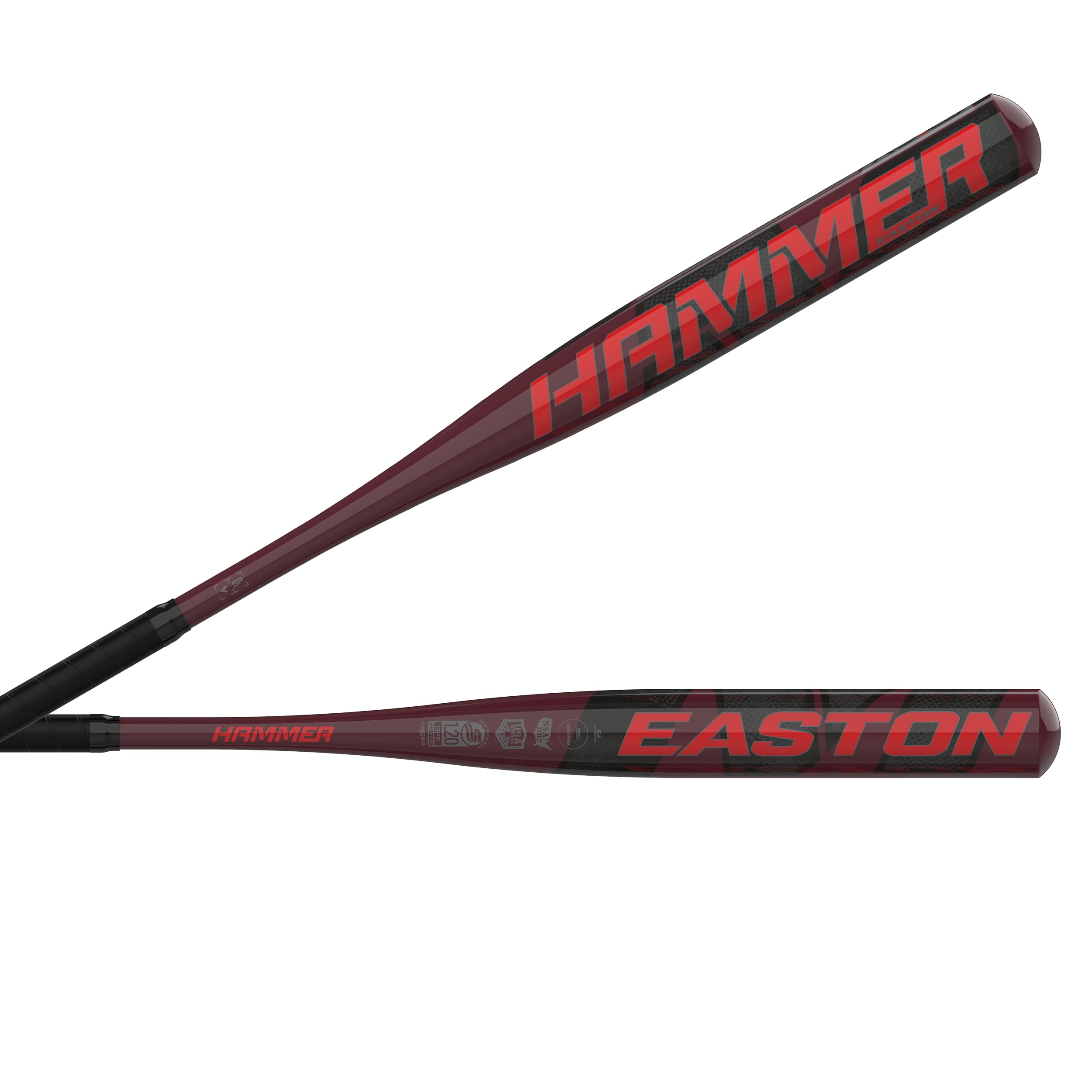
The Easton Hammer occupies a specific corner of the slowpitch market: the affordable, all-association bat that rec leagues and casual teams keep around as a dependable option. At 33 inches and 26 ounces with a loaded swing weight and a 12-inch barrel, it is aimed at players who want a bat that feels substantial through the zone without paying premium composite prices. Whether it makes sense for you depends largely on how seriously you take your at-bats.
The first thing to understand about the Hammer is its construction. This is an aluminum bat, not a composite one, and that distinction matters more than any spec sheet. Aluminum barrels tend to have a stiffer feel on contact and a smaller effective sweet spot than composites, but they also hold up better in cold weather and require no break-in period. You can take it out of the wrapper and swing it in a 45-degree early-spring game without worrying about cracking the barrel. For players in northern climates or leagues that start before the ground thaws, that durability is a genuine practical advantage.
The loaded weighting is the defining characteristic here. Easton lists this as a loaded model, meaning the weight is distributed toward the end of the barrel rather than balanced through the handle. In practice, that translates to more momentum through the swing and, for stronger hitters, more carry on well-struck balls. The trade-off is swing speed. A 26-ounce loaded bat does not swing like a 26-ounce balanced bat, and players with slower bat speed or late timing may find themselves a fraction behind on good pitches. It is a bat that rewards a deliberate, powerful swing more than a quick, compact one.
The 12-inch barrel is on the shorter side for slowpitch, where 13- and 14-inch barrels are common. A shorter barrel concentrates mass and can feel more whip-like, but it also means a smaller hitting area. Mishits toward the taper or the very end of the barrel will sting, and the ball will not travel as far as it would off a larger composite barrel. Expect the Hammer to perform best on balls struck near the middle of the barrel; contact elsewhere is functional but not forgiving.
In real-world use, the Hammer shows up most often in recreational leagues, church and corporate teams, and pickup games where the priority is having a bat that works for a range of players and survives a full season of shared use. The all-association certification is a meaningful detail here, since it means the bat is approved across the major slowpitch sanctioning bodies rather than being restricted to one. That flexibility matters for teams that play in multiple leagues or tournaments with different rules. The grip is a standard cushion style, adequate but unremarkable, and the end cap is the usual aluminum-bat design.
Where the Hammer falls short is in the category of performance feel. Players accustomed to high-end composites will notice the difference immediately: less trampoline effect, a harsher sound, and a smaller margin for error on off-center contact. There is also no break-in period to improve performance over time, which cuts both ways. The bat performs as it performs from day one, and it will not get hotter with use the way a composite will. For someone chasing maximum exit velocity, this is not the tool.
Compared with a composite slowpitch bat, the Hammer trades peak performance and feel for durability, price, and cold-weather reliability. Compared with a balanced aluminum bat, it trades swing speed for power potential. Neither comparison makes it better or worse in absolute terms; it simply occupies a different slot in the bag. The closest alternative category is the entry-level composite, which offers a softer feel and a larger sweet spot but demands more care and typically costs more.
This bat suits recreational players, teams that share equipment, and anyone who plays in colder conditions or wants a durable backup. It is less suitable for competitive tournament players who rely on composite performance, hitters with slower bat speed who need a lighter-swinging balanced model, and anyone who prefers a larger barrel for forgiveness. The Hammer is a workmanlike choice, and for the right player, that is exactly the point.