
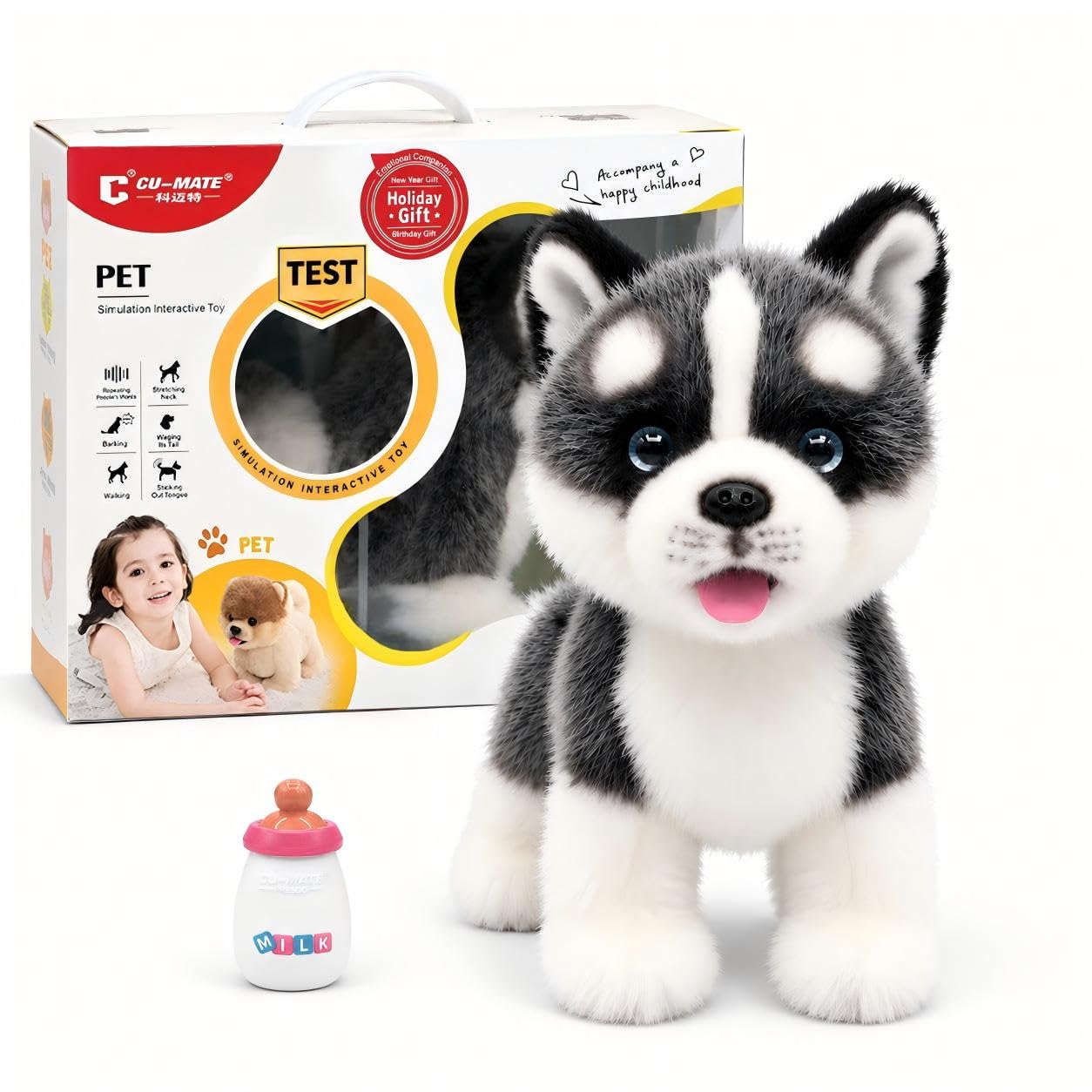
The CU-MATE Electronic Walking Dog Toy sits in a crowded category of interactive plush pets, and it arrives with a fairly long feature list for its price bracket: walking movement, barking, a wagging tail, and talking or repeating sounds. It is aimed at children aged three and up, and it is styled as a Siberian Husky puppy. The question worth asking is not whether it does all these things, but whether it does them well enough to hold a child’s attention past the first week.
In practice, this toy is used the way most plush electronic pets are used: a child carries it around the house, sets it on the floor to watch it move, and interacts with it in short bursts rather than long sessions. Because it walks, it needs a hard, flat surface to perform as intended. Carpet is a common stumbling block; thick rugs and plush flooring tend to interfere with the walking mechanism, causing the toy to stall or veer. On tile, laminate, or short-pile carpet, the movement is more convincing. This is a detail worth knowing before purchase, because a child who first tries it on a bedroom rug may conclude it is broken.
The functional set is straightforward. The toy walks forward using a motorized leg mechanism, emits barking sounds, wags its tail, and can produce talking or repeating audio, typically in the form of a voice that mimics what it hears. Volume is fixed rather than adjustable on most units of this type, which matters in households where noise sensitivity is a factor. The plush exterior is soft and the Husky styling is reasonably detailed, though the electronic housing inside means the body is firmer than a standard stuffed animal. Children who expect to cuddle it like a regular plush may find it less huggable than anticipated.
Battery life is the practical constraint that shapes most of the experience. Walking motors draw power steadily, and repeated use drains cells faster than a simple sound-only toy would. Parents should expect to keep a supply of batteries on hand, and the battery compartment is usually accessed through a hook-and-loop or zippered flap on the underside, which is secure but not especially quick to open. The toy is not designed for outdoor use in wet conditions, and the walking mechanism is exposed enough that dirt and pet hair can accumulate around the legs over time.
- Walking motion: Motorized legs move the toy forward on flat, hard surfaces; performance drops on carpet.
- Sound: Barking and talking/repeating audio; volume is generally fixed.
- Tail: Wagging action tied to the sound and movement cycle.
- Build: Plush exterior over a rigid electronic core; not machine washable.
- Age range: Marketed for ages 3 and up; adult supervision is sensible around the battery compartment.
The most significant trade-off is durability versus complexity. A moving, barking, tail-wagging plush has more parts that can fail than a static stuffed dog, and the walking mechanism is the component most likely to wear out first, particularly if the toy is dropped or dragged. The plush surface also cannot be washed in a machine, so spot cleaning is the only option, which is a real limitation for a toy handled constantly by young children. Compared with simpler interactive plush pets that only make sounds or respond to touch, this one offers more engagement but also more to go wrong. Compared with a remote-controlled toy dog, it is less controllable and less precise, but it is also easier for a young child to operate independently, since there is no controller to master.
Attention span is another consideration. The novelty of a walking, barking dog tends to be strong in the first days and then settles into occasional use. Children who enjoy pretend play and narrating scenarios with a pet tend to get more sustained value than children who expect a responsive, adaptive robot. The talking feature is entertaining but limited; it repeats rather than converses, and children figure that out quickly.
This toy suits children roughly three to six who are comfortable with moderately loud sounds and who enjoy active floor play. It is a reasonable gift for a child who has asked for a pet and is not ready for one, provided the family understands it is a toy rather than a substitute companion. It is not a good fit for households with noise sensitivity, for children who want a soft cuddle toy, or for families unwilling to manage battery replacement. It is also not appropriate for children under three, given small parts and the battery compartment. Buyers should treat it as a short-to-medium-term entertainment item rather than a long-lasting keepsake, and set expectations accordingly.