
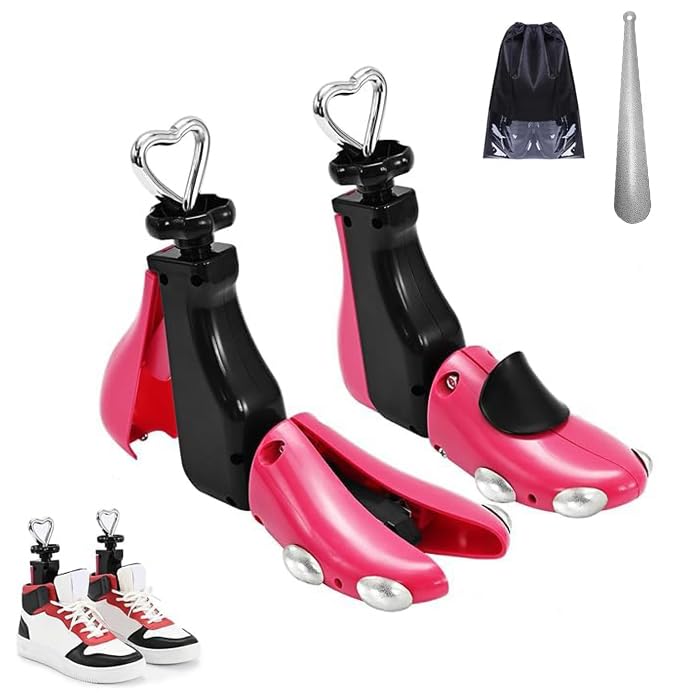
When you buy shoes online or even in stores, the fit doesn’t always match what you expected. That’s where shoe stretchers come in, and the UHIAGREE model is a plastic, adjustable option aimed at women’s sizes 6-11 and men’s 5-9.5. It’s designed to tackle tight spots, especially for wide feet, and can be used on boots as well as standard shoes. I’ve been testing it on a pair of leather loafers that were pinching at the toes and a pair of ankle boots that felt a bit snug around the instep.
The stretcher itself is made of hard plastic with a metal turning mechanism. You insert it into the shoe, then turn the handle to expand the width. There are also two small, round plastic nubs that can be inserted into the side of the stretcher to target specific pressure points, like a bunion area. The adjustment range is noticeable—you can increase width by about half an inch or so, which makes a real difference for shoes that are just a touch too narrow. The boot version is longer, designed to reach down into the shaft, which is useful for tall boots or high-top sneakers.
In real-world use, the process is straightforward but requires patience. You spray the shoe with a stretching solution (or use a water and alcohol mix), insert the stretcher, and turn the handle until you feel resistance. Leave it for 24 to 48 hours. I found that for thin leather, the stretcher worked well, widening the toe box noticeably. For thicker boot leather, it took two rounds of stretching to get a comfortable fit. The plastic construction feels sturdy enough for occasional use, but it’s not heavy-duty like metal stretchers. The turning mechanism can feel a bit stiff at first, and you need to be careful not to overtighten, as the plastic might crack under too much pressure.
Key functional features include the adjustable width via a threaded rod, the removable pressure nubs for spot stretching, and the boot-specific length. The stretcher also has a small plastic plate at the heel to help hold the shoe’s shape. It’s lightweight and easy to store, which is a plus for people with limited space. However, it doesn’t come with a spray or any stretching fluid, so you’ll need to buy that separately or make your own.
One clear limitation is the plastic build. While it’s functional, it doesn’t feel as robust as a metal shoe stretcher from brands like FootFitter or Stratton. If you have very stiff leather or need to stretch shoes frequently, the plastic may wear down or break over time. I also found that the stretcher didn’t work as well on synthetic materials or very thin canvas—it either didn’t hold the shape or caused the material to warp slightly. Another trade-off is that the adjustment knob is not the smoothest; you have to apply some force, and it can be tricky to get both shoes stretched evenly.
Compared to wooden shoe stretchers, which are often more expensive but more durable and better at absorbing moisture, this plastic option is a budget-friendly alternative. Wooden stretchers also tend to have a more natural feel and can be left in shoes for longer periods without risk of damage. The UHIAGREE is lighter and easier to handle, but it lacks the same premium feel. For someone who stretches shoes only occasionally, the plastic version is fine. For frequent stretchers or heavy-duty use, a wooden or metal model might be a better investment.
So, who is this for? It suits people with wide feet who need a bit of extra room in the toe box or across the vamp, especially if they have a few pairs of leather shoes that are slightly tight. It’s also good for those who wear boots and want a stretcher that can reach deeper into the shaft. The adjustable width and spot-stretching nubs are helpful for targeted relief. On the other hand, it’s not ideal for people with very stiff, thick leather shoes like work boots or hiking boots, as the plastic may not generate enough force. It’s also not the best choice for delicate materials like suede or satin, where the stretcher might leave marks or cause distortion. If you need to stretch multiple pairs of shoes regularly, you might find the plastic construction limiting and prefer a metal alternative.
Overall, the UHIAGREE shoe stretcher does what it claims for most standard leather shoes and boots. It’s a practical tool for occasional use, with a few caveats about build quality and material compatibility. It won’t transform poorly fitting shoes into perfect ones, but it can relieve pressure points and make tight shoes wearable. Just manage your expectations and be prepared to repeat the process for stubborn spots.