
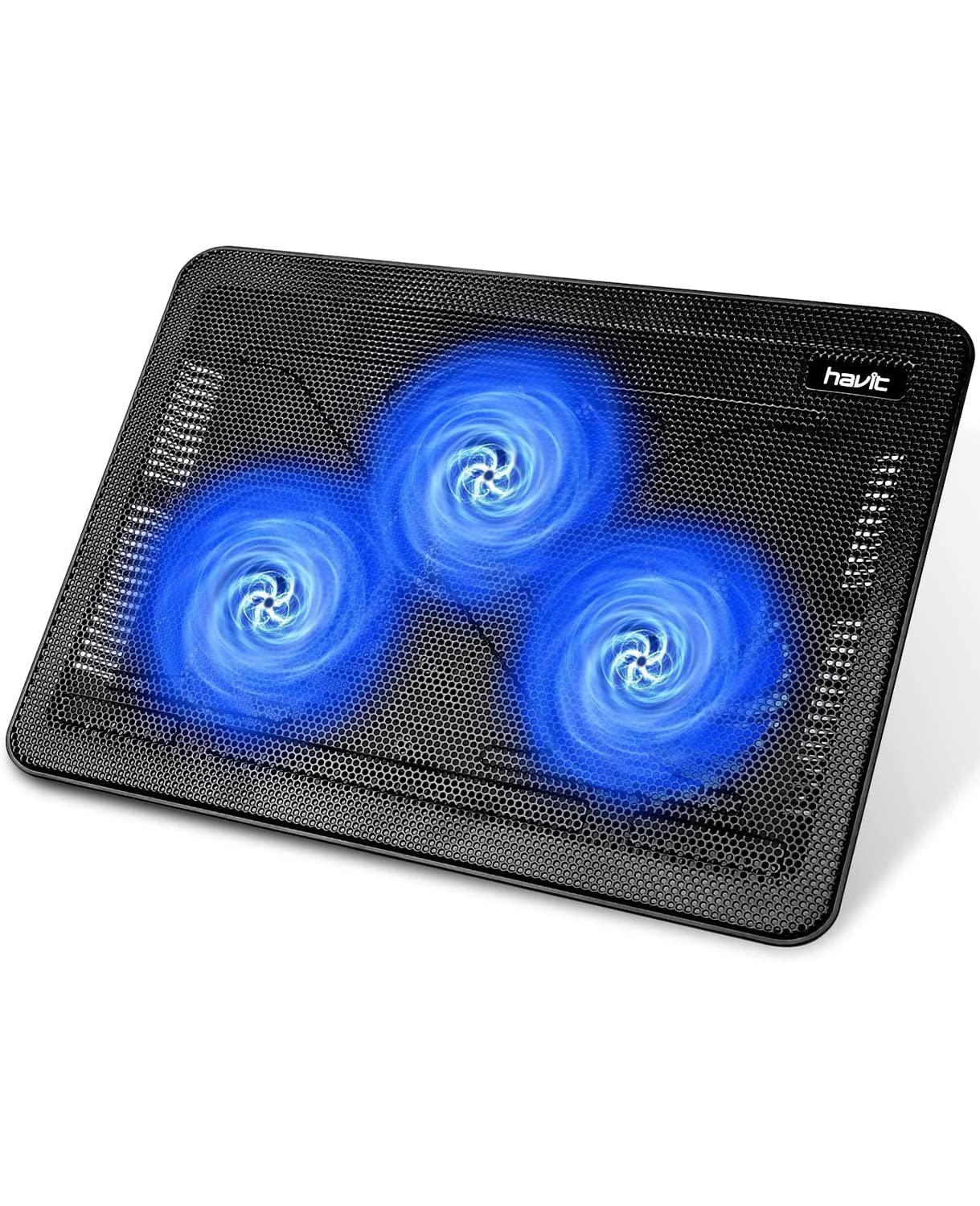
The Havit HV-F2056 is one of those accessories that shows up constantly in budget-minded laptop discussions, and it is easy to see why. It is a five-fan cooling pad aimed at 15.6- to 17-inch machines, it costs very little, and it does not ask much of the buyer beyond plugging in a USB cable. Whether it actually helps depends a great deal on the laptop sitting on top of it, which is the part most buyers underestimate.
The pad itself is a fairly plain black plastic frame with a mesh surface. Three 110mm fans sit across the top section and two smaller 75mm fans sit lower down, all of which can be switched between a few speed settings or turned off entirely. There is a small control dial or button array on the left side, along with a USB pass-through port so the pad does not permanently consume one of the laptop’s ports. Two plastic kickstands flip out at the back to raise the rear edge, and the front has small lips to stop the laptop sliding forward. Build quality is what you would expect at this price: the plastic flexes a little under pressure, and the mesh is not especially rigid, but nothing about it feels like it will fall apart in normal desk use.
In practice, the HV-F2056 is used in two main ways. The first is on a desk, where it mostly serves as an angled stand with some airflow underneath. The second is on a bed, couch, or lap, where the solid base keeps the laptop’s vents from being buried in fabric. That second scenario is arguably where a pad like this earns its keep, because many thin laptops pull air from the bottom and choke quickly on soft surfaces. Raising the rear by a couple of inches and pushing air upward can make a measurable difference in those situations.
On hard surfaces, though, expectations should be realistic. The fans move air, but they are not high-static-pressure blowers, and the mesh and fan grilles add resistance. For a laptop that already runs warm under load, the pad typically shaves a few degrees off CPU and GPU temperatures rather than transforming thermals. It is more useful for keeping a machine away from thermal throttling during long sessions than for making a hot laptop cool. The effect also varies by laptop design: rear-exhaust machines benefit mostly from the elevation, while bottom-intake models get more from the direct airflow. Anyone expecting a dramatic drop in temperatures will probably be disappointed.
Noise is the other trade-off. At the lowest setting the fans are close to inaudible in a quiet room, but at higher speeds the small fans produce a noticeable whine that some users will find distracting during calls or quiet work. The five-fan layout also means the airflow is spread out rather than concentrated, so the pad is better at general ventilation than at targeting one hotspot. There is no fan-speed memory either, so the pad starts at whatever default the switch uses each time it is powered on.
Compared with a simple laptop stand, the HV-F2056 offers active cooling but adds bulk, a cable, and noise. Compared with a single-large-fan cooler, it spreads airflow more evenly across a wide chassis but tends to be louder per unit of cooling. It is also worth noting that a cooling pad cannot fix a laptop with a poorly designed internal cooling system; if the heatsink is clogged or the thermal paste is dried out, no external fan will compensate.
Who it suits: owners of 15.6- to 17-inch laptops who want a cheap way to lift the machine, improve airflow on soft surfaces, and take the edge off sustained heat during long work or gaming sessions. It is also a reasonable pick for students or office users who just want an angled, ventilated stand without spending much.
Who should look elsewhere: people with 13- to 14-inch laptops, since the wide frame will dwarf a smaller machine; users who need near-silent operation at higher fan speeds; and anyone hoping for a large, measurable temperature drop on an already well-cooled laptop. Those buyers are better served by a passive aluminum stand or a cooler with larger, slower-spinning fans.
Overall, the HV-F2056 is a modest, functional accessory that does what a budget cooling pad can reasonably do. It is not a thermal solution so much as a cheap ergonomic and airflow aid, and judged on those terms it is easy to live with.