
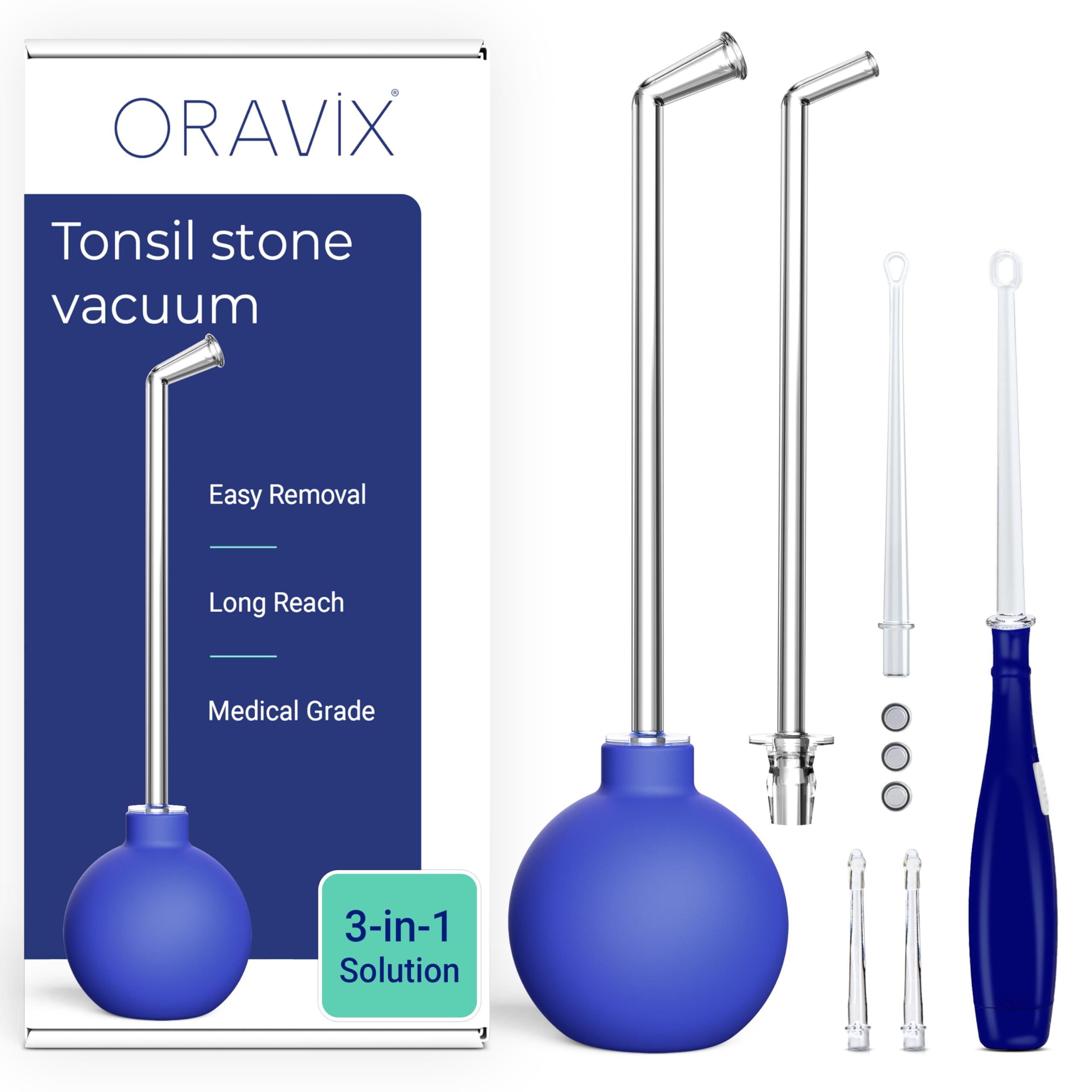
Tonsil stones are one of those minor but persistent annoyances that many people deal with quietly. They cause bad breath, a sensation of something stuck in the throat, and occasional discomfort. While some people can dislodge them with a vigorous gargle or a cotton swab, others find that stones recur and are difficult to reach. The Oravix Tonsil Stone Vacuum is a 3-in-1 kit designed to address this by using suction to pull stones out, rather than poking or scraping at the tonsils. It’s a niche product, but for those who get frequent stones, it might be worth considering.
The kit includes three main components: a vacuum handle that generates suction, a set of interchangeable tips (including a curved tip for reaching around the tonsil and a flat tip for broader coverage), and a small LED light that attaches to the handle to illuminate the back of the throat. The device is battery-operated (it takes two AAA batteries, not included) and is intended for personal use. The suction is created by a small motor, and the tips are designed to be gentle on the delicate tissue of the tonsils.
In real-world use, the Oravix is typically employed in front of a bathroom mirror, with the user opening their mouth wide and using the light to guide the tip toward the stone. The suction is not particularly strong—it’s more of a gentle pull—so it works best on stones that are already partially exposed. For deeper stones, you may need to use the curved tip to gently manipulate the stone loose before suction can grab it. The process can take a few minutes, and it may require some trial and error to find the right angle. Users often report that it’s less painful than using a cotton swab or finger, but it’s not entirely discomfort-free, especially if the stone is lodged firmly.
One of the key functional features is the variability of the tips. The curved tip is particularly useful for reaching stones that are tucked behind the tonsillar folds, while the flat tip can be used for broader suction over the surface. The LED light is a thoughtful addition, as the back of the throat is notoriously poorly lit. However, the light is not exceptionally bright, and it may not provide enough illumination for everyone, especially if the user has a strong gag reflex and can’t hold their mouth open wide for long. The device is also relatively quiet, which is a plus, but the suction power is modest—it’s not going to yank a stone out forcefully. Instead, it relies on the user to gently tease the stone free.
A significant limitation is that the Oravix is not a substitute for professional medical care. If you have large, deeply embedded stones or if you experience pain or bleeding, you should see a doctor. The device is also not designed for people with a strong gag reflex; using it requires holding the mouth open and inserting the tip far back, which can be uncomfortable. Additionally, the suction is not adjustable, so you can’t increase the power for stubborn stones. The tips are made of plastic and may wear out over time, though replacements are available. The kit also requires batteries, which adds an ongoing cost and means you need to have them on hand.
Compared to alternative methods, such as using a water flosser on a low setting or a specialized tonsil stone removal tool (like a curette), the Oravix offers a less invasive approach. Water flossers can be effective but may be too intense for some, and curettes require more precision and can cause gagging. The Oravix’s suction is gentler, but it may not be as effective for larger stones. Another alternative is simply gargling with salt water or using a cotton swab, which are low-cost but can be less hygienic and more irritating. The Oravix sits in the middle: it’s more targeted than gargling but less forceful than a water flosser.
Who is this for? It’s suitable for adults who get occasional tonsil stones that are visible and not deeply embedded, and who are comfortable with inserting a device into their mouth. It’s also for those who prefer a less manual method than swabs or curettes. It is not suitable for children, people with a severe gag reflex, or anyone who has never had tonsil stones (obviously). It’s also not for those expecting a powerful vacuum; the suction is mild. If you have chronic tonsil stones or large ones, you may need to see an ENT specialist rather than rely on a home device.
In terms of build quality, the Oravix feels adequate but not premium. The plastic housing is lightweight, and the tips snap on securely. The LED light is a small button cell battery, which is included. The device is easy to clean—the tips can be rinsed, and the handle can be wiped down. However, the suction mechanism is not waterproof, so you can’t submerge the handle. The kit comes with a small storage case, which is convenient for keeping everything together.
Overall, the Oravix Tonsil Stone Vacuum is a useful tool for a specific problem, but it’s not a miracle solution. It works best as part of a routine that includes good oral hygiene and, if necessary, professional advice. For the occasional stone, it can be a less irritating alternative to swabs, but don’t expect it to solve chronic issues. At around $30-40, it’s a reasonable investment if you’re prone to stones, but it’s not essential for everyone.