
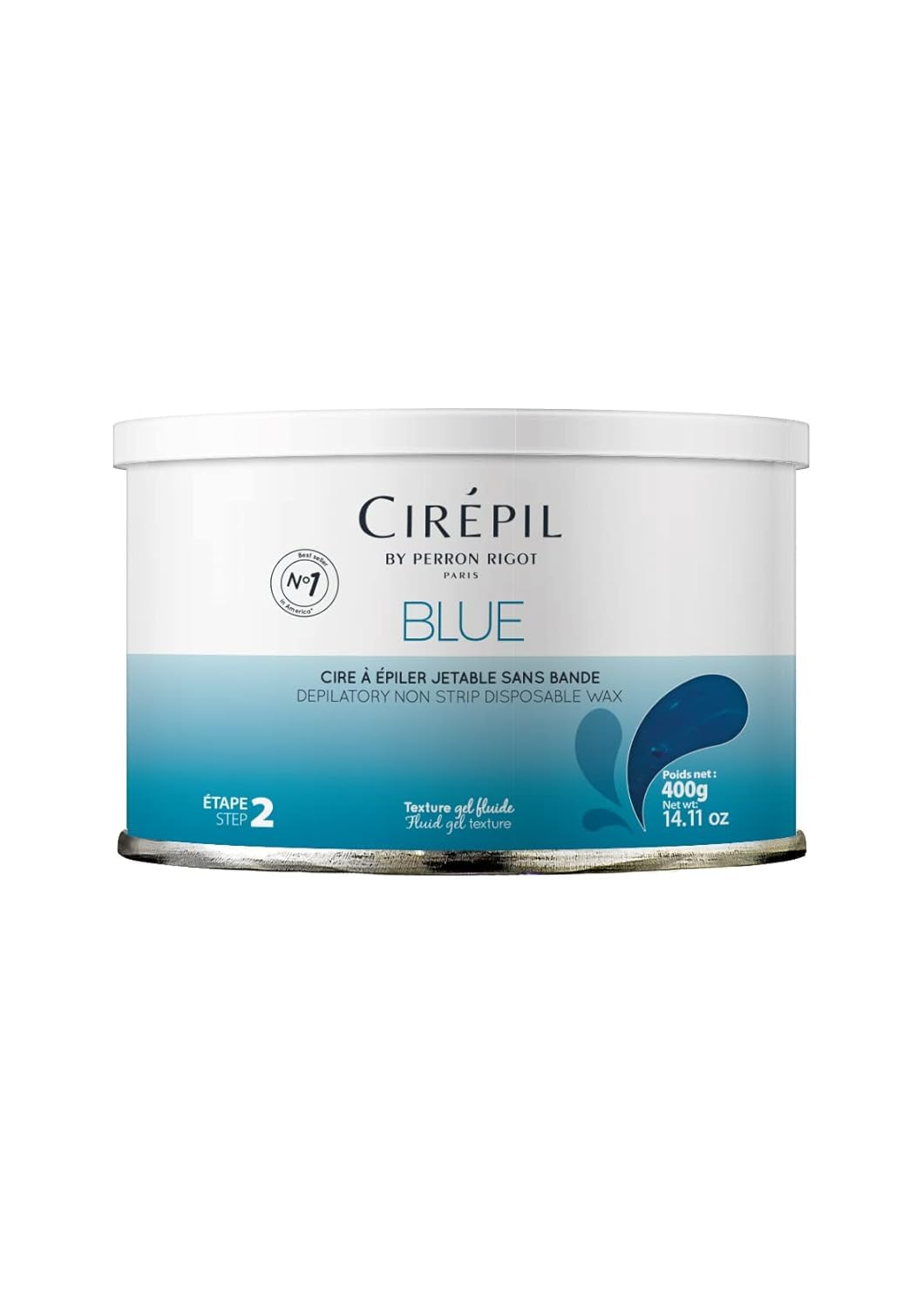
Cirepil BLUE is one of those waxes that shows up repeatedly in professional esthetician conversations, not because it is flashy but because it occupies a specific niche: hard wax formulated for skin that does not tolerate heat well. The 400g tin is a standard professional size, and the blue color is not decorative — it is a visual cue that this is a low-melting-point formula, which matters more than it might seem at first glance.
In practice, Cirepil BLUE is used the way most hard waxes are: warmed in a professional wax heater until it reaches a honey-like consistency, applied in a thin layer against the direction of hair growth, allowed to set, and then removed without a cloth strip. The difference is in the working temperature. Because the wax melts at a lower point than many strip-less formulas, it stays pliable longer and can be applied in a slightly thicker layer over delicate areas — underarms, bikini line, facial hair — without the sting that hotter waxes produce on contact. Estheticians who work with clients on retinoids, or who have rosacea-prone or recently exfoliated skin, tend to reach for lower-temperature hard waxes for exactly this reason.
Functionally, the tin contains 400g of wax, which is a reasonable amount for a working professional but more than most at-home users will get through before the product’s practical shelf life becomes a concern. The formula is rosin-based, which is typical for hard waxes and gives it the grip needed to lift coarse hair without a strip. It is not a film wax, so it does not spread as thinly as some newer formulas, and that has real consequences: a thicker application means more product per service, which affects cost-per-client over time. The blue color also makes it easier to see where the wax has been applied, which sounds trivial until you are working in a dim treatment room.
Where Cirepil BLUE earns its reputation is in the removal. Because it sets firm rather than tacky, it comes off in a single piece in most cases, which reduces the need for repeated passes over the same patch of skin. Fewer passes means less trauma, and for clients who find waxing genuinely painful, that difference is noticeable. It also handles finer hair reasonably well, though it is not the strongest option for very short, stubborn stubble — for that, a stiffer formula or a strip wax tends to perform better.
The trade-offs are worth being honest about. The low melting point is an advantage for comfort but a disadvantage for speed: in a warm room or during a long appointment, the wax can cool unevenly in the pot, and it benefits from being stirred and monitored more carefully than a higher-temperature formula. It also does not tolerate being overheated — push it past its working range and it becomes stringy and difficult to apply cleanly, which is a common complaint among users new to the product. Compared to a standard strip wax, hard waxes like this one are slower per service and require more technique; compared to a modern film wax, Cirepil BLUE uses more product per area and does not spread as thinly. Neither is a flaw exactly, but they are reasons a salon might choose a different formula depending on volume and clientele.
The 400g tin is a professional format, and that shapes who this is actually for. Working estheticians who see sensitive-skin clients regularly will find it a dependable staple, particularly for facial and bikini work where heat sensitivity is a real concern. It is also a reasonable choice for experienced at-home waxers who already own a proper wax heater and have learned to control temperature — though the learning curve is real, and the tin size is larger than a casual user needs. It is not a good fit for someone looking for a quick drugstore solution, for anyone without a controlled heating method, or for high-volume salons that prioritize speed over gentleness. Beginners who have never used hard wax should expect to waste some product while learning the correct thickness and removal angle; that is true of any hard wax, but the low-temperature formula is less forgiving of hesitation than some stiffer alternatives.
Overall, Cirepil BLUE is a competent, purpose-built hard wax that does one thing well: it removes hair from sensitive skin with less heat and less repeated trauma than many alternatives. It is not the fastest, not the most economical per service, and not the most beginner-friendly option on the shelf. But for the specific use case it was designed for — reactive skin, delicate areas, and clients who dread the sting — it holds up as a sensible, unglamorous workhorse.