
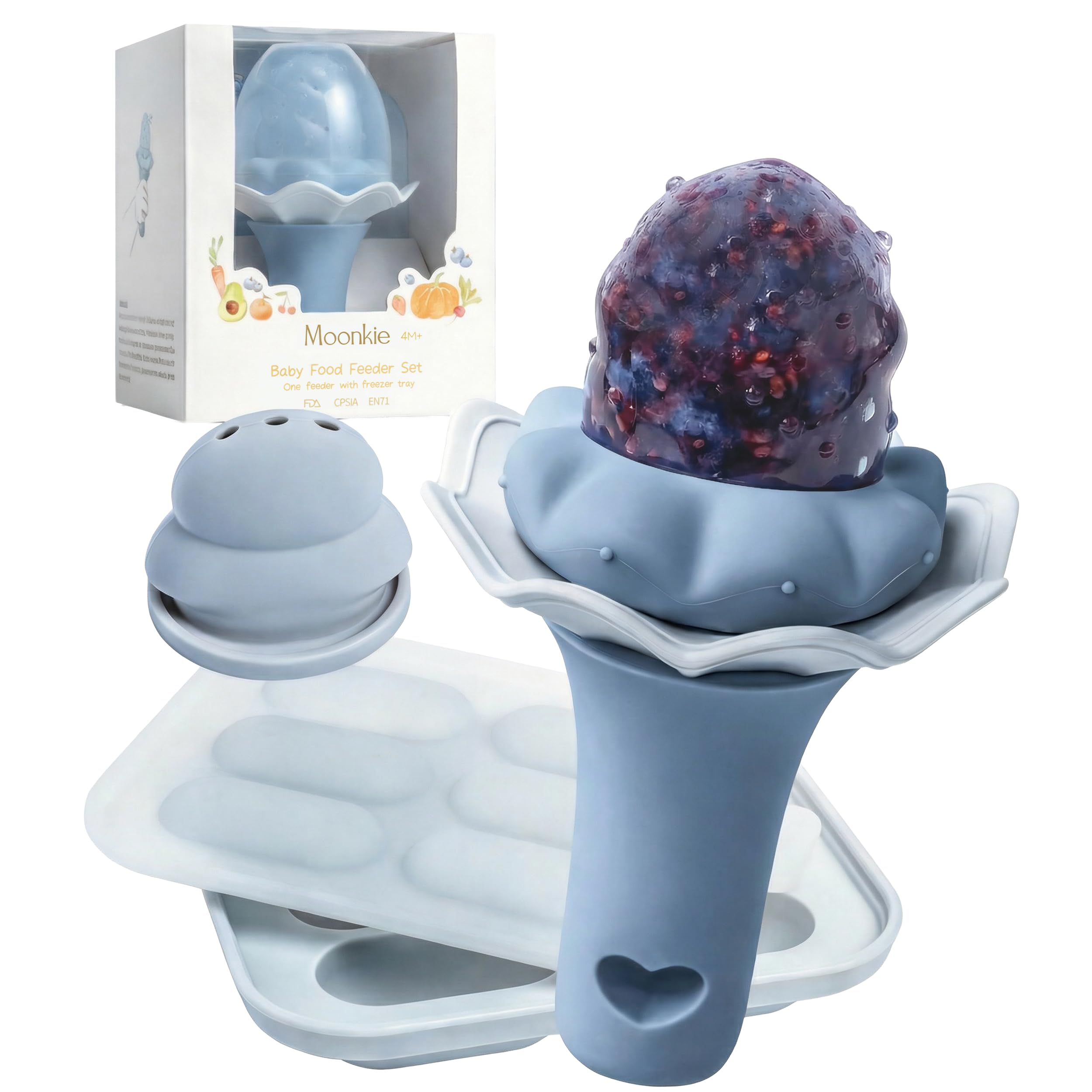
The Moonkie Baby Fruit Feeder is one of several two-pouch feeder sets aimed at parents introducing solids. The premise is straightforward: you put soft fruit or cooked vegetables into a mesh or silicone pouch, the baby gnaws on it, and small amounts of food pass through the holes while larger pieces stay contained. It is a low-commitment way to let a baby explore flavors and textures without the choking risk of loose chunks. Moonkie’s version stands out mainly for shipping two pouches sized for different stages rather than one, which is worth examining closely because the stage distinction is the product’s main claim.
In practice, these feeders get used in a fairly narrow window. Most families pull them out around five to seven months, when a baby can sit upright with support and bring objects to their mouth but hasn’t mastered chewing. A typical session involves loading the pouch with something soft — banana, steamed pear, mango, avocado — snapping it shut, and handing it over. The baby gums at the silicone or mesh, and the parent watches for the food to break down. It is often used as a bridge between purées and finger foods, or as a distraction during family meals so the baby has something to do while everyone else eats. Cleanup is the recurring chore: the pouch, the collar, and the handle all need rinsing fairly promptly, because fruit residue dries and sticks in the perforations.
The two-stage design is the feature worth understanding. The smaller pouch is intended for earlier eaters, with a smaller food chamber and finer openings that release less material per bite. The larger pouch has a bigger capacity and coarser openings for babies who have some experience and are ready for more volume and texture. In real use, the distinction is meaningful but not dramatic — many babies move from one to the other within a few weeks, and some parents report that the small pouch becomes redundant quickly. The handles are sized for a baby’s grip, and the snap-on collar is designed to stay put during chewing, which is the failure point on cheaper feeders. The silicone components are soft enough that teething babies tend to accept them, and the set is generally dishwasher-safe on a top rack, though hand-washing the perforated parts is more reliable for getting pulp out.
There are real trade-offs. First, these feeders teach a specific skill — extracting food from a pouch — that doesn’t map directly onto eating real finger foods. Some feeding therapists note that heavy reliance on mesh or silicone feeders can delay the transition to self-feeding actual pieces, so they work best as an occasional tool rather than a daily staple. Second, the pouches hold residue and odor if not cleaned thoroughly; silicone in particular can pick up a smell from strong fruits. Third, the two-stage system means two sets of parts to wash and store, and the smaller pouch’s useful life is short. Finally, capacity is modest — a hungry baby will empty a loaded pouch in a few minutes, so it isn’t a meal replacement.
Compared with the broader category, Moonkie sits in the middle. Basic single mesh feeders from generic brands cost less and do roughly the same job, but the mesh tears sooner and the collars loosen. Higher-end silicone feeders from established baby-gear brands offer similar function with sturdier construction and sometimes a better-designed handle, at a higher price. The two-pouch staging is a reasonable middle-ground value if you expect to use the feeder across several months; if you only need one, a single-pouch option is more economical.
Who it suits: parents starting solids who want a controlled way to introduce fruit and soft vegetables, caregivers who want a mess-limited activity during meals, and families who plan to use a feeder for a few months across two stages.
Who it doesn’t suit: parents committed to baby-led weaning with whole finger foods, families who want a single durable feeder rather than a staged set, and anyone unwilling to hand-clean perforated silicone parts regularly. Babies who are already confident eaters will outgrow it fast. Realistic expectation: it is a useful transitional tool, not a long-term feeding solution, and its value depends heavily on how often you actually reach for it.