
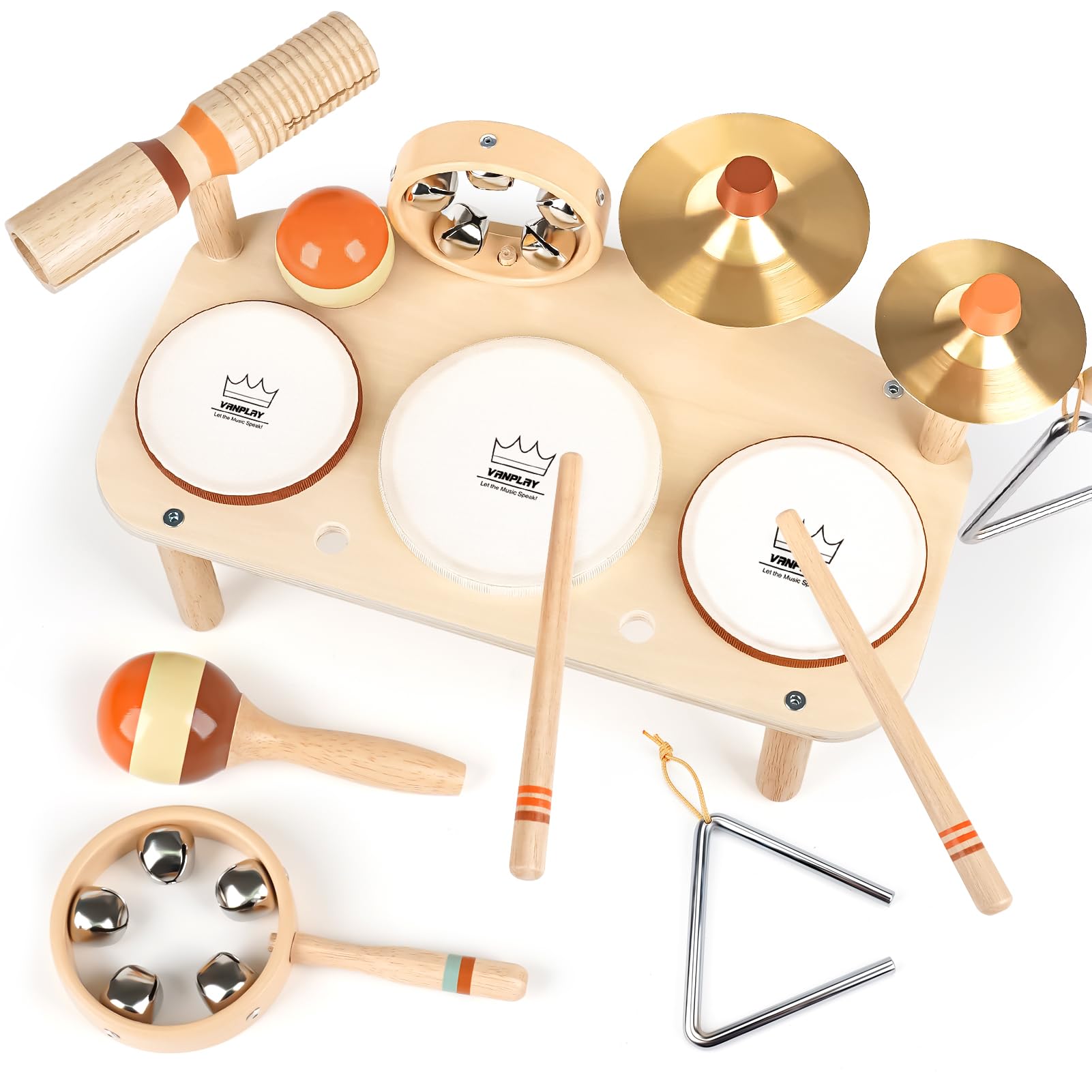
The Vanplay Kids Drum Set is one of those toys that tends to divide parents before it even comes out of the box. A toddler-sized percussion kit promises engagement and rhythm practice on one hand, and a house full of noise on the other. Whether it earns its place in a playroom depends heavily on what you expect from it and how much tolerance your household has for repeated thumping.
This set falls into the broader category of Montessori-inspired musical toys for two- and three-year-olds. That label gets applied loosely across the market, so it is worth being specific about what it actually means here: a child-scaled instrument with multiple playable surfaces, designed to be explored by hand rather than taught formally.
What you actually get
Based on the product listing and typical configurations for this type of kit, the set includes a small drum with a strap, a pair of child-sized drumsticks, and a handful of auxiliary percussion pieces such as a tambourine or cymbal element. The components are sized for small hands and short arms, which matters more than it sounds. Adult drum hardware is heavy and awkward for a two-year-old; this is built around the reach and grip of a toddler.
The strap is a functional detail rather than decoration. It lets the drum sit against the body so a child can march, sway, or move around while playing, which is how most toddlers actually use a drum anyway. Very few young children sit still and practice rudiments, and the design seems to acknowledge that.
How it gets used in practice
In real households, a toy like this rarely becomes a structured music lesson. It gets pulled out during free play, used to accompany a song, or dragged into a sibling’s room for a spontaneous parade. The multiple pieces encourage turn-taking and imitation, which is where the Montessori framing has some genuine substance. A child can hand a stick to a parent and copy a simple beat, or trade instruments with a friend.
It also works as a first introduction to cause and effect. Hit the surface, get a sound. Hit it harder, get a louder sound. That feedback loop is absorbing for children in the two-to-three range, and it is the reason percussion tends to hold attention longer than many other toy categories.
Where it falls short
The most obvious trade-off is volume. Toy drums are not tuned instruments, and the sound tends to be bright and sharp rather than warm. In a small apartment or a house with a light-sleeping baby, that becomes a real consideration. There is no volume control here, and no mute function. Some parents end up restricting play to certain hours, which somewhat undercuts the idea of open-ended, always-available play.
Build quality is another area to set expectations around. These kits are typically made from wood or a wood-composite frame with a synthetic drumhead, and they are priced accordingly. They survive normal toddler handling, but they are not heirloom instruments. The drumhead in particular can dent or loosen over months of enthusiastic use, and the sticks are thin enough that they will eventually be chewed, lost, or snapped. Treat it as a first instrument with a finite lifespan rather than a long-term investment.
There is also the question of range. A drum kit is a rhythm tool, not a melody tool. If your goal is pitch recognition or song-playing, this will not get you there. It is a narrow but useful slice of musical play.
How it compares to alternatives
The closest comparison is a general toddler music set that bundles a xylophone, shakers, and a small drum together. Those sets offer more variety and introduce pitch, but the individual pieces are usually smaller and less satisfying to play. A dedicated drum kit like this one gives a more tactile, physical experience, and the strap-mounted design encourages movement in a way that tabletop instruments do not.
Another alternative is a full electronic drum pad for kids, which offers volume control and different sound settings. Those cost more, depend on batteries, and introduce screens or buttons that can distract from the physical act of playing. For a two- or three-year-old, the simplicity of an acoustic toy is often the better fit, noise notwithstanding.
Who it suits, and who it does not
This is a good match for families with a toddler who already shows interest in banging on pots and pans, and who have the space and tolerance for acoustic play. It works well as a gift for a second or third birthday, particularly when the giver checks with the parents first. It is also a reasonable pick for a playroom or a grandparents’ house where it can live permanently.
It is a poor fit for households where noise is a genuine constraint, for children under about eighteen months who may put small parts in their mouths, and for anyone hoping for a toy that teaches melody. Parents expecting a polished, durable instrument will likely be disappointed; parents expecting a sturdy, engaging first percussion toy with a realistic lifespan will find it does the job.