
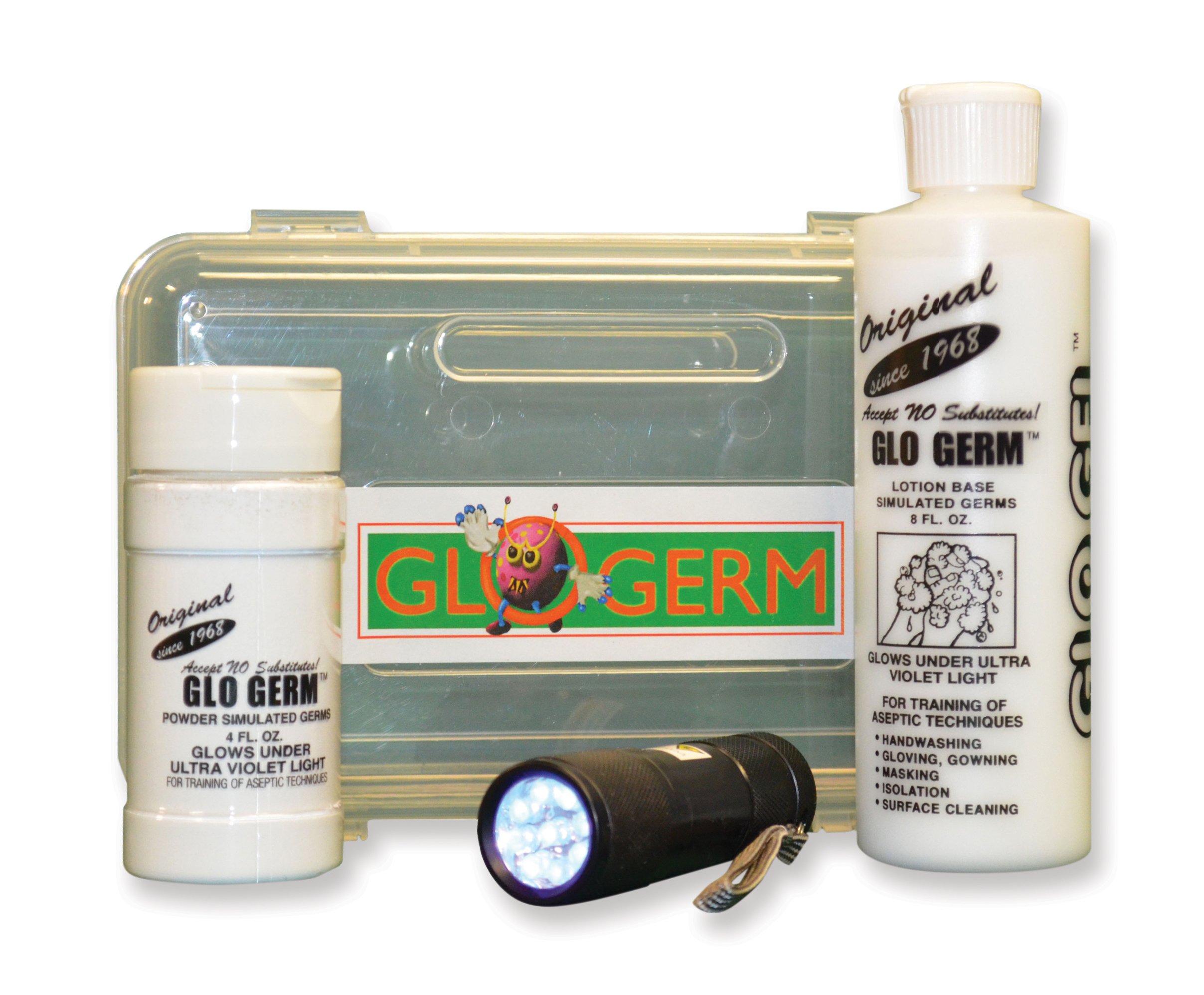
The Glo Germ Experiment Kit is one of those educational products that makes an abstract idea visible. It is built around a simple premise: apply a fluorescent lotion or powder to your hands or a surface, then use a UV blacklight to reveal where it has spread. Because the material behaves similarly to the oils and residues on real hands, it serves as a stand-in for germs in classrooms, clinics, and food-safety training sessions. The kit ships with an 8-ounce bottle of gel and a 1.9-ounce container of powder, which is enough material for repeated demonstrations rather than a single lesson.
The most common use case is a handwashing exercise. A teacher or trainer applies a small amount of gel to a participant’s hands, has them wash as they normally would, and then checks under the blacklight. Residual glow on wrists, between fingers, or under fingernails gives immediate, visual feedback that a verbal reminder rarely achieves. The powder serves a different purpose: it is typically dusted on a doorknob, phone, or other surface to show how contamination travels from one person or object to another. Both materials glow a pale green-white under ultraviolet light, and the contrast is strong enough to be seen in a normally lit room, though it is far more dramatic in dim conditions.
Functionally, the kit is straightforward. The gel is a thick lotion that spreads easily and rinses off with soap and water; the powder is fine and lightweight, which makes it useful for surface-transfer demonstrations but also means it can drift if applied carelessly. Neither material is a real pathogen, and the kit is not a diagnostic or clinical tool. It is a visual aid, and its value depends almost entirely on how well the person running the demonstration frames the exercise. A trainer who explains that the glow represents contamination rather than actual germs will get more from it than one who simply hands out the bottle.
What the kit does well is scale. The 8-ounce gel bottle is generous for a classroom or a series of training sessions, and a little goes a long way; a pea-sized amount is usually enough for one pair of hands. The powder container is smaller but similarly long-lasting for surface demonstrations. There is no blacklight included, which is worth noting. The kit is marketed as an experiment kit, and the glow only works with a UV light source, so buyers should expect to supply their own flashlight or lamp. That omission is the most significant practical gap, because without a blacklight the materials are inert.
There are other trade-offs. The gel can feel slightly tacky on the skin before it dries, and some users may find the residue noticeable until they wash. The powder, while effective, is messy in the wrong hands; it can settle on clothing and surfaces and is best applied sparingly with a controlled hand. Cleanup is generally easy with soap and water, but the powder can leave a fine film that requires a damp cloth rather than a dry wipe. None of these issues are dealbreakers for a supervised educational setting, but they are reasons the kit is better suited to a planned lesson than to casual, unsupervised play.
Compared with alternative approaches, the Glo Germ kit sits somewhere between a homemade demonstration using flour or glitter and a professional training system with pre-treated surfaces and dedicated UV cabinets. Flour and glitter can illustrate transfer, but they do not glow, so the reveal is less striking and harder to see in a large group. Commercial training kits with built-in lighting offer more polish but cost considerably more. The Glo Germ kit occupies a middle ground: it is more convincing than kitchen-pantry substitutes and more affordable than institutional systems, provided the buyer already owns or purchases a UV light.
The kit is well suited to teachers, nurses, childcare workers, food-service trainers, and parents who want a concrete way to demonstrate hand hygiene or cross-contamination. It is also useful for school science units on hygiene or for workplace safety briefings where a visual hook helps retention. It is less suitable for anyone expecting a self-contained experiment with all necessary equipment, for unsupervised children, or for clinical settings that require validated disinfection indicators. The materials are not a substitute for actual cleaning products, and the kit should not be presented as one.
Realistic expectations matter here. The glow is visible but not theatrical, and the demonstration works best in a darkened room with a decent UV flashlight. Results vary with how thoroughly the gel is applied and how the hands are washed; that variability is the point of the exercise, but it also means the kit is only as effective as the person leading the lesson. For a modest price, it delivers a durable teaching moment, and the generous gel quantity means it will last through many sessions. Buyers should budget for a blacklight and plan the demonstration in advance, and they should treat the kit as a supplement to, not a replacement for, clear instruction about handwashing and surface hygiene.