
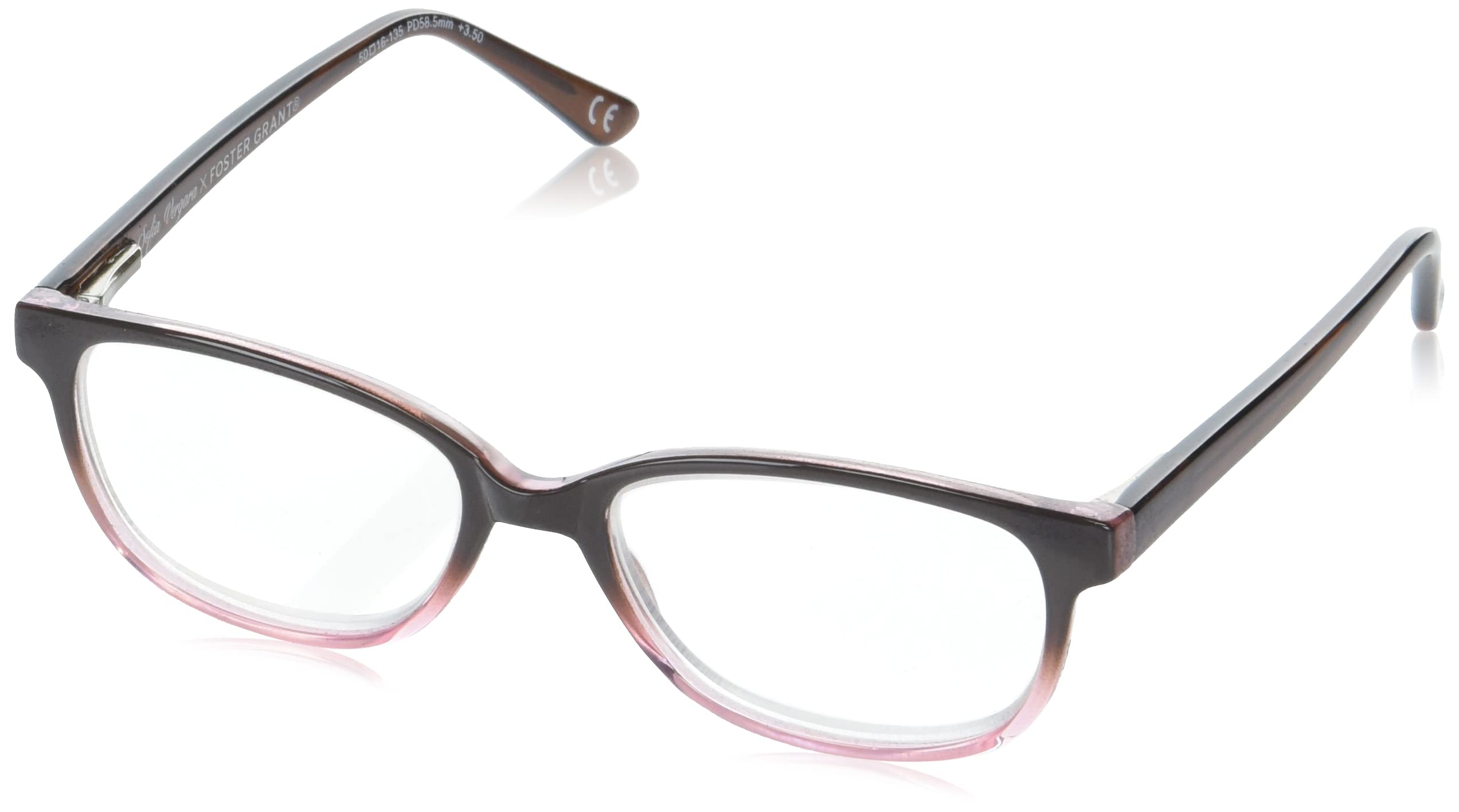
Foster Grant’s collaboration with Sofia Vergara produced a line of reading glasses that leans toward fashion-forward frames rather than clinical-looking drugstore readers. The Alicia model in Brown Lilac at 3.5x magnification sits at the stronger end of the ready-made reader spectrum, which makes it worth examining for anyone whose near vision has deteriorated past the point where +2.00 or +2.50 still works. At this strength, the frame’s styling matters less than whether the optics and fit hold up during sustained reading.
The frame itself combines a brown front with lilac accents, a two-tone treatment that reads as understated in person rather than loud. The shape is a rounded rectangle with a slightly upswept brow line, and the temples carry a subtle decorative element near the hinge. Construction is plastic, as expected at this price tier, and the overall weight is light enough that most wearers will forget they have them on during a long session with a book or tablet. Spring hinges are present, which helps the frame tolerate the on-and-off cycle that readers typically put glasses through dozens of times a day.
Where the Alicia earns its place is in real-world reading scenarios. At 3.5x, these are not glasses for glancing at a menu or checking a phone notification — that strength is meant for close work: reading fine print, threading a needle, examining labels, or working through a paperback for an extended stretch. The magnification is strong enough that the comfortable reading distance shortens noticeably, typically landing somewhere around 8 to 10 inches from the eye. Users coming from a +2.50 will notice they need to hold material closer than they’re used to, and that adjustment takes a few days.
Optically, the lenses are decent for a mass-market reader. They’re clear acrylic with a modest anti-scratch coating, and distortion toward the edges is present but not egregious. As with virtually all single-vision readers at this magnification, there’s a visible sweet spot in the center of each lens, and text toward the periphery softens. That’s inherent to the category rather than a flaw specific to Foster Grant, but at 3.5x the effect is more pronounced than at lower strengths, so readers who move their eyes rather than their heads across a page may find the edges distracting.
- Magnification: +3.5 diopters, suited to fine close work rather than casual reading
- Frame: Plastic with spring hinges; brown front, lilac temple accents
- Lenses: Acrylic with basic scratch-resistant coating; no blue-light filter
- Fit: Standard medium-width frame; lens width roughly in line with typical women’s readers
- Included: Matching case, though the case is soft-sided and offers limited protection
The most significant trade-off is the strength itself. Ready-made readers at +3.50 are a narrower market than the +1.00 to +2.00 range, and the jump from +3.25 to +3.50 can feel larger than the numbers suggest. Anyone whose prescription sits between standard increments, or who has astigmatism significant enough to warrant cylinder correction, will likely find these unsatisfying — an optician-fitted pair with a proper prescription and measured pupillary distance will outperform any over-the-counter reader at this magnification. That’s not a knock on Foster Grant specifically; it’s the ceiling of the category.
Compared with a dedicated prescription pair from an optical shop, the Alicia is considerably cheaper and available immediately, which is the point of ready-made readers. Compared with budget no-name readers from a pharmacy bin, the frame quality and hinge construction are a step up, and the styling is more deliberate. Compared with other designer-collaboration readers, it sits in the same middle ground: nicer than generic, not built like premium eyewear.
These glasses suit someone who needs strong magnification for close tasks, wants a frame that looks intentional rather than medical, and is comfortable with the limitations of single-vision readers. They’re also a reasonable backup pair to keep in a drawer or bag for prescription wearers. They are not suitable for anyone who needs bifocals or progressives, anyone with a meaningful astigmatism correction, or anyone who primarily needs mid-range magnification for computer work — +3.50 is too strong for a monitor at arm’s length and will cause eye strain if used that way. Buyers should also confirm their needed strength with a simple reading test before committing, since the return process on a wrong-strength reader is an avoidable hassle.