
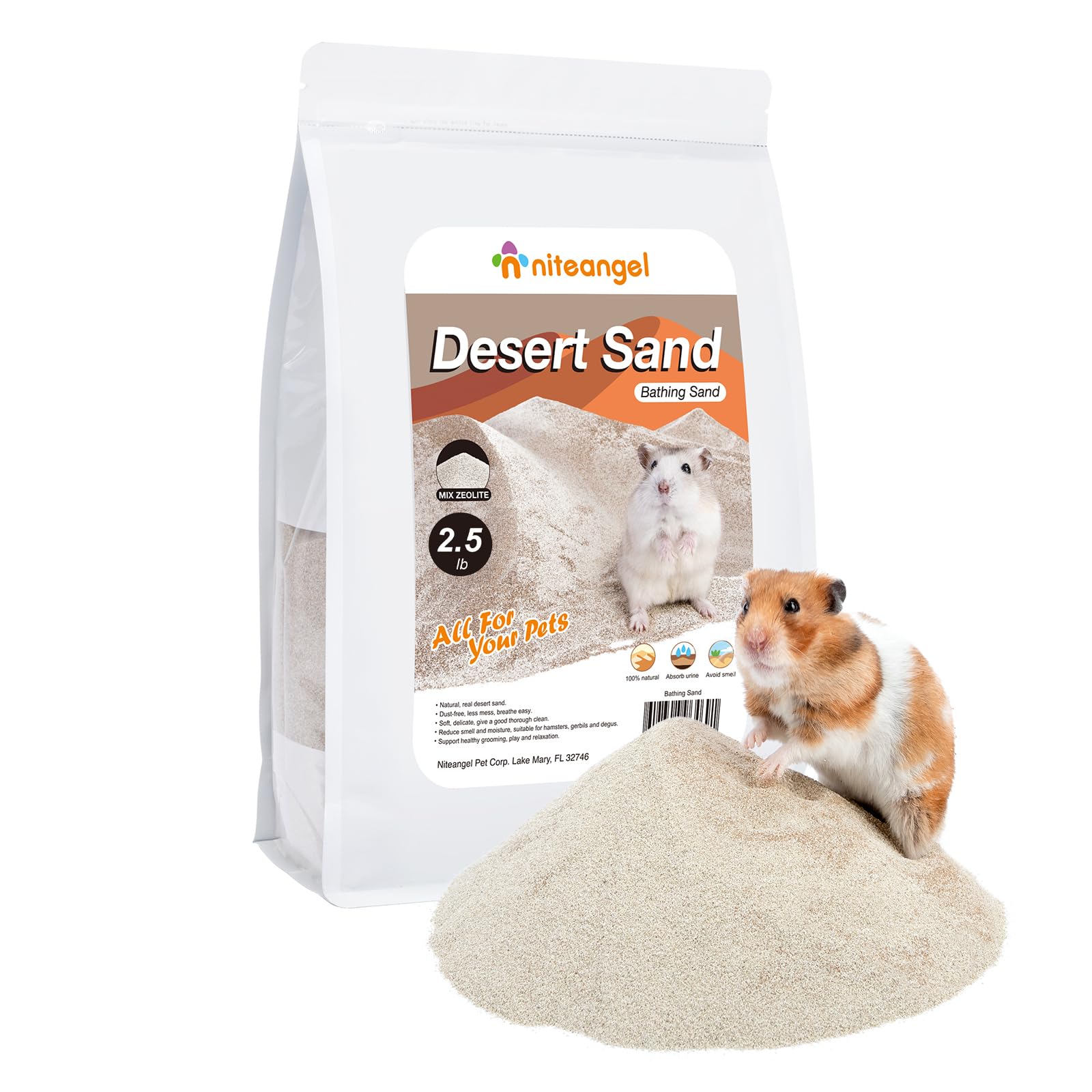
Sand baths have become a standard part of hamster care, and the Niteangel Desert Bath Sand is one of the more widely available options for owners who want a ready-to-use substrate rather than mixing their own. It is sold as a 2.5 lb (40 oz) bag of desert sand blended with zeolite particles, marketed for hamsters, chinchillas, gerbils, mice, degus, and other small pets. The intended uses are twofold: as a digging and dust-bathing material, and as a potty litter for pets that tend to urinate in one corner of the enclosure.
The product is a blend rather than plain sand. The desert sand component provides the fine grit that small pets roll and dig in, while the zeolite particles are included for their absorbent and odor-binding properties. That combination is what separates it from a bag of ordinary play sand, which is cheap but does nothing for smell and can be dusty if not washed and dried first. The bag is small enough to store easily but large enough that a single hamster setup will get several refills out of it, depending on how large a bath container is used.
In practice, most owners use this in a shallow dish or a small enclosed container placed inside the habitat. Hamsters, in particular, tend to use a sand bath both for grooming and as a toilet, which is why a product that doubles as litter makes practical sense. Gerbils and degus may dig more vigorously, so a deeper container with higher sides helps keep the sand contained. For chinchillas, a sand bath is a regular routine, though chinchilla owners often prefer larger volumes and may find a 2.5 lb bag runs out quickly if used as the primary bathing material.
The no-dust claim is the feature most buyers will care about, and it holds up reasonably well in normal use. The sand is fine but not powdery, and pouring it into a container does not produce the visible cloud that cheaper sands can. That matters for pets with sensitive respiratory systems and for owners who keep enclosures in living spaces. It is worth noting that any fine substrate can become airborne if a pet digs aggressively or if the bag is poured from a height, so the claim is best read as low-dust rather than dust-free in every circumstance.
The zeolite component is the more distinctive element. Zeolite is a porous mineral that absorbs moisture and traps ammonia, which is the main reason this works as a potty litter rather than just a bath. In a corner litter tray, it clumps slightly and holds odor better than plain sand, though it is not a clay clumping litter and should not be expected to perform like cat litter. Spot-cleaning soiled patches is still necessary, and the material should be replaced periodically rather than topped up indefinitely.
- Format: 2.5 lb (40 oz) resealable-style bag of desert sand blended with zeolite particles
- Intended pets: hamsters, chinchillas, gerbils, mice, degus, and similar small species
- Primary uses: sand bath, digging substrate, corner potty litter
- Dust level: low in normal handling, though not entirely dust-free
- Odor control: moderate, thanks to the zeolite fraction
The main trade-off is cost relative to plain sand. A bag of children’s play sand or a bulk bag of reptile sand costs far less per pound, and for a single hamster the difference is not enormous but adds up over a year of regular changes. The zeolite blend earns part of that back through odor control and convenience, but owners with many animals or large chinchilla setups may find the small bag size and per-pound price hard to justify as an everyday staple. It is also not a substitute for proper cage cleaning; it reduces smell in a localized area but will not compensate for an enclosure that is overdue for a full change.
Compared with generic play sand, the Niteangel product is more consistent in texture and requires no washing or baking before use, which is the real convenience argument. Compared with paper-based small pet litter, it offers a more natural digging experience and is closer to what these species encounter in the wild, but it is heavier, messier if kicked out of the container, and not flushable. Compared with dedicated chinchilla dust, it is less powdery, which some owners prefer and others find less effective for chinchilla coats, since chinchillas typically need a finer dust to properly clean their fur.
This sand suits hamster owners who want a single product for both bathing and litter, keepers of gerbils and degus who want a low-dust digging medium, and anyone who values convenience over buying raw sand and preparing it. It is less suitable for chinchilla owners who need a fine dust bath in quantity, for large multi-pet households watching substrate costs, and for anyone expecting a clumping litter that can be scooped like cat litter. Used within those expectations, it is a practical, well-behaved substrate rather than a transformative one.