
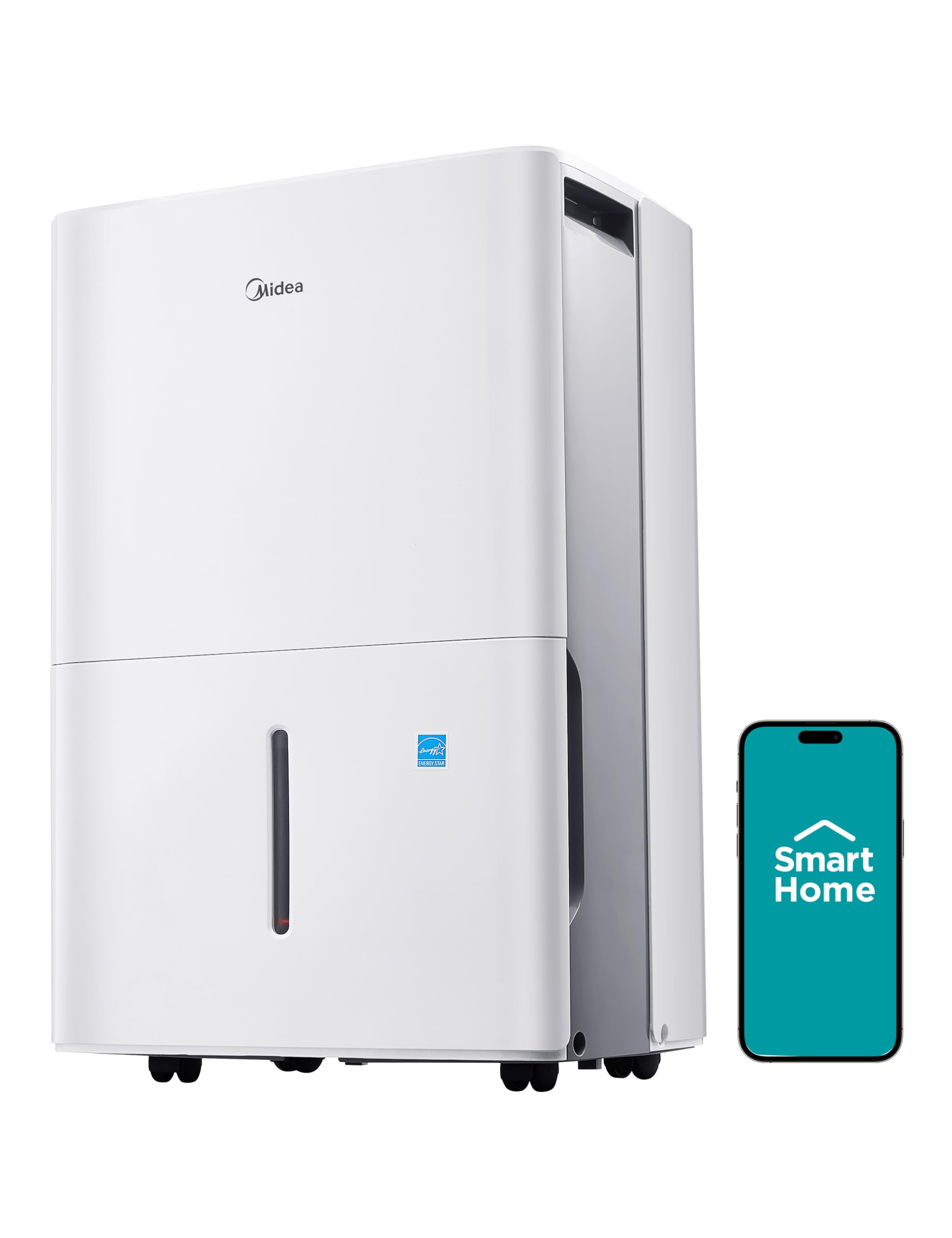
The Midea 50-pint dehumidifier is aimed at homeowners dealing with persistent moisture in basements, crawl spaces, or large rooms up to 4,500 square feet. It’s a conventional refrigerant-based unit with a focus on capacity and energy efficiency, earning an Energy Star rating. In real-world use, it’s the kind of appliance you set up in a corner, hook up to a floor drain or empty its tank periodically, and largely forget about—until the humidity creeps back up. This review breaks down what you can expect from its features, performance, and where it might fall short.
At its core, the Midea does what a dehumidifier should: it pulls moisture from the air. The 50-pint capacity (measured at standard AHAM conditions of 80°F and 60% relative humidity) means it can remove up to 50 pints of water per day. In a typical damp basement, that translates to a noticeable drop in clamminess within a few hours of operation. The unit has a built-in humidistat that lets you set a target humidity level, and it will cycle on and off to maintain it. Many users appreciate the auto-restart feature after a power outage, which resumes operation with the previous settings—a small but practical touch.
For drainage, you have two options: a removable 1.6-gallon bucket or a continuous drain hose (included). The bucket is on the smaller side for a 50-pint unit, so in high-humidity conditions, you might find yourself emptying it once or twice a day. That’s a trade-off: a larger bucket would mean less frequent emptying but would add bulk and weight. The continuous drain option is more convenient if you have a floor drain nearby, but it requires a gravity feed, so the unit must be elevated or placed near a drain—not always possible in every basement layout.
Energy efficiency is a strong point. The Energy Star rating means it meets strict guidelines for energy use, and in practice, it consumes less power than older, non-rated models. However, like all refrigerant dehumidifiers, its efficiency drops in cooler temperatures. Below 65°F, the coils may frost up, and the unit will enter a defrost cycle, temporarily pausing moisture removal. For unheated spaces that drop below 60°F for extended periods, a desiccant dehumidifier might be a better fit, though those typically use more energy and have lower capacity.
Build quality is generally solid, but there are some compromises. The unit is on the heavier side (around 40 pounds) and has casters, which help with mobility but can be tricky on uneven floors. The fan is not the quietest—at higher speeds, it produces a noticeable hum that could be distracting in a living space. If you plan to run it in a finished basement or near bedrooms, you might want to consider a quieter model or run it during off-hours. The control panel is straightforward with a digital display and simple buttons, but the lack of smart features (no Wi-Fi or app control) might disappoint tech-savvy users. It does include a washable filter, which is easy to access and clean—a plus for maintenance.
In terms of real-world usage, this dehumidifier shines in large, open basements where humidity is a constant issue. It can handle the square footage claim under ideal conditions, but in practice, factors like open stairwells, frequent door openings, and poor insulation can reduce its effective coverage. For a typical 1,000–1,500 square foot basement, it’s more than capable. For a full 4,500 square feet, you’d likely need multiple units or a whole-house solution. It’s also useful for drying out after a minor leak or flood, but for severe water damage, professional equipment is recommended.
Compared to a desiccant dehumidifier, the Midea is more energy-efficient in warm conditions and has a higher moisture removal rate. Desiccant units, on the other hand, perform better in cold temperatures and are often lighter and quieter, but they consume more power and have lower capacity. If your basement stays above 65°F, the Midea is a sensible choice. If it’s consistently colder, you might want to look at a desiccant model or a low-temperature refrigerant unit.
Who is this for? It’s well-suited for homeowners with a damp basement or crawl space who want a set-and-forget solution with the option of continuous drainage. It’s also a good fit for those who prioritize energy efficiency and don’t mind a bit of fan noise. It’s not for someone looking for a whisper-quiet unit for a bedroom or living area, nor for those with unheated spaces that drop below 60°F. And if you need smart home integration or remote monitoring, you’ll have to look elsewhere.
Overall, the Midea 50-pint dehumidifier is a capable, no-frills appliance that does its job without unnecessary extras. It has its quirks—the small bucket, the noise, the temperature limitations—but for the price and capacity, it’s a reasonable option for many basements. Just go in with realistic expectations about coverage and maintenance.