
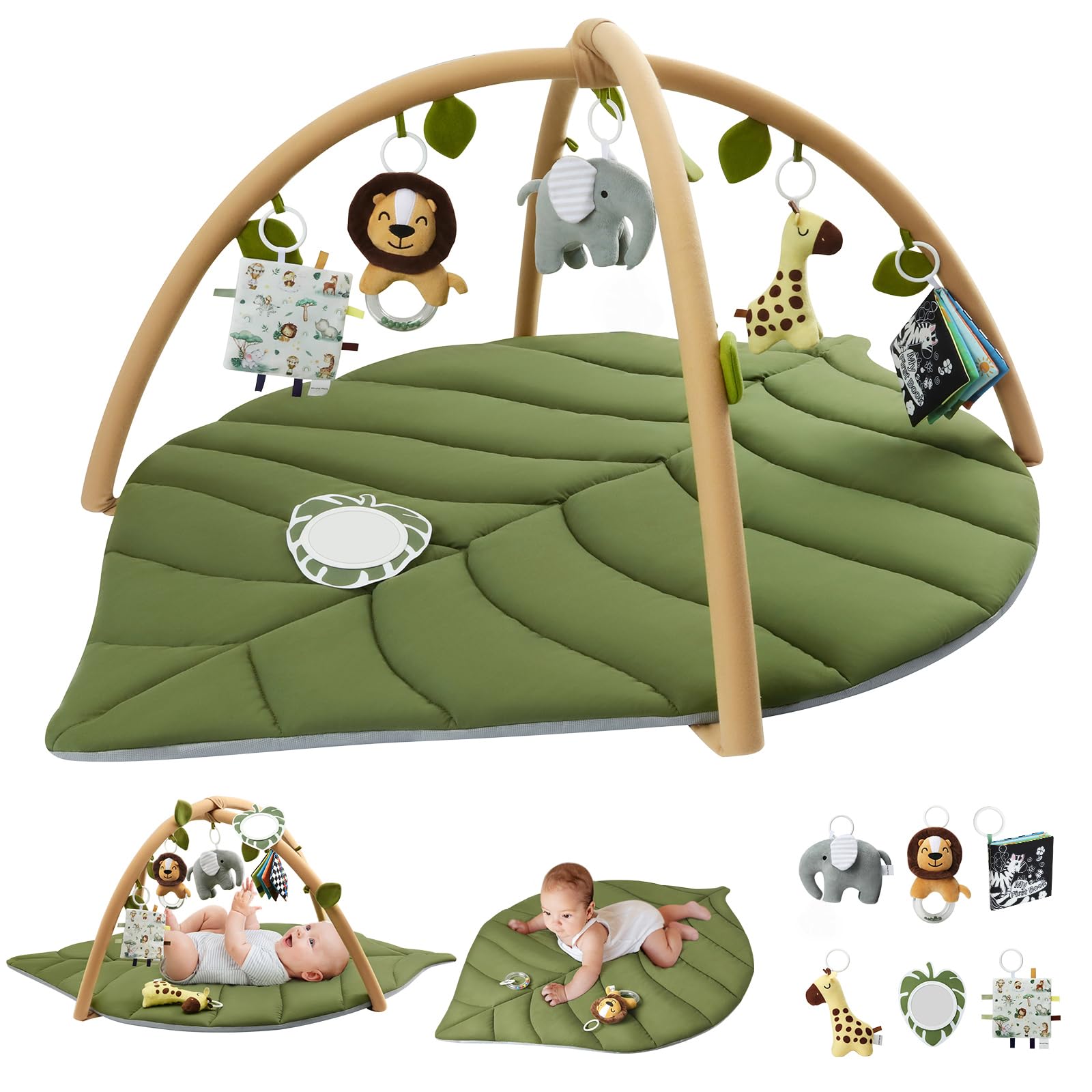
The Blissful Diary baby play gym is one of those products that looks, at first glance, like a decorative floor mat and only reveals its actual purpose once you start using it. The oversized leaf shape is the defining feature: it covers considerably more floor area than a standard rectangular activity mat, which matters more than it might seem. Parents typically lay it out in a living room or nursery and use it as a semi-permanent play zone rather than something they fold up after each session. In that role, the extra surface area means a baby can roll, scoot, and sprawl without immediately sliding onto bare floor.
The mat ships with an arched frame and six detachable toys that hang above the play surface. The toys are the part that tends to get the most use in the early months, since a newborn’s visual range is short and hanging objects at the right distance give them something to track. Because the toys detach, the setup can be simplified for younger babies (fewer hanging items, less visual clutter) and expanded as they gain the coordination to reach and bat at things. That adjustability is a practical detail rather than a marketing one, and it is the main reason this gym stays relevant past the first few weeks.
The leaf silhouette is also functional in a modest way. The pointed ends create natural zones: one end often ends up as the tummy-time spot, the other as a spot for lying on the back looking up at the toys. Whether that is intentional design or a happy accident, it gives the mat a bit of structure that a plain rectangle lacks. The surface itself is padded, which is what you want for tummy time, though it is not thick enough to substitute for a proper play mat on hard flooring. On tile or hardwood, most families will want something underneath it.
In real-world use, this is a mat that lives on the floor. It is not a portable item in any meaningful sense. The leaf shape is wide, the frame adds height, and moving it from room to room is a two-handed job. Families who want something they can toss in a diaper bag or take to a grandparent’s house will find this cumbersome. It is better understood as a fixed station: a defined place where the baby plays during awake windows, with toys already in position.
Assembly is straightforward but not instant. The frame pieces connect and the toys clip or loop on, and the whole thing takes a few minutes to set up the first time. The detachable toys are a genuine convenience for cleaning, since fabric and plastic parts that get mouthed can be wiped or washed separately. That said, the mat surface itself is the part that will collect spit-up, drool, and the general debris of infancy, and it is not as easy to clean as a simple machine-washable blanket. Spot cleaning is the realistic expectation, and darker or patterned versions will hide wear better than light ones.
Compared with a conventional play gym, which is usually a compact frame with a small mat underneath, this product leans much further toward being a floor mat with a gym attached. The trade-off is space. A standard gym tucks into a corner; this one claims a noticeable footprint. Compared with a plain padded play mat, it offers more stimulation out of the box thanks to the hanging toys, but a plain mat is more versatile once the baby starts crawling and no longer wants to lie under an arch. Many households end up owning both at different stages, and that is a reasonable way to think about it.
The motor-skill and sensory claims are the usual ones for this category, and they are broadly fair without being exceptional. Reaching for hanging toys does encourage hand-eye coordination, and the different textures and shapes provide something to explore. But any activity gym does this, and there is nothing here that meaningfully outperforms a simpler setup. The advantage is the size and the leaf shape, not the developmental science.
Who is this for? Primarily parents of newborns through the early sitting months who have floor space to dedicate and want a single, visually distinctive play area that doubles as tummy-time support. It suits households where the mat can stay put. It is less suitable for small apartments, for families who need portability, or for parents who prefer minimal baby gear. It is also not a long-term purchase: once a baby is mobile and crawling, the arch becomes an obstacle rather than an attraction, and the mat’s role shrinks to a floor pad. Expect a useful life of roughly the first six to nine months, which is typical for the category but worth being honest about.
The build quality is reasonable for the price bracket, though the frame is lightweight and will not survive being climbed on or repeatedly disassembled. Treat it as a stationary mat and it will hold up; treat it as rugged gear and it will not. As a gift for new parents, it is a sensible choice if you know they have space, and a questionable one if you do not. The leaf shape is the selling point, and it is a real one, as long as the room can accommodate it.