
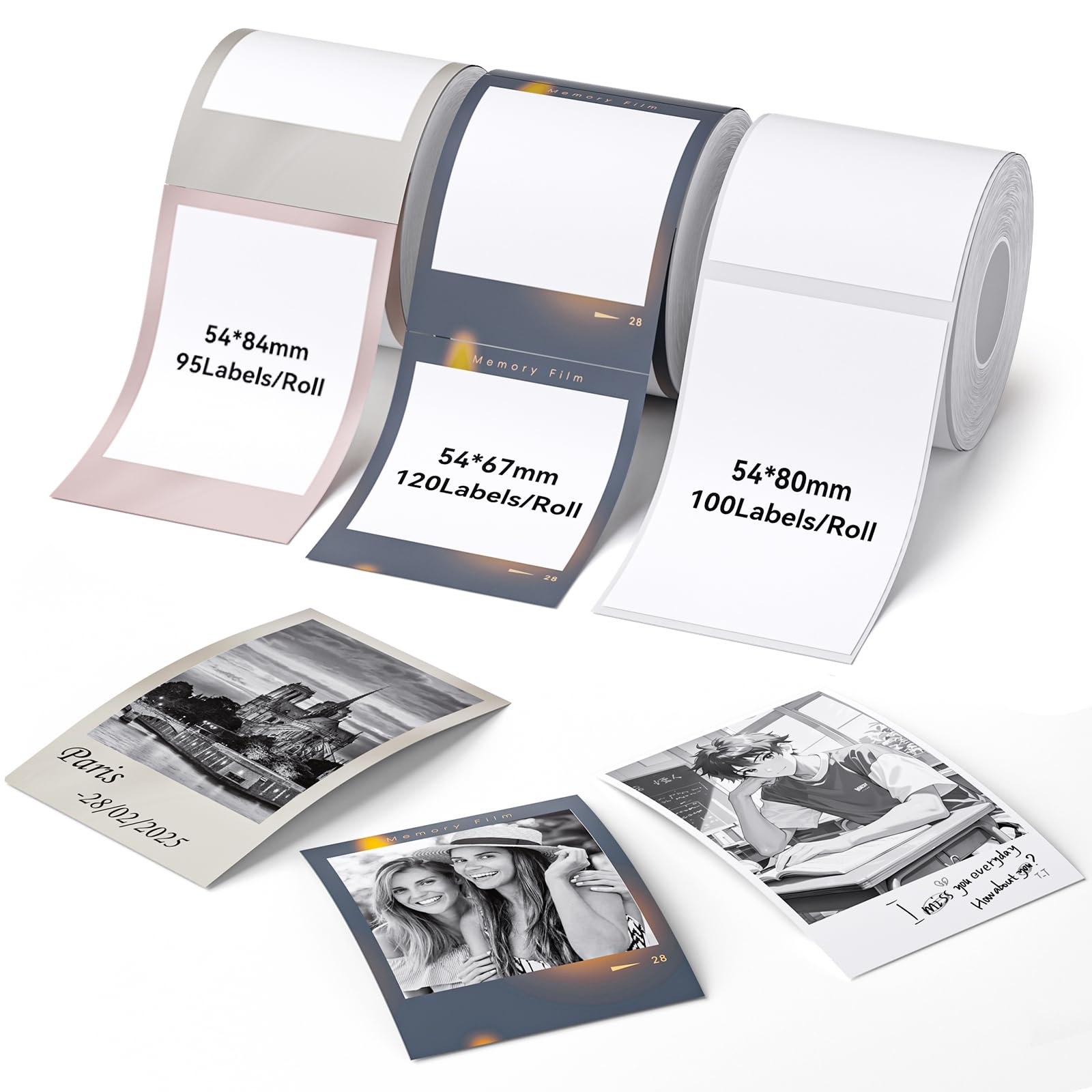
The NIIMBOT three-roll label set is a consumable pack rather than a standalone product, and that matters for how it should be judged. These rolls only work with compatible NIIMBOT thermal label printers, so the set is really an answer to a practical question: which label sizes do you actually need for everyday labeling? The pack bundles three formats — roughly 2″ x 3″, 2.1″ x 3.3″, and 2.1″ x 2.6″ — which covers a useful middle ground between tiny address labels and full shipping labels.
In real use, these rolls tend to end up in small offices, home workshops, retail back rooms, and classrooms. The 2″ x 3″ size is the closest to a standard address or mailing label, so it sees the most consistent use for envelopes, small parcels, and file folders. The 2.1″ x 3.3″ roll is slightly larger and works well for product labels, storage bin tags, and shipping labels on smaller boxes. The 2.1″ x 2.6″ format is the odd one out — it is close to a square, which makes it handy for jar lids, cable tags, and short content labels, but it is also the size most people will use least.
Functionally, these are direct thermal labels, meaning they rely on heat from the printhead rather than ink or toner. That has two consequences worth knowing before buying. First, there is no ink to run out, which keeps ongoing costs predictable. Second, direct thermal labels are sensitive to heat, sunlight, and abrasion over time. Labels applied to items that sit in a hot car, a sunny window, or a warehouse rack for years may fade or darken. For short-term labeling — shipping, inventory rotation, temporary signage — this is rarely a problem. For archival or long-term outdoor use, it is a real limitation.
The adhesive is a standard permanent type. It holds well on cardboard, paper, glass, and most smooth plastics, and it does not peel up at the corners under normal indoor conditions. On textured or dusty surfaces, adhesion drops off, as it does with most label stock in this class. The rolls are wound for the NIIMBOT feed mechanism, and users should expect the printer’s app to recognize the label size automatically; if a roll is loaded incorrectly or the app is set to the wrong template, alignment issues follow. That is a setup issue rather than a defect, but it is a common source of frustration for first-time users.
Compared with generic third-party thermal label rolls, the NIIMBOT set costs more per label. Generic rolls in similar sizes are widely available and often work fine, though compatibility and adhesive quality vary. The trade-off is convenience: this set is guaranteed to fit the printer, the sizes are pre-matched to common templates in the app, and there is no guesswork about whether a roll will feed correctly. Buyers who print heavily will likely find generic rolls more economical; buyers who print occasionally and value low friction will get more out of the branded set.
Label yield is another consideration. Because the rolls are relatively short compared with bulk commercial rolls, frequent users will go through them quickly. Someone printing dozens of shipping labels a week may find the pack runs out faster than expected, which pushes the effective cost per label up. Occasional users — a few labels a day or a burst of labeling during a move or inventory count — will find the quantity reasonable.
Who is this for? It suits home users, small business owners, crafters, and office administrators who already own a compatible NIIMBOT printer and want a mixed-size starter or refill pack without buying three separate rolls. It is also a sensible choice for anyone unsure which size they need, since the pack lets them test all three formats in real conditions. Who is it not for? Anyone without a NIIMBOT printer, obviously, and anyone who needs weather-resistant, long-life labels for outdoor or high-heat environments. High-volume printers will likely be better served by bulk generic rolls or a larger commercial label system.
Overall, the set is a practical, no-surprises consumable. It does not reinvent labeling, and the per-label cost is not the lowest available. What it offers is compatibility and a sensible size mix, with the main caveats being direct thermal’s limited durability and the premium over generic stock. For moderate, indoor labeling tasks, those trade-offs are easy to accept.