
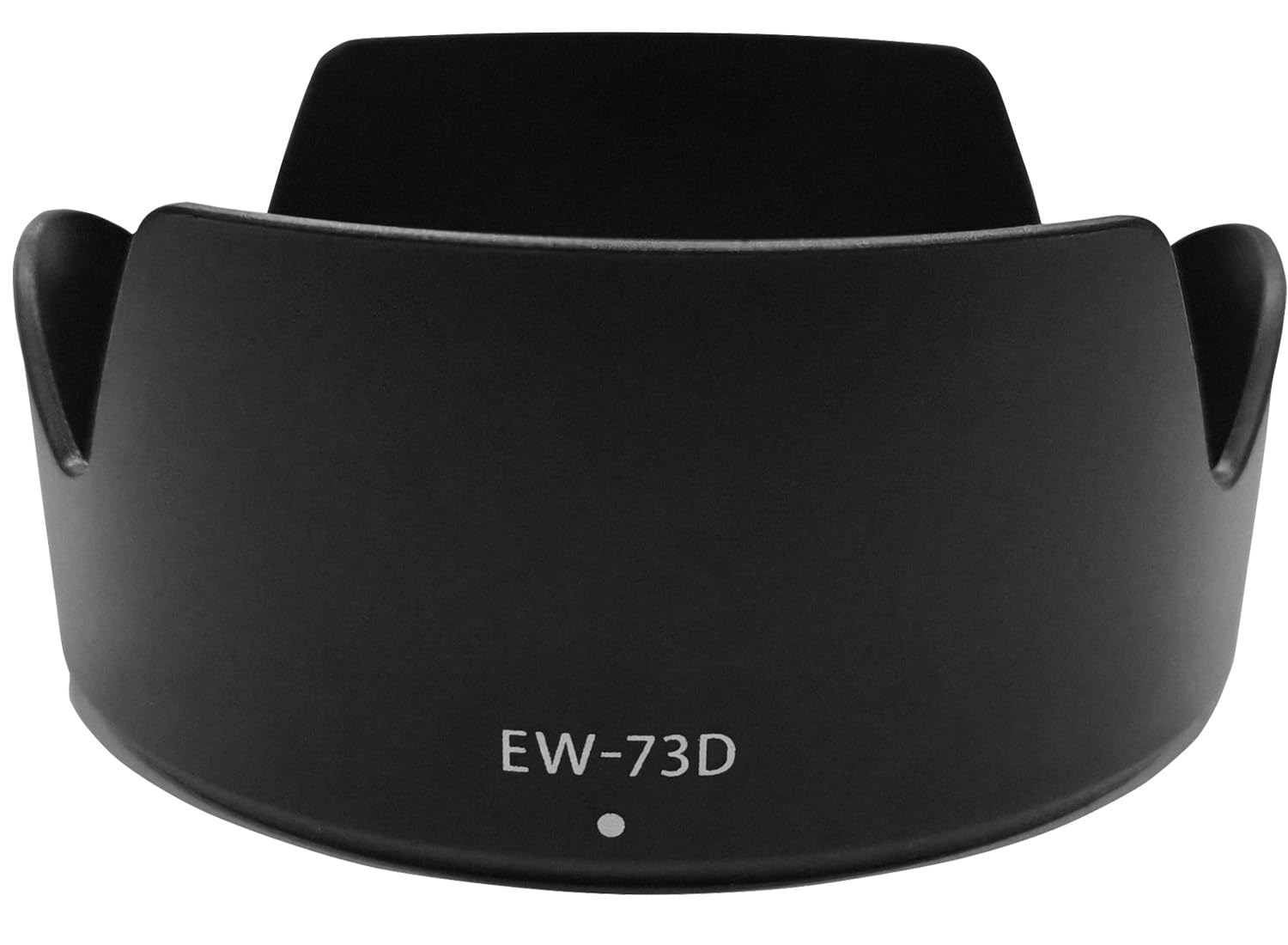
The EW-73D lens hood is a small, unglamorous accessory that tends to get bought after the lens itself, usually once the first flare-ruined shot or stray fingerprint on the front element makes the case for it. It’s designed for the Canon RF 28-70mm F2.8 IS STM, and the same part number is commonly listed for the older RF 28-70mm F2L USM. That dual listing is worth noting up front, because it says something about how this hood is positioned: it’s a generic-fit accessory rather than a precision-matched piece of Canon OEM hardware, and buyers should read the listing carefully before assuming a perfect match to their specific lens.
In practice, a hood like this gets used in fairly ordinary situations. Shooting outdoors on a bright day, the sun sits just outside the frame and the front element picks up veiling flare that flattens contrast. At a crowded event, the hood provides a physical buffer between the front glass and whatever bag, strap, or elbow is nearby. And when the camera hangs at your side between shots, the hood keeps fingers and jacket fabric off the coating. Those are the real jobs, and none of them require exotic engineering. What matters is fit, rigidity, and whether the hood stays put when you don’t want it in the way.
Functionally, this is a petal-style bayonet hood. It mounts by twisting onto the lens’s front bayonet thread and is shaped to avoid vignetting at the wide end while still shielding the longer end of the zoom range. Petal hoods are the sensible choice for a zoom like the 28-70mm, since a round hood would either intrude into the corners at 28mm or be too shallow to do much at 70mm. The reversible design is the other key feature: the hood can be flipped backward and stored on the lens barrel, which is how most people carry it when the camera goes back in the bag. That reversibility is standard for this category, and it’s the reason a hood this size doesn’t become a permanent nuisance.
Build quality is where expectations should be calibrated. Third-party hoods at this price point are typically molded plastic, and the differences from an OEM hood show up in small ways: slightly more flex in the petals, a bayonet mount that may engage with a bit more or less friction than the original, and interior surfaces that may or may not be as thoroughly matte-finished. A glossy or semi-gloss interior can reduce the hood’s effectiveness by bouncing light toward the front element rather than absorbing it, so it’s worth checking the inside surface when the hood arrives. None of this makes the hood unusable, but it does mean the fit and finish won’t feel identical to a Canon-branded part.
The most significant trade-off is fit uncertainty. Because the EW-73D is listed against two different lenses with different front-end designs, the actual bayonet engagement can vary between units and sellers. A hood that mounts cleanly on one copy may sit slightly loose or require more force on another. A loose hood can rotate out of position or, worse, work itself free, and a hood that’s too tight is awkward to reverse quickly when you’re switching between shooting and packing up. Buyers should expect to test the mount immediately and be prepared to return it if the fit is poor. This is the main reason some photographers simply pay more for the OEM hood, which is matched to a single lens and generally seats with predictable tension.
Compared with alternative approaches, the calculus is straightforward. A collapsible rubber hood is more forgiving of bumps and folds flat for storage, but it offers less consistent shading across a zoom range and can sag over time. A plain UV or clear filter protects the front element but does nothing for flare, and stacking filters behind a hood can introduce its own vignetting issues at 28mm. The rigid petal hood remains the most effective general-purpose option for this lens, provided the fit is right. The EW-73D sits at the budget end of that category, which is appropriate for what it is.
Who is this for? Primarily photographers who want basic flare control and front-element protection without spending OEM prices, and who are willing to verify fit on arrival. It suits casual and enthusiast shooters who mostly work outdoors or in mixed lighting and who keep the hood reversed in the bag. It’s also a reasonable spare or replacement if an original hood has been lost. Who is it not for? Anyone who needs guaranteed, lens-specific fit and consistent build quality, particularly professionals relying on the gear daily, will likely be better served by the Canon original. Similarly, buyers who rarely shoot toward light sources or who always use a filter for protection may find a hood adds bulk for little practical gain.
The honest summary is that this is a functional, inexpensive accessory with a real caveat around fit. It does the job a hood is supposed to do, and it costs little enough that the risk is modest. But it isn’t a precision part, and treating it as one will lead to disappointment. Check the mount, check the interior finish, and keep the packaging until you’re satisfied it seats properly on your lens.