
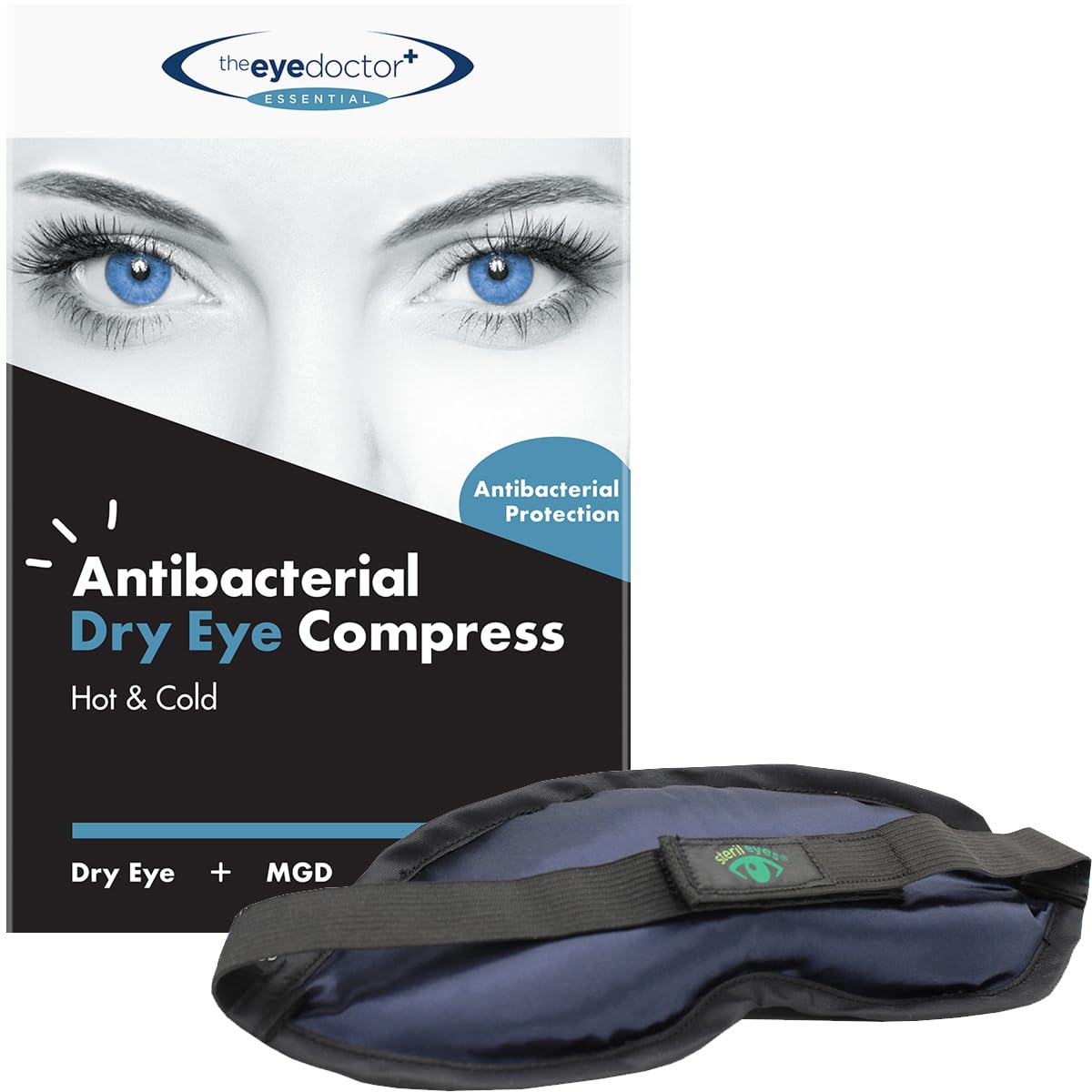
Heated eye masks occupy a small but useful niche: they are one of the few at-home tools recommended by eye care professionals for managing meibomian gland dysfunction, a common contributor to dry eye, and for loosening crusted debris along the lash line in blepharitis. The Eye Doctor Hot Compress is a reusable microwave-heated mask aimed at that job. It is not a gadget with temperature controls or timers, and it does not pretend to be. The question is whether its simpler approach holds up in daily use.
The mask is a fabric-covered compress filled with a heat-retaining material, shaped to sit across both closed eyes and the surrounding orbital area. You heat it in a microwave, check the temperature, and wear it for roughly five to ten minutes. That is the entire workflow. For anyone treating dry eye or blepharitis on a recurring basis, the appeal is obvious: no batteries, no charging cable, no app, and nothing to replace except eventually the mask itself.
What it actually does well
In practice, the value of a warm compress comes down to two things: whether it delivers consistent, safe heat and whether it stays in place long enough to be useful. The Eye Doctor mask is contoured rather than flat, which helps it rest against the brow and cheekbones instead of sliding down the face. The fabric backing is soft enough for extended contact, and because it is reusable, the cost per use drops quickly compared with disposable warming pads.
The heat itself is the standard microwave-compress trade-off. You control duration by heating time, and the material holds warmth reasonably well for a short session. For the intended use—softening oils in the eyelid glands or loosening crusts before lid hygiene—a few minutes of gentle warmth is generally what matters, not precise temperature regulation.
Where it falls short
The main limitation is temperature consistency. Microwaves vary enormously in power, and the mask does not indicate its surface temperature. The instructions typically call for short heating intervals and testing before applying, and that caution is not decorative: overheated compresses are a genuine burn risk, particularly for anyone with reduced skin sensation or diabetes. Users need to be disciplined about reheating in increments and checking against the wrist or inner forearm first.
Heat retention is also finite. The mask is warmest in the first few minutes and cools gradually, so a full ten-minute session becomes lukewarm toward the end. Some users reheat midway; others simply accept a shorter effective window. Either way, it is less controlled than an electrically heated mask with a thermostat, which maintains a steady temperature for as long as it is plugged in.
There are practical annoyances too. The fabric cover is not removable on this model, so cleaning is limited to surface wiping, which matters for a product used near the eyes and lashes. Over months of use, that is a hygiene consideration worth weighing. The mask is also not sleep-friendly—it is a treatment tool, not something to wear overnight.
How it compares
The closest alternative category is the electric heated eye mask, which plugs in via USB and holds a set temperature for a fixed timer period. Those cost more and add a cable, but they remove the microwave guesswork and the cooling curve. Disposable warming eye pads are the other option: more convenient and hygienic, but ongoing cost adds up and the heat output is usually milder. The Eye Doctor compress sits in the middle—cheaper than electric over time, more substantial than disposable pads, but dependent on the user to manage heat safely.
Who it suits
This mask makes sense for people with a diagnosed dry eye or blepharitis routine who want a low-cost, cord-free compress they can use at home once or twice a day. It is also reasonable for occasional use during a stye or a flare-up, provided the user follows heating instructions carefully. It is less suitable for anyone who wants set-and-forget temperature control, people with reduced facial sensation who may not reliably detect excess heat, or households where the microwave settings are unpredictable and the user is not meticulous about testing. Children should only use it under adult supervision.
Overall, the Eye Doctor Hot Compress is a functional, unglamorous tool that does a modest job well enough if used with care. It rewards routine and caution more than it rewards convenience.