
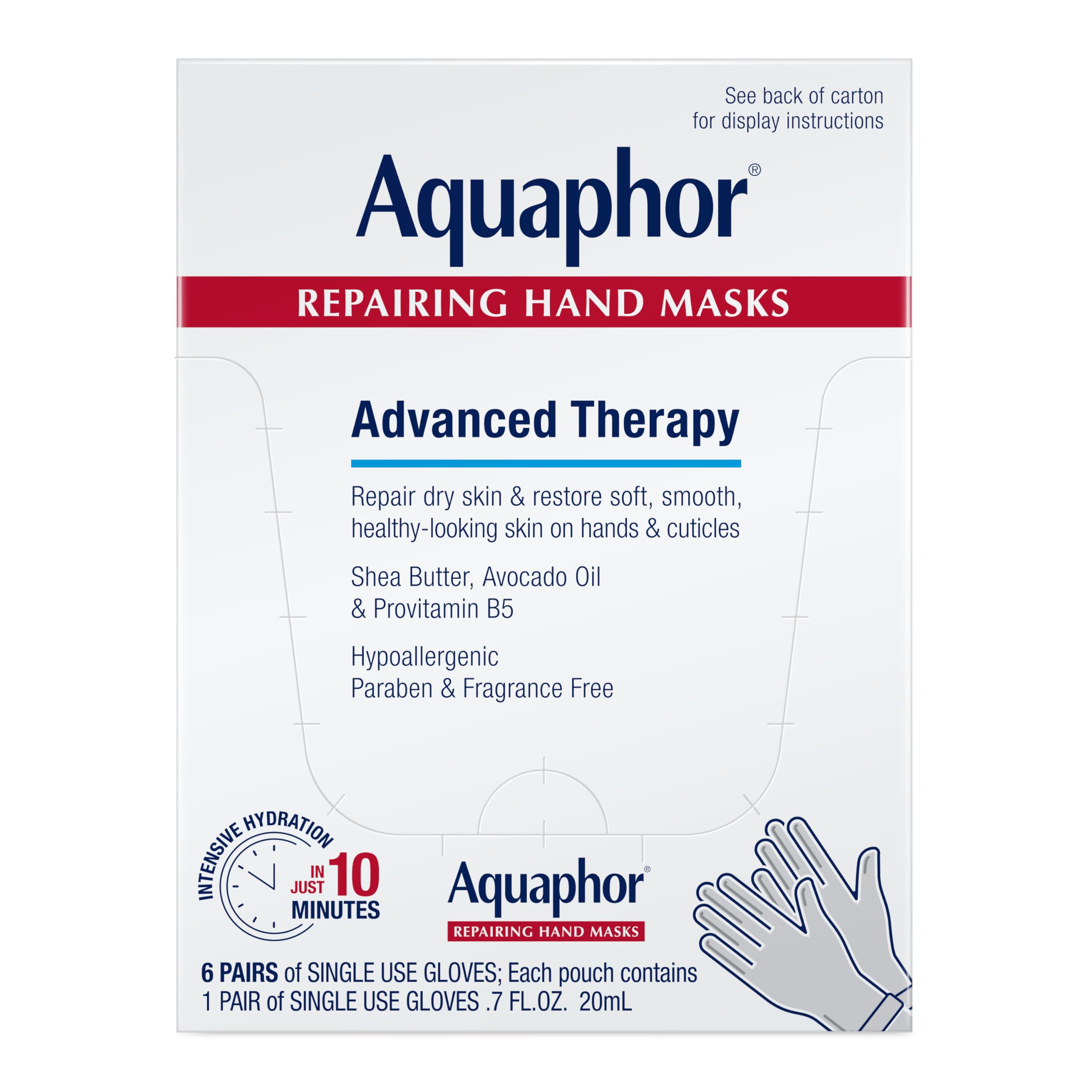
Hand masks occupy an odd spot in the skincare aisle. They promise the focused treatment of a sheet mask without the awkwardness of walking around with wet fingers, and Aquaphor’s entry into this category leans on the brand’s established reputation for occlusive, barrier-focused formulas. The Advanced Therapy Repairing Hand Masks come as six individually wrapped pairs, each holding 0.7 fluid ounces of product, and they are positioned as an intensive treatment for dry, rough, or compromised hands rather than a daily moisturizer.
The format itself is straightforward. Each package contains a pair of glove-style masks lined with a thick, emollient cream. You tear open the packet, slide the gloves on, and leave them for a set period—typically around ten to fifteen minutes according to the packaging instructions—before removing them and working any remaining product into the skin. There is no rinsing step, which matters for anyone who has used clay or acid-based hand treatments that require cleanup. The gloves are ambidextrous in practice, though the fit is loose enough that they will slide around on smaller hands.
What distinguishes this product from a standard tube of Aquaphor Healing Ointment is really the delivery method, not the chemistry. The formula relies on the same general approach the brand is known for: petrolatum and glycerin forming an occlusive layer that limits water loss while humectants draw moisture into the upper layers of the skin. The glove format traps body heat and prevents the product from rubbing off onto clothing or surfaces, which is the main functional argument for buying masks instead of simply applying a thick cream at night. In practice, the warmth does seem to help the product absorb rather than sit on top of the skin, and the residue after removal is noticeable but not greasy enough to interfere with using a phone or keyboard once it settles.
Real-world use cases are fairly specific. These make the most sense after periods of cumulative exposure—winter weather, frequent handwashing, handling cardboard or cleaning products—or as a pre-event treatment before a situation where rough cuticles and dry knuckles would be visible. They are also a reasonable option for people who find overnight hand creams impractical because they dislike the sensation of coated hands against bedding. The single-use packaging makes them easy to keep in a drawer or travel bag, and there is no risk of a tube splitting or leaking in a purse.
Performance expectations should be calibrated. A single fifteen-minute session produces a temporary softening effect that is visible the same day, particularly around the knuckles and fingertips, but it does not replace consistent daily moisturizing. Users who expect a mask to undo weeks of neglect in one sitting will be disappointed; the improvement is real but incremental, and it fades within a day or two without follow-up care. The effect is closest to what you would get from slathering on a heavy ointment and covering your hands with cotton gloves overnight, which is a useful comparison point. That DIY approach costs far less per treatment, though it is less convenient and requires planning.
The most obvious limitation is cost and waste. Six pairs work out to a per-use price that is substantially higher than a comparable amount of bulk ointment, and each session generates a foil packet and a pair of plastic-lined gloves that go straight into the trash. For regular use—say, twice a week through winter—the expense and packaging add up quickly. The fit is another minor issue: the gloves are one-size, and on smaller hands the excess material bunches at the wrists, which can let air in and reduce the warming effect. People with larger hands may find the gloves tight across the palm.
Compared with the broader category of hand creams and ointments, these masks are a convenience product rather than a superior formula. A standard barrier cream applied nightly will deliver comparable or better cumulative results for most people at a fraction of the cost. Where the masks earn their place is in situations where the ritual itself helps—forced downtime, a travel day, a post-yard-work recovery session—or for people who simply will not remember to apply cream otherwise. Compared with paraffin wax treatments done in a salon, they are cheaper and far more accessible, though the results are less dramatic.
These are best suited to people with genuinely dry or irritated hands who want an occasional intensive treatment and value the convenience of single-use packaging. They are also a sensible gift or stocking stuffer for someone who works with their hands. They are not a good fit for anyone looking for a daily moisturizer, for people sensitive to fragrance or petrolatum-derived ingredients, or for those trying to reduce disposable plastic in their routine. Anyone with a tight budget will get more value from a large tub of ointment and a pair of cotton gloves. Treated as an occasional supplement rather than a staple, the masks do what they claim, just not more than that.