
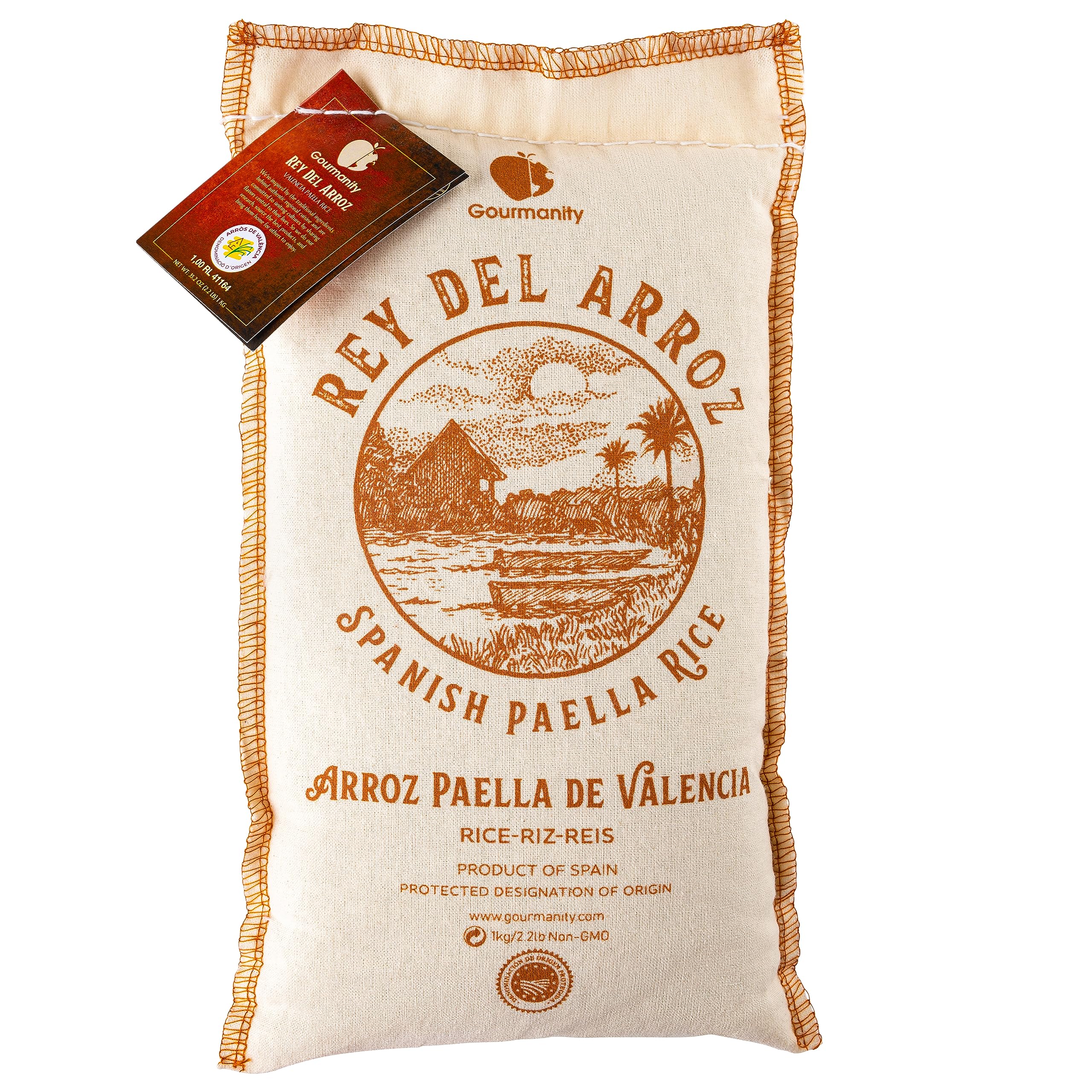
Gourmanity’s Spanish paella rice is a short-grain Valencia-style rice sold in a 2.2-pound bag, positioned for home cooks who want to make paella without hunting down specialty imports. Valencia rice is the traditional choice for paella for a reason: the short, plump grains absorb liquid and flavor well while staying distinct rather than turning gluey, which is the failure mode most people run into when they substitute ordinary supermarket rice.
The bag doesn’t specify a region of origin beyond Spain, and it doesn’t carry a Denominación de Origen designation like some premium paella rices do. That’s worth noting if you’re comparing it against D.O.arròs de València or similar certified products. For most home cooks, though, the practical difference is small; the bigger variable is technique.
In use, this behaves the way you’d expect short-grain paella rice to behave. It takes on color from sofrito and saffron, holds up to the relatively high liquid-to-rice ratio paella requires, and finishes with a texture that’s tender but still has a little bite if you pull it at the right moment. The grains are short and rounded rather than long and slender, so the finished dish reads as paella rather than as a pilaf. It also works for other Spanish rice dishes such as arroz negro or arroz caldoso, and it’s serviceable for risotto-adjacent cooking, though it isn’t a substitute for carnaroli or arborio if you’re chasing a specific risotto texture.
The 2.2-pound bag is a reasonable size for a household that makes paella a few times a year. It’s enough for roughly four to six paella pans depending on serving size, which means it’s likely to sit in the pantry for a while between uses. Rice keeps well if stored airtight and away from moisture, but it does lose some aroma over many months, so buying a smaller quantity more often is arguably the better strategy if you cook paella rarely.
Where this rice falls short is in the details that matter to more serious cooks. There’s no harvest date or milling date on the packaging, which makes it hard to judge freshness, and freshness does affect how much liquid the rice absorbs. The bag is also fairly plain; it’s a straightforward polyethylene-style package rather than a resealable one, so you’ll want to transfer the rice to a jar or canister once opened. These are minor issues, but they’re the kind of thing that separates a commodity bag of rice from a carefully sourced one.
Compared with generic medium-grain rice from the supermarket, this is a clear step up for paella specifically. Medium-grain rice can work in a pinch, but it tends to be less absorbent and can go from al dente to mushy faster. Compared with premium D.O.-certified València rice, Gourmanity sits a tier below on provenance and probably on consistency, though the gap in the finished dish is narrower than the price difference might suggest. It’s also not the right choice if you’re making sushi, jasmine rice dishes, or anything that calls for long-grain rice; the starch profile is wrong for those applications.
This rice is best suited to home cooks who make paella occasionally and want a dependable, reasonably priced short-grain rice without ordering from a specialty Spanish importer. It’s also fine for anyone exploring Spanish cooking more broadly and wanting a single bag that covers paella, arroz caldoso, and similar dishes. It is less suitable for professional or competition-level paella cooks who care about certified origin and harvest dates, and it’s not a general-purpose pantry rice if your cooking leans toward Asian or Indian cuisines.
Realistic expectations matter here: this rice won’t make a bad paella good, and it won’t rescue a cook who drowns the pan in stock or stirs it like risotto. What it does is remove one variable from the equation. If your technique is sound, the rice performs. If it isn’t, no bag of Valencia rice will fix that, and the packaging gives you little information to troubleshoot with. Treat it as a solid mid-tier ingredient rather than a premium one, and it does its job without drama.