
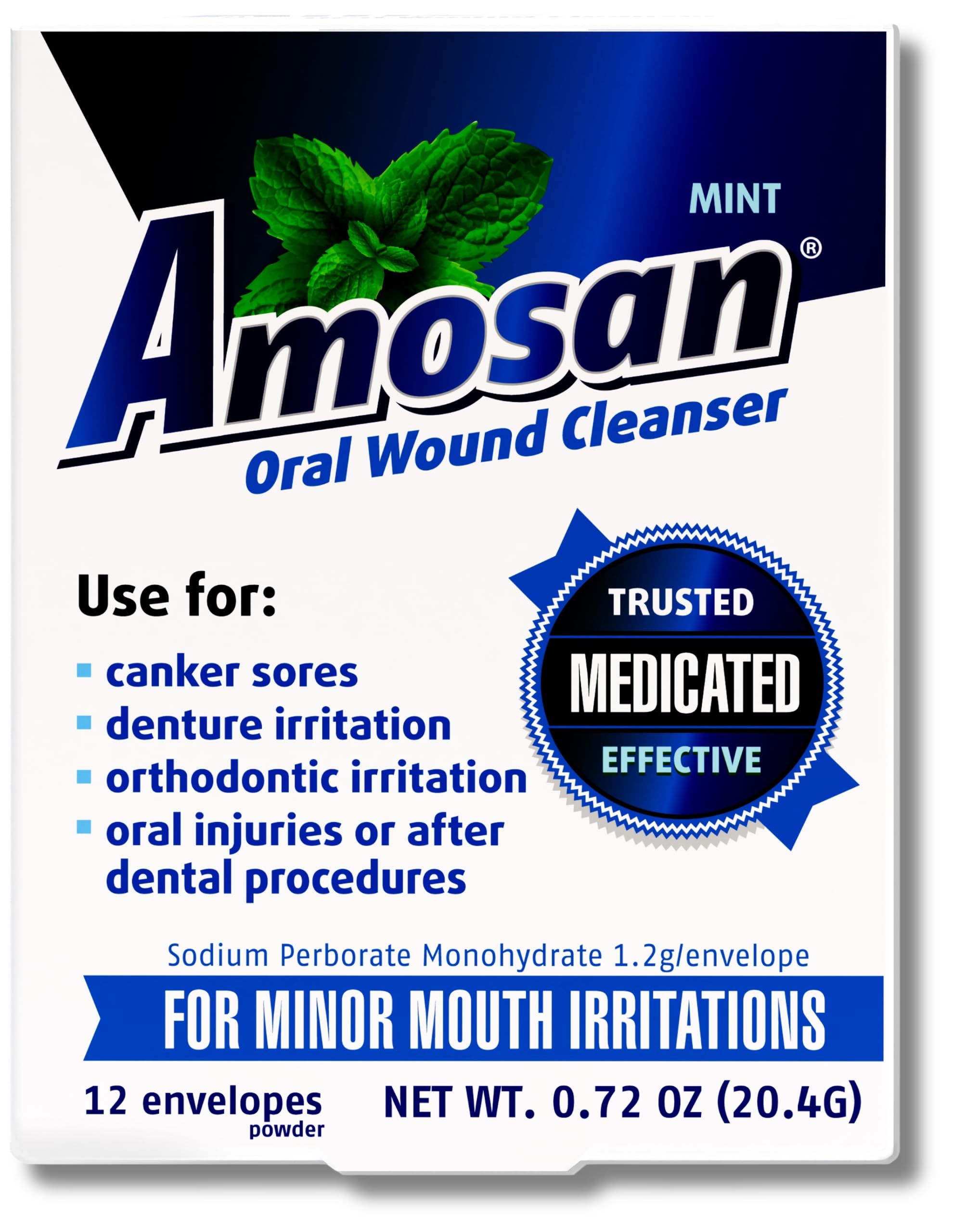
Oral wounds—whether from a biopsy, a lost filling, or a stubborn canker sore—present a unique challenge: the mouth is a moist, bacteria-laden environment that’s constantly in motion. Amosan Oral Wound Cleanser is a prescription-strength rinse designed for these situations, using a sodium perborate-based formula to mechanically cleanse and oxygenate damaged tissue. It’s not a mouthwash in the conventional sense; it’s a targeted wound-care product that sits somewhere between a first-aid antiseptic and a professional dental rinse. In this review, we’ll look at how it’s actually used, what it does well, and where it falls short.
Amosan has been around for decades, originally as a treatment for trench mouth and other acute oral infections. Today, it’s most commonly recommended by dentists and oral surgeons for short-term use after procedures like tooth extraction, periodontal surgery, or laser treatment for oral lesions. The product comes as a powder that you dissolve in warm water—typically one packet in about 4 ounces—and then swish for 30 seconds to a minute, up to four times daily. The effervescent action is key: as the powder dissolves, it releases oxygen bubbles that help lift debris from the wound surface and create an environment less favorable to anaerobic bacteria.
From a functional standpoint, the oxygenating mechanism is the main event. Sodium perborate breaks down into hydrogen peroxide and sodium borate in water, and that fizzing action is what distinguishes Amosan from a simple saline rinse. In practice, users report a mild stinging or tingling sensation, especially on open wounds, which is expected given the peroxide release. The taste is often described as salty and slightly metallic—not pleasant, but tolerable for the short contact time. The powder format also means you can adjust the concentration slightly by using more or less water, though the manufacturer’s instructions should be followed for safety.
One of the more practical aspects of Amosan is its portability. The individual packets are small and lightweight, making them easy to stash in a bag or travel kit. That’s a contrast to large bottles of prescription rinses like chlorhexidine, which are bulky and prone to leakage. However, the powder format also introduces a limitation: you need access to warm water and a cup to mix it, which isn’t always convenient if you’re at work or on the go. And unlike a ready-to-use rinse, there’s a small margin for error in mixing—too little water and the solution can be overly concentrated and irritating; too much and it’s less effective.
Compared to a standard saline rinse or a diluted hydrogen peroxide solution, Amosan offers a more controlled and consistent dose of the active ingredient. Saline is gentler and can be used more frequently, but it lacks the oxygenating action that may help disrupt bacterial biofilms. Chlorhexidine gluconate (e.g., Peridex) is another common alternative, and it’s generally considered the gold standard for plaque control and antimicrobial action. However, chlorhexidine can stain teeth with prolonged use and is typically prescribed for longer periods. Amosan is intended for short-term use—usually no more than seven days—because prolonged exposure to sodium perborate can irritate oral tissues and potentially affect tooth enamel. That short window is a trade-off: it’s effective for acute wounds but not a long-term maintenance rinse.
In terms of real-world performance, user experiences vary. Many people find it helpful for reducing soreness and promoting healing after dental work, particularly when used as directed starting the day after the procedure. Some report that it soothes the ache of aphthous ulcers (canker sores) and helps them resolve faster, though there’s limited clinical evidence to support that specific claim. On the flip side, a common complaint is the taste and the burning sensation, which can be off-putting for children or those with sensitive mouths. It’s also not a substitute for proper wound care—if you have a persistent oral lesion or excessive bleeding, you need to see a professional, not just rinse with Amosan.
Who is this for? Amosan is best suited for adults and older children (typically age 12 and up) who have a specific, short-term oral wound and can tolerate the sensation and taste. It’s also useful for people who’ve been instructed to use an oxygenating rinse after periodontal surgery or a biopsy. It is not appropriate for young children, people with known sensitivities to peroxide or borate compounds, or anyone looking for a daily mouthwash. Pregnant women should consult a doctor before use, as with any medicated rinse. And if you have extensive oral damage or a condition like oral mucositis from chemotherapy, you’ll want a product specifically formulated for that—Amosan may be too harsh.
Overall, Amosan Oral Wound Cleanser is a niche product that does one job reasonably well: delivering a short burst of oxygenating cleansing to a localized oral wound. It’s not a pleasant experience, and it’s not meant to be. The powder packets are convenient for travel, but the mixing requirement adds a step that some users may find annoying. Compared to saline, it’s more aggressive; compared to chlorhexidine, it’s shorter-acting and less staining but also less studied for long-term use. If you have a specific need and your dentist recommends it, it’s a solid choice. If you’re just looking for a general mouthwash, this isn’t it.