
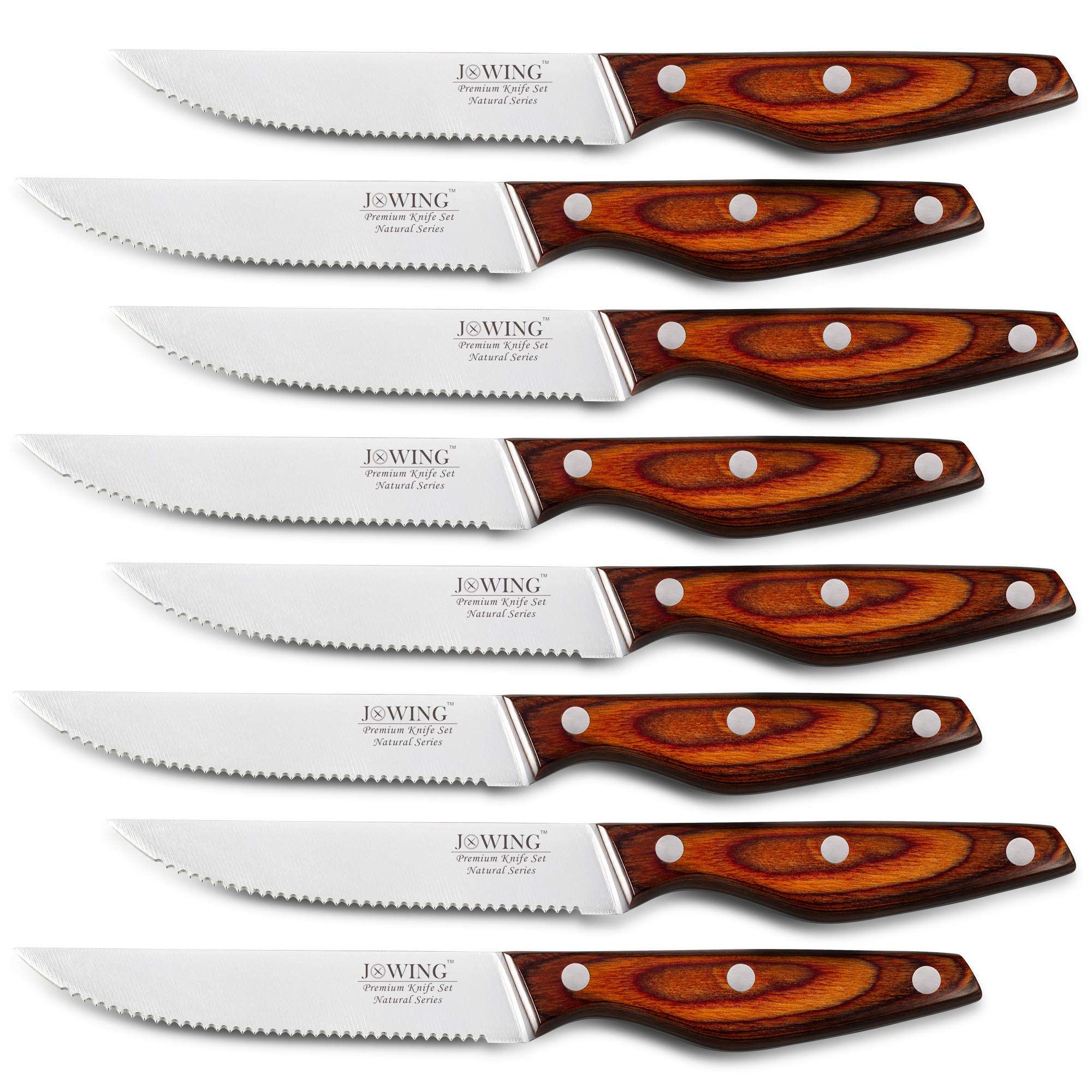
Steak knives occupy an odd position in most kitchens. They are used for a few minutes at a time, often at the table rather than the cutting board, and yet a dull or flimsy blade can make a good piece of meat frustrating to eat. The JXWING set of eight serrated steak knives, with German steel blades and pakkawood handles, is aimed at households that want a matching set for dinner parties without paying for a premium brand. Whether that trade-off makes sense depends on how you plan to use them.
The core specification is straightforward: eight knives, serrated edges, blades described as German steel, and pakkawood scales on the handles. In practice, that combination puts the set in the middle of the steak knife market. It is a step up from the stamped, hollow-handled knives that often come bundled with cutlery sets, but it is not in the same territory as forged knives from established European makers. The serrated edge is the most consequential design choice, and it drives most of the day-to-day experience.
How they are likely to be used
Serrated steak knives are designed around a specific problem: cutting cooked meat on a ceramic plate without destroying the plate. The scalloped edge lets the knife saw through fibrous protein while the points keep contact with the food rather than the glaze. For anyone who regularly serves steak, chops, roast chicken, or even crusty bread at the table, that is a practical advantage. The eight-knife count also means the set can cover a dinner for six or eight without reaching for mismatched backups, which is more useful than it sounds once you have hosted a few times.
The pakkawood handles are worth noting separately. Pakkawood is a resin-impregnated wood laminate, which makes it more moisture-resistant than plain wood and less prone to the swelling and cracking that untreated handles can develop after repeated washing. Visually, it gives the knives a warmer look than plain black plastic, and the material is common on mid-range kitchen knives for good reason. It is not indestructible, and prolonged soaking is still a bad idea, but it holds up better than many budget alternatives.
What the serrated edge means in practice
The biggest misconception about serrated steak knives is that they never need sharpening. They do stay usable longer than a plain edge because the points protect the scallops, but they dull eventually, and resharpening them properly requires a tapered rod or a professional service. A standard honing steel will not restore a serrated edge. Buyers should go in expecting a few years of decent performance followed by either professional sharpening or replacement. That is true of nearly all serrated steak knives, not just this set, but it is worth stating plainly because the marketing around serrated blades often implies otherwise.
On the plate, the serrated edge does what it should. It bites into the surface of a steak rather than sliding, which matters more with well-done meat or a tougher cut. The trade-off is a slightly rougher cut surface than a sharp plain edge would produce. For most home dining that is invisible, but anyone who cares about clean, uniform slices for presentation may prefer a plain-edged steak knife instead.
Where the set sits against alternatives
Compared with a traditional forged steak knife set from a European brand, the JXWING knives are likely to feel lighter and less substantial in the hand, and the blade geometry will not have the same heft through a thick cut. Compared with basic stamped knives sold in big-box stores, the pakkawood handles and the German steel claim suggest a more considered build, though buyers should treat steel-origin claims on mid-priced sets with some skepticism; the practical performance matters more than the label. A reasonable way to think about it: this is a set for people who want a consistent table setting and decent cutting performance, not a set for people who want heirloom tools.
One more comparison worth making is against plain-edged steak knives in the same price range. A plain edge can be honed at home and will ultimately give a cleaner cut, but it requires more maintenance and dulls faster in contact with plates. The serrated design here trades long-term sharpening simplicity for day-to-day convenience. Neither approach is wrong; they suit different habits.
Limitations and who should look elsewhere
The main limitations are maintenance-related rather than functional. Serrated edges are harder to sharpen at home, the knives should be hand-washed to protect the pakkawood, and the set does not include a storage block or case, so buyers need to think about drawer space or a separate block. The eight-knife count is generous for couples and possibly excessive for small households, where four knives plus a block might be a better use of counter space.
This set is a sensible fit for households that host regularly, want a uniform look at the table, and accept that serrated knives are a convenience item rather than a lifelong investment. It is less suitable for anyone who prefers to maintain their own edges with a whetstone, for professional or high-volume use, or for buyers who want the weight and balance of forged cutlery. Those users are better served by a smaller set of plain-edged forged knives, even if it costs more per knife.
Overall, the JXWING set reads as a practical mid-range option with a clear use case. It is not a set that will impress anyone who knows knives well, but it is likely to do the job it was bought for: cutting dinner without fuss, eight times over.