
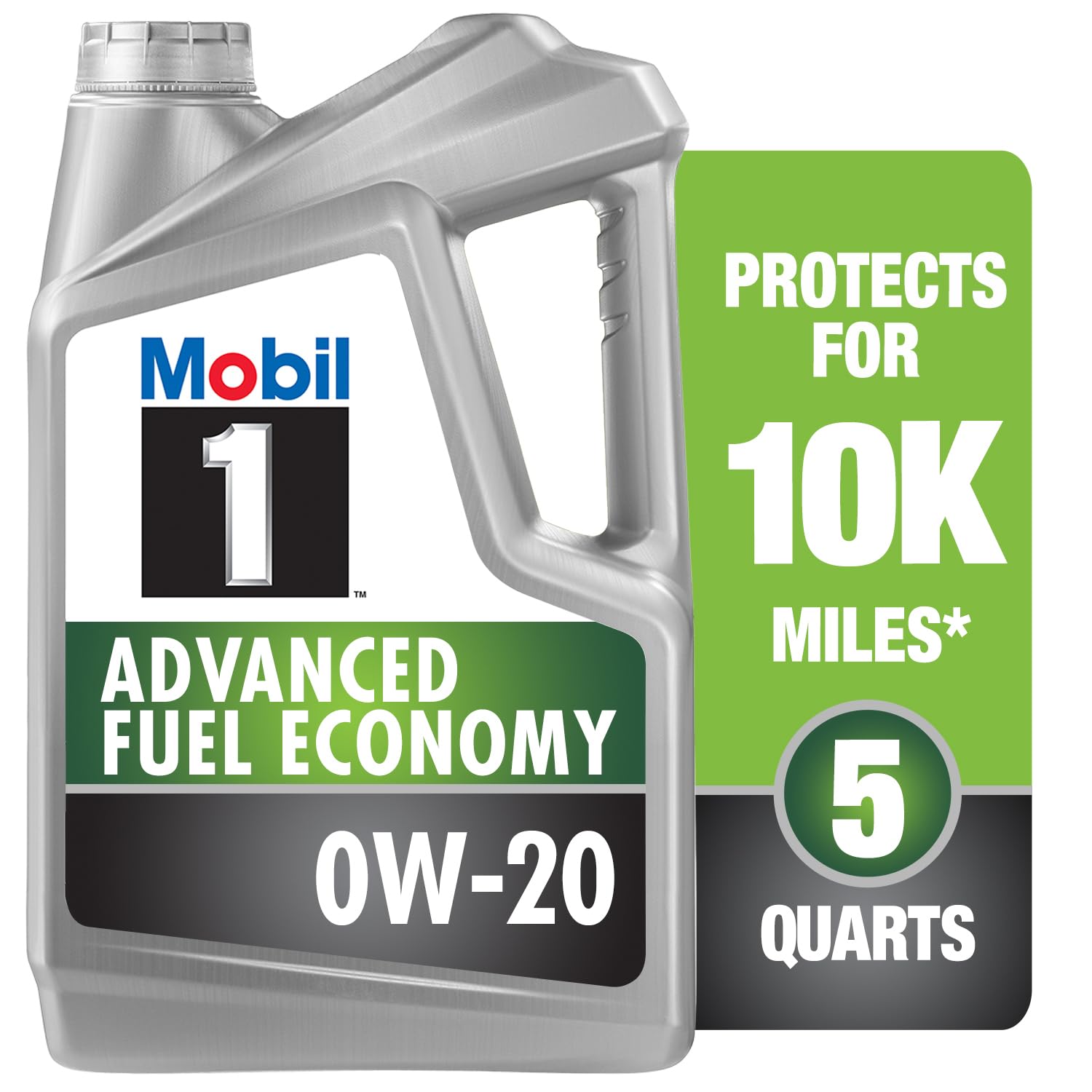
When you pop the hood of a late-model car, there’s a good chance you’ll see a recommendation for 0W-20 oil. That’s where Mobil 1’s Advanced Fuel Economy formula comes in. This is a full synthetic oil designed to meet the needs of modern engines that prioritize fuel efficiency and low-temperature flow. But as with any specialized lubricant, it comes with trade-offs that are worth understanding before you commit to a five-quart jug.
In real-world use, this oil is meant for daily drivers, commuters, and family sedans that operate in moderate to cold climates. The 0W-20 viscosity rating means it stays thin at low temperatures, which helps with cold starts and reduces internal drag. Many newer engines from Honda, Toyota, Ford, and others specify this weight. The oil’s primary job is to reduce friction enough to squeeze out an extra mile or two per gallon compared to a thicker oil like 5W-30. In practice, the fuel economy benefit is modest—usually around 1 to 2 percent—but it’s measurable over a year of driving.
Key features include a proprietary additive package that resists thermal breakdown and keeps sludge from forming. Mobil 1 uses a synthetic base stock rather than conventional crude, which means the oil maintains its viscosity longer and handles higher temperatures without thinning out. This is especially relevant for turbocharged engines, where heat can degrade lesser oils quickly. The 0W-20 formula also meets the latest API SP and ILSAC GF-6 standards, which means it’s designed to protect against low-speed pre-ignition (LSPI) in modern direct-injection engines.
However, there are limitations. The most obvious one is that this oil is not suitable for high-mileage engines that have developed wear. Thicker oils, like a 5W-30 or 10W-40, often do a better job of filling gaps in worn bearings and piston rings, reducing oil consumption and noise. If your car has over 100,000 miles and burns oil, switching to 0W-20 might increase consumption. Also, this oil is not formulated for extreme performance driving or track use. Under sustained high loads, the thin film strength can be a liability. For a weekend autocross car or a heavy-duty truck, a 5W-30 or 0W-40 would be more appropriate.
Compared to a conventional 5W-30 oil, Mobil 1 Advanced Fuel Economy offers better cold-weather flow and slightly better fuel economy, but at a higher price point. A five-quart jug typically costs 30 to 40 dollars, while a conventional oil of similar viscosity might be half that. The synthetic also lasts longer—often 7,500 to 10,000 miles between changes versus 3,000 to 5,000 for conventional—so the cost difference can be offset by fewer oil changes. But if you change your oil yourself, the upfront price is something to consider.
This oil is best suited for drivers who own a relatively new car (under 75,000 miles) that specifies 0W-20, and who want to maximize fuel economy without sacrificing engine protection. It’s also a good choice for those who live in cold climates, where the oil’s low-temperature properties really shine. On the other hand, it’s not ideal for older engines with high mileage, vehicles used for towing or racing, or anyone on a tight budget who doesn’t want to pay a premium for synthetic.
In summary, Mobil 1 Advanced Fuel Economy 0W-20 is a competent, modern synthetic oil that does what it promises: it reduces friction, improves cold starts, and meets the latest industry standards. But it’s not a miracle worker. The fuel savings are incremental, and it won’t solve underlying engine problems. If your car calls for 0W-20, this is a reliable choice—just don’t expect it to transform your driving experience or make your engine last forever. It’s a tool for a specific job, and it does that job well enough.