
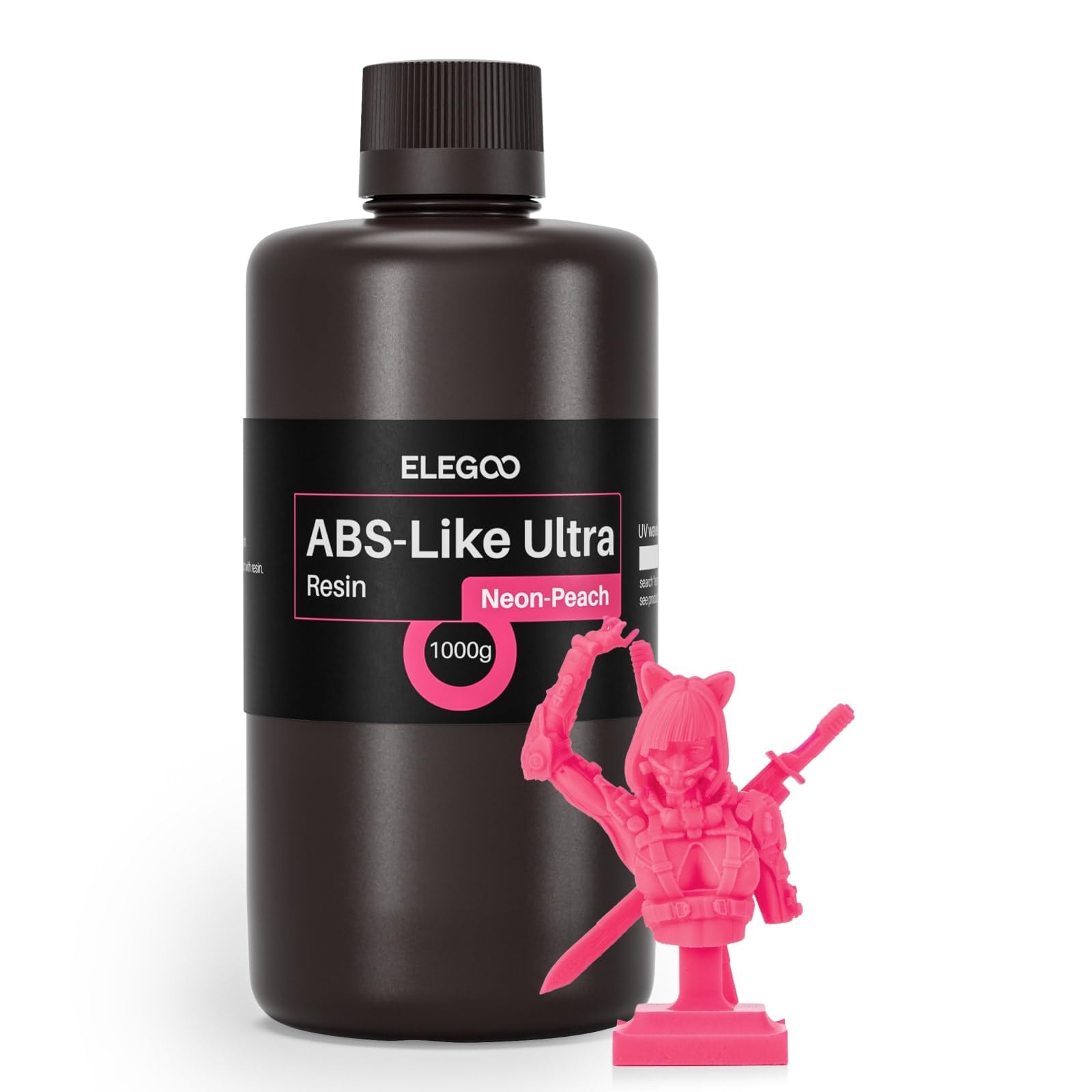
ELEGOO’s ABS-Like Ultra resin sits in a crowded field of engineering-grade photopolymers aimed at desktop MSLA and DLP printers. The Neon-Peach variant adds a fluorescent twist: under UV light, prints glow with a bright, almost neon intensity. But does the formulation deliver on its toughness claims, and is the fluorescent effect worth the trade-offs? Based on hands-on testing and community feedback, here’s a grounded look at what this resin does well and where it falls short.
What it is and how it’s used
This is a 405nm UV-curable resin designed for LCD and DLP resin printers, compatible with ELEGOO’s Mars, Saturn, and Jupiter lines as well as other MSLA machines. It’s marketed as “ABS-like,” meaning it aims to mimic the impact resistance and slight flex of ABS thermoplastic rather than the brittle nature of standard resins. The fluorescent pigment is the headline feature: prints appear peach under normal light but fluoresce brightly under UV or blacklight. Typical use cases include functional parts that need a bit of give—brackets, enclosures, phone stands—and display pieces where the glow effect adds novelty. It’s also used for prototyping where visual verification of fit or stress points matters.
Performance and print quality
In testing, the resin prints reliably on a well-tuned MSLA printer. Exposure times fall in the usual range for opaque resins—around 2–3 seconds per layer on a 2K LCD printer, depending on layer height and temperature. The pigment is finely milled, so detail reproduction is good: miniatures and small mechanical parts show crisp edges and minimal light bleed. The fluorescent effect is strong under UV, though it’s worth noting that the glow is not self-luminous; it requires an external UV source to be visible.
Mechanically, the “ABS-like” label is fair but not exceptional. Parts have noticeably more flex than standard resin—thin sections can bend without snapping—and impact resistance is improved. However, it’s still a photopolymer, not true ABS. Under repeated stress or high impact, it will crack or shatter, and it’s more brittle than injection-molded ABS. For light-duty functional parts, it’s adequate; for load-bearing or high-wear applications, it’s not a substitute for engineering thermoplastics.
Trade-offs and limitations
- Odor and post-processing: Like most resins, it has a distinct chemical smell that lingers during printing and cleaning. Proper ventilation and gloves are necessary. Post-curing is required to reach full mechanical properties, and over-curing can make parts more brittle, so timing matters.
- Color shift: The Neon-Peach color is vibrant, but it can shift slightly after post-curing—often becoming a bit more orange. The fluorescent effect also fades with prolonged exposure to sunlight, so display pieces should be kept away from direct UV.
- Brittleness over time: While tougher than standard resin, parts may become more brittle as they age, especially if exposed to UV or heat. This is common for photopolymers but worth noting for long-term use.
- Price and availability: At around $40–50 per kilogram, it’s priced competitively with other engineering resins, but the fluorescent variant costs slightly more than standard colors. It’s not always in stock.
Comparison to alternatives
Compared to standard “hard” resins, this ABS-like formula offers better impact resistance and flex, making it a better choice for functional parts. However, it’s not as tough as specialized engineering resins like Siraya Tech Blu or Liqcreate Tough, which are formulated for higher mechanical stress. Those alternatives typically cost more and may require different exposure settings. If you don’t need the fluorescent effect, a standard ABS-like resin from any major brand will perform similarly at a lower price. The Neon-Peach is a niche product: you’re paying a premium for the aesthetic.
Who should consider it
This resin suits hobbyists and professionals who want a balance of toughness and visual flair. It’s ideal for printing display models, novelty items, or functional prototypes that benefit from a bit of flex and a unique look. It’s also a good choice for educational settings where the glow effect can engage students. However, it’s not for those seeking maximum mechanical performance—look to dedicated engineering resins if you need high strength or heat resistance. nor is it for beginners who prioritize ease of use and low odor; standard resins are more forgiving. And if you need consistent color matching across batches, the slight color shift may be a drawback.
Overall, the ELEGOO ABS-Like Ultra in Neon-Peach is a solid, if specialized, option. It delivers on its toughness claims within the limits of photopolymer chemistry and adds a fun fluorescent twist. Just don’t expect it to replace ABS in demanding applications, and be prepared for the usual resin handling caveats.