
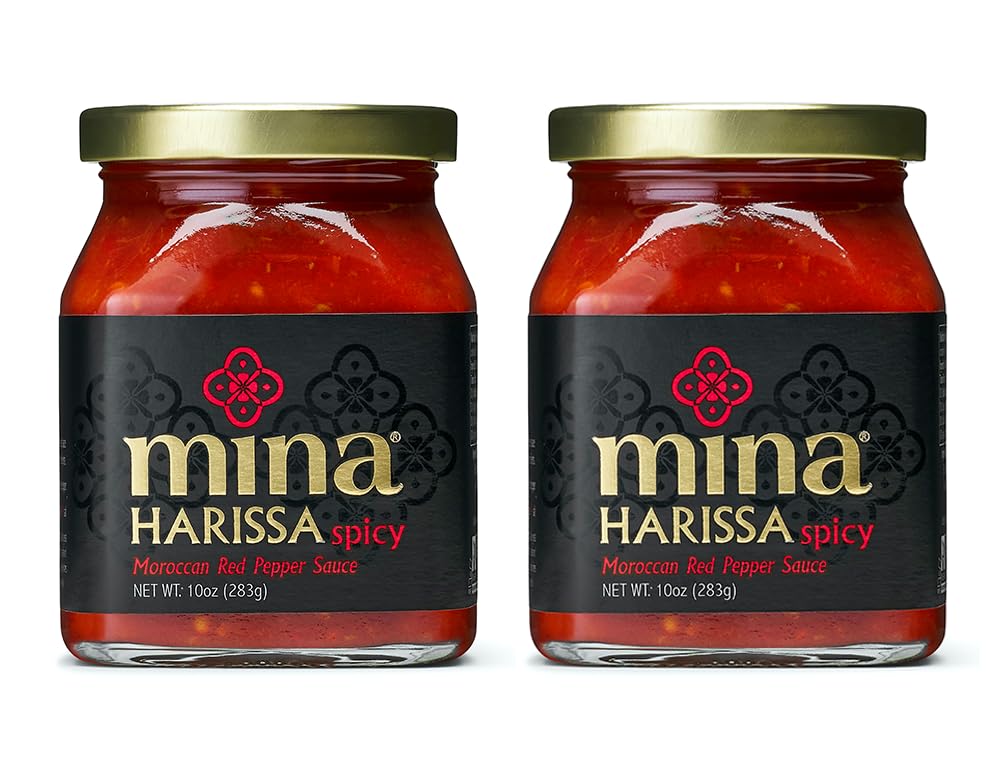
Harissa has a way of meaning different things depending on who made it. In Tunisia and Morocco it can be a rough, deeply spiced paste built on rehydrated chilies and carried by caraway and coriander. On American shelves, the word often gets applied to something closer to a chili ketchup. Mina’s version sits somewhere in between, and the tangy note the label advertises is the first thing worth talking about, because it changes how the product behaves in a kitchen.
The pack of two 10-ounce jars is a practical format for anyone who cooks with harissa regularly. Ten ounces is enough to get through several meals but not so much that an opened jar lingers in the back of the fridge for a year. The paste is fairly smooth compared with the coarse, hand-crushed harissas sold in Middle Eastern markets, which makes it easier to whisk into liquids but removes some of the texture that traditional versions offer.
What it actually is
- Red chili paste with a noticeable acidic tang alongside the heat
- Moderate heat level — warm and persistent rather than punishing
- Thinner and more spoonable than many jarred harissas, closer to a thick sauce than a stiff paste
- Sold as a two-pack of 10 oz jars, so roughly 20 ounces total
The tang is the defining trait. Where many jarred harissas taste primarily of roasted pepper and cumin, this one has a brightness that reads almost like tomato or vinegar. That is not a flaw, but it does mean the product will not always substitute cleanly for a more traditional harissa in recipes that expect a rounder, smokier flavor.
How it gets used
The consistency matters here. Because it is loose enough to pour and whisk, it works well stirred into yogurt for a quick sauce, spooned over eggs, or swirled into a bowl of chickpeas and olive oil. It dissolves into broths and marinades without leaving clumps, which is more than can be said for the stiffer pastes. On the other hand, that same looseness means it does not hold its shape when spread on flatbread or used as a rub — it tends to run and soak in rather than sit on the surface.
For roasting vegetables, a couple of spoonfuls tossed with oil and salt before the tray goes in the oven gives a decent result, though the tang becomes more pronounced as the moisture cooks off. In a sandwich or as a condiment alongside grilled meat, it behaves more like a hot sauce than a paste, which is consistent with how Mina positions it.
Where it falls short
The main trade-off is depth. Traditional harissa gets much of its character from caraway, coriander, and sometimes rose or preserved lemon, and those layers are muted here. The heat arrives first and the tang follows, but the spice complexity is modest. Anyone who has cooked with a good Tunisian harissa will notice the difference immediately, and cooks who want a paste that tastes of toasted spice rather than chili and acid may find this one thin.
Heat level is also worth calibrating. It is not a mild product, but it is not a scorcher either — most people accustomed to sriracha or gochujang will find it manageable. Those expecting the aggressive burn of a ghost pepper sauce will be underwhelmed, and those who are heat-averse should still start with a small amount.
Compared with other options
Against a traditional jarred harissa from a Middle Eastern grocer, this is brighter, looser, and less spiced. Against a standard vinegar-based hot sauce, it is thicker, more textured, and less sharp. The closest comparison might be a chili paste like gochujang in terms of versatility — it can go into marinades, soups, and dips — though the flavor profile is entirely different. For anyone building a pantry, it overlaps with both categories without fully replacing either.
Who should consider it
This suits home cooks who want a single jar that can move between eggs, grain bowls, roasted vegetables, and grilled meats without much planning. It is a reasonable entry point for someone curious about harissa but not ready to seek out a specialty import. It also works for people who find traditional harissa too thick or too heavily spiced.
It is less suitable for cooks who want an authentic, coarse, spice-forward harissa for recipes that depend on those characteristics, or for anyone who needs a paste that stays put when spread. The two-pack is convenient but means committing to 20 ounces, which is worth considering if you are trying the product for the first time.
Overall, this is a competent, versatile chili paste with a distinct tangy slant. It performs reliably in everyday cooking, though it trades some traditional depth for accessibility and ease of use. Buy it for convenience and flexibility, not as a stand-in for a carefully made North African harissa.