
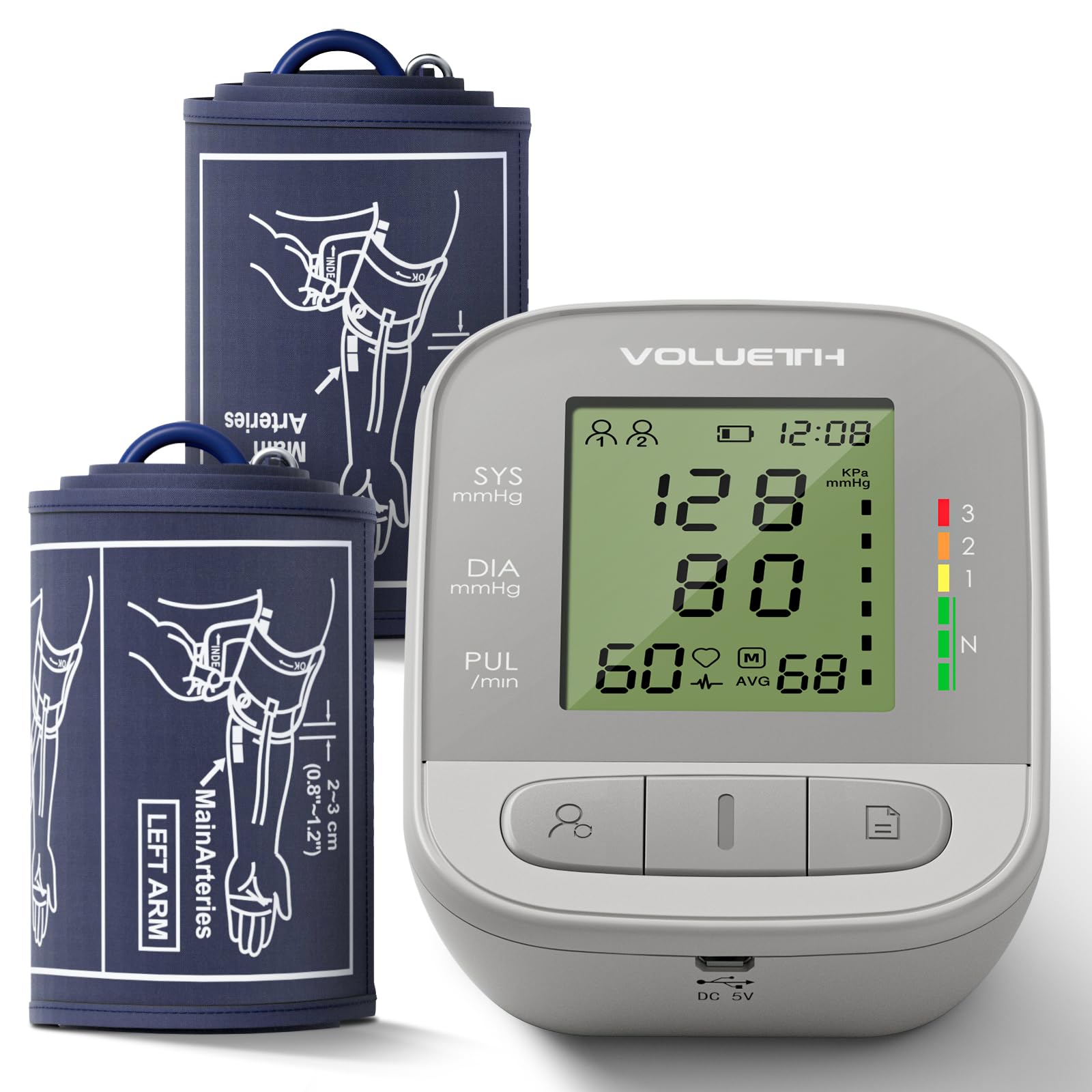
Home blood pressure monitors for children occupy an awkward niche. Pediatric hypertension is real, and some families genuinely need regular readings between clinic visits, but the equipment market is dominated by adult cuffs that simply do not fit small arms. The VOLUETH Kids Blood Pressure Cuff addresses that gap with a two-size approach: a small cuff sized for 7 to 9 inch arms and a medium/large cuff for 9 to 17 inch arms. Whether that pairing makes sense depends heavily on how the device is actually used, so it is worth looking at the practical details rather than the packaging claims.
The most useful way to think about this product is as a replacement or supplemental cuff set rather than a complete monitoring solution. In most real-world scenarios, a parent is not buying a cuff in isolation; they are buying it because the cuff that came with their monitor does not fit their child, or because one child has outgrown the small size and a younger sibling now needs it. That is where the two-size range earns its keep. A single purchase can cover a wide span of childhood, from a small grade-schooler up through a teenager, which is more than most single-cuff pediatric options offer.
Functionally, the cuffs follow the standard oscillometric design used by most home monitors. They wrap around the upper arm, inflate, and pass pressure data back to the monitor through the attached tubing. The sizing ranges are printed on the cuffs, which sounds trivial but matters in practice, because arm circumference, not age, is what determines a correct fit. A cuff that is too small will read high; one that is too large can read low or fail to register at all. The 7 to 9 inch small cuff and the 9 to 17 inch medium/large cuff cover a genuinely broad range, but the overlap point around 9 inches deserves attention. Parents should measure the child’s upper arm at the midpoint and match it carefully rather than guessing by age.
Build quality is best described as adequate for home use. The materials are the standard nylon-and-bladder construction found across this price tier, and the hook-and-loop closure holds well enough during inflation. Nothing about the cuffs suggests clinical-grade durability, and families using them several times a day for a medical condition should expect wear over time, particularly at the tubing connection. For occasional monitoring, the construction should hold up fine.
Compatibility is the biggest practical caveat, and it is the kind of thing buyers often overlook. These cuffs are designed to work with monitors that use a standard connector, but not every brand uses the same fitting. A cuff that does not seal properly at the monitor will produce erratic readings or fail entirely, and there is no universal standard across the home monitor market. Before buying, it is worth confirming the connector type on the existing monitor. This is not a flaw unique to VOLUETH, but it is a limitation that deserves more prominence than it usually gets.
Compared with the alternative of buying a dedicated pediatric monitor, the cuff-only route has clear trade-offs. A dedicated pediatric monitor typically includes a correctly sized cuff and validation for that pairing, which reduces guesswork. The cuff set, by contrast, assumes you already have a monitor you trust and simply need the right fit. That is cheaper and less wasteful if you already own a compatible device, but it puts more responsibility on the parent to verify compatibility and correct sizing. Neither approach is inherently better; they serve different starting points.
Accuracy expectations should stay realistic. Home cuffs in this category are not validated against clinical standards in the way hospital equipment is, and the readings are only as good as the monitor they are attached to and the technique used. Proper positioning, a rested child, and the right cuff size matter more than the cuff brand. Parents tracking a diagnosed condition should treat home readings as a supplement to clinical measurements, not a replacement.
Who is this for? It suits families who already own a compatible monitor and need a smaller or additional cuff for a child, especially households with children at different ages who can share the two sizes over time. It also works for parents who want a spare cuff so one can be washed or replaced without buying a whole new device. Who is it not for? Anyone starting from scratch should probably buy a complete pediatric monitor instead, since matching a loose cuff to an unknown monitor adds risk. Families needing clinically validated equipment for managing a serious condition should look at devices with documented validation rather than accessory cuffs.
The VOLUETH Kids Blood Pressure Cuff is a sensible, unglamorous accessory that fills a real gap for the right household. Its two-size range is the strongest argument in its favor, and the compatibility question is the strongest argument for caution. Measure the arm, check the connector, and go in expecting a functional tool rather than a precision instrument.