
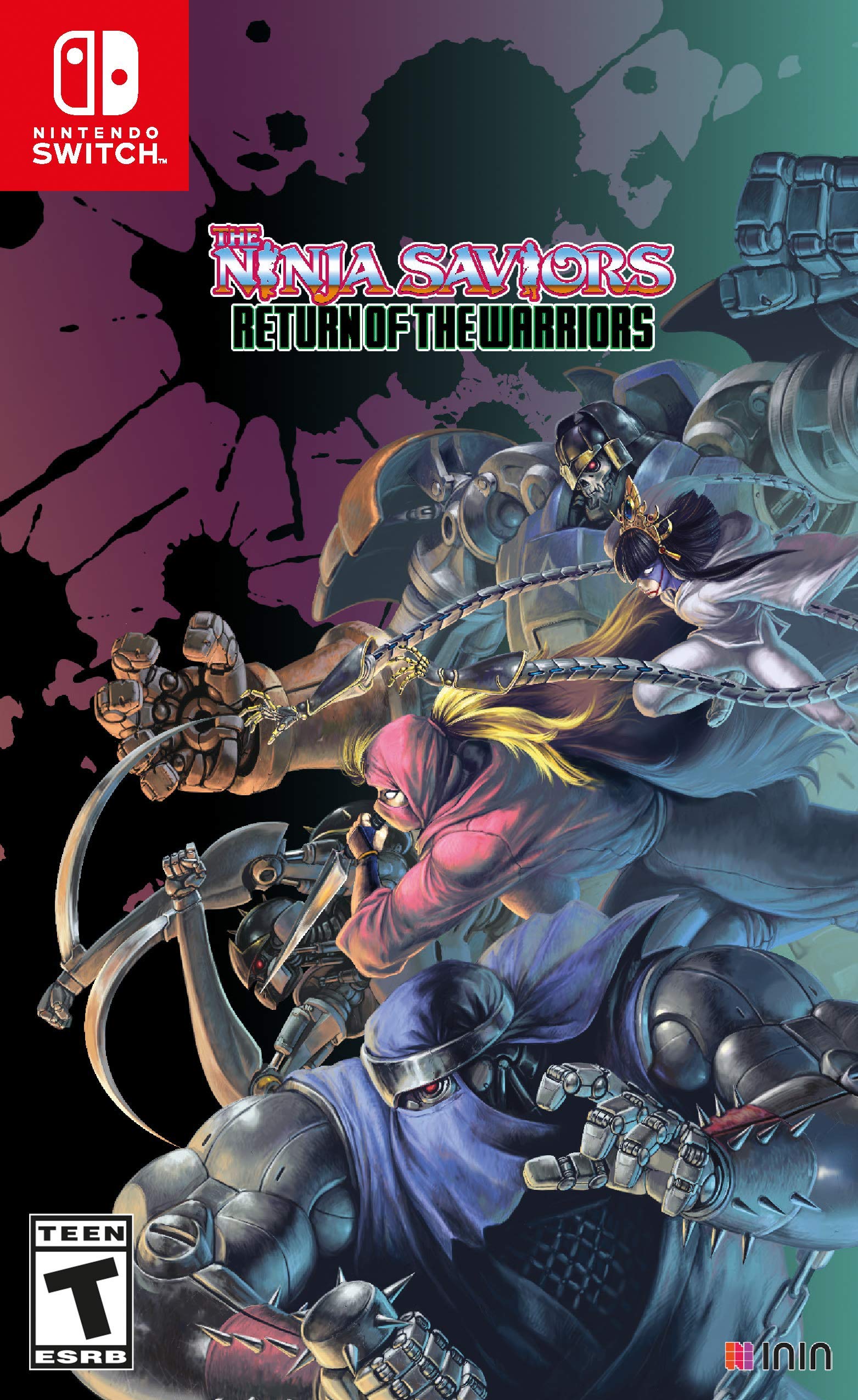
The Switch has no shortage of retro revivals, but The Ninja Saviors: Return of the Warriors occupies a specific niche. It is a remake of the 1994 Super Famicom game Ninja Warriors Again, itself a follow-up to the 1987 arcade original. Taito’s design lineage is visible throughout, and the Switch port adds a two-player co-op mode that was absent from the original console release. For anyone who has spent time with the beat-’em-up genre, the appeal is immediate; for everyone else, the experience is more conditional.
The structure is straightforward. Players move left to right through a handful of stages, clearing waves of soldiers, mechs, and armored enemies before reaching a boss. Three characters are available: Ninja, a balanced fighter; Kunoichi, faster but more fragile; and Yaksha, a heavier android with slower attacks and more reach. The roster covers the usual archetypes without much overlap, and each character has a distinct move set that rewards different approaches. The Switch version also includes Raiden, a boss character made playable, which adds a fourth option for repeat runs.
Combat is where the game earns its attention. The core loop revolves around light and heavy attacks, a dedicated jump, a guard, and a small set of special moves tied to a meter. Positioning matters more than in many genre peers, because enemies approach from both sides and the screen can fill quickly. The dash and the throw mechanics give the player tools to manage crowds, and landing a clean combo has a satisfying weight to it. The controls are responsive, and the input timing is forgiving enough to be learned without frustration.
What separates this from a simple emulated re-release is the presentation. The pixel art has been redrawn at a higher resolution while keeping the original sprite proportions, and the result is crisp without losing the chunky character of the source material. The soundtrack has been rearranged, with the option to switch to the original tracks. These are meaningful additions rather than cosmetic ones, and they show that the port was handled with some care.
In practice, the game is best suited to short sessions. A full playthrough runs roughly an hour, depending on difficulty and familiarity, which makes it easy to pick up for a commute or a single sitting. The two-player co-op is local only, so it works well on a TV with a second controller but does not extend to online play. That is a limitation worth noting for anyone expecting to team up remotely.
Difficulty is adjustable, but the default setting is not gentle. Enemies hit hard, and the screen can become chaotic, particularly in the later stages. The game expects players to learn enemy patterns and use the guard and dodge options rather than brute-forcing through. This is a deliberate design choice inherited from the arcade era, and it will appeal to players who enjoy that kind of challenge. Those looking for a relaxed, forgiving brawler may find the pacing abrasive.
Compared with other side-scrolling brawlers on the Switch, such as Streets of Rage 4 or the Capcom Beat ‘Em Up Bundle, The Ninja Saviors is a more focused and shorter experience. Streets of Rage 4 offers a longer campaign, more characters, and online co-op, while this game is closer to a faithful restoration of a single arcade-style title. The comparison is not a knock against either; it simply clarifies what kind of product this is. It is a compact, replayable brawler rather than a sprawling modern revival.
Content volume is the main trade-off. The stage count is small, and while there are multiple difficulty levels and characters to try, the game does not have the breadth of a modern release. Players who want a long campaign with unlockables and progression systems will find this thin. The value depends on how much the player enjoys mastering a short, repeatable arcade loop.
The game is suitable for fans of classic beat-’em-ups, players interested in Taito’s back catalog, and anyone who wants a local co-op game that can be finished in an evening. It is less suitable for players who prefer long, story-driven campaigns, online multiplayer, or a gentler difficulty curve. As a historical restoration with modern conveniences, it does what it sets out to do with few missteps, provided the buyer knows what they are getting.