
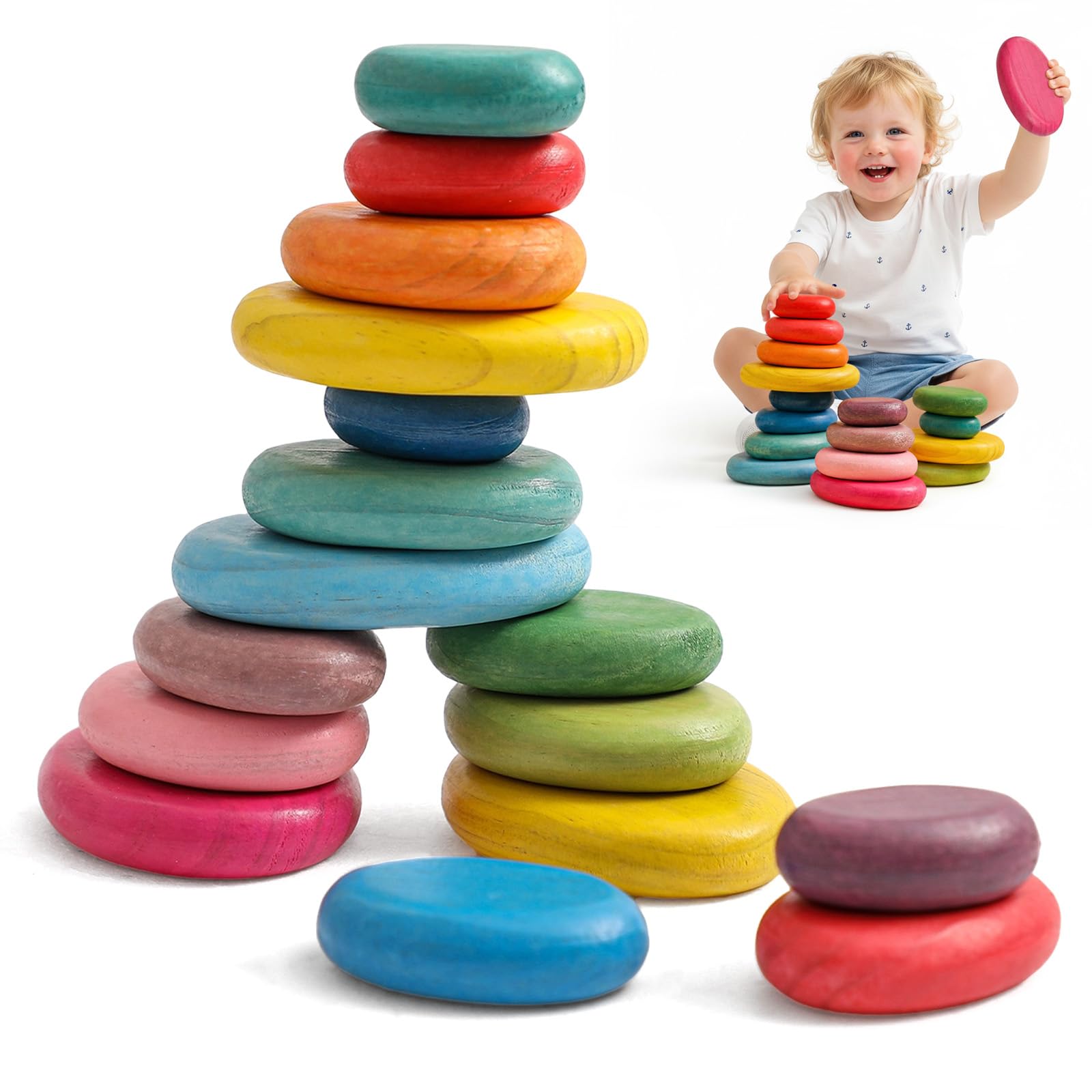
Stacking toys for toddlers tend to fall into two camps: the small, fiddly wooden blocks that require fine motor precision, and the oversized, soft-sided blocks that are easy to grasp but offer little challenge. The OESSUF Extra-Large Stacking Rocks sit somewhere in between, offering 16 chunky wooden pieces shaped like irregular stones. The idea is to balance them into towers, arches, or whatever else a child dreams up, with the open-ended play pattern that Montessori-inspired toys often aim for. At first glance, they look like a simpler, more forgiving version of the classic balancing stones—larger, smoother, and presumably easier for small hands to manage.
In practice, these rocks are likely to see use in several ways. A one-year-old might simply pick them up, bang them together, or carry them around, enjoying the weight and texture. A two-year-old might try to stack two or three before they topple. A three-year-old might attempt more elaborate structures, perhaps with a little help from an adult. Because the pieces are extra-large, they’re less of a choking hazard and easier to spot when scattered across the floor—a small but real advantage for parents of crawlers and early walkers. The wood is sanded smooth, and the edges are rounded, which matters for a toy that will inevitably be mouthed or dropped on toes.
Functionally, the set includes 16 pieces in varying sizes and shapes. The irregular forms are meant to encourage experimentation: some stack easily, others require careful placement. That unpredictability is part of the appeal, but it also means that young toddlers may become frustrated if the rocks won’t stay put. Unlike interlocking blocks, these rely entirely on balance, so a wobbly tower is the norm rather than the exception. The wood is sturdy, and the pieces have a satisfying heft—they’re not hollow or flimsy. However, they are not painted or sealed with a glossy finish, so they may show wear over time, especially if they end up being used on hard floors or outside. A quick wipe with a damp cloth is about all the maintenance they need.
One limitation worth noting is the size itself. While “extra-large” is helpful for safety and grip, it also means the set takes up more storage space and is less portable. Tossing all 16 pieces into a bag for a restaurant or airplane trip isn’t practical—they’re bulky and have some weight to them. For families with limited space, these might become a floor-toy that stays at home. Also, because the pieces are unpainted, they offer a natural look that blends with many playrooms, but they lack the visual stimulation of colorful blocks. Some children are drawn to bright colors, and these muted tones may not capture their attention as quickly.
Compared to traditional wooden building blocks, which are uniform and stack predictably, the OESSUF rocks demand more problem-solving but offer less immediate success. They’re also a different experience from magnetic tiles or interlocking plastic blocks, which snap together and hold their shape. The balancing rocks are more about trial and error, patience, and spatial reasoning—skills that develop over time. For a child who gets easily frustrated, a simpler stacking toy with flat surfaces might be a better starting point. But for a child who enjoys a challenge and has the dexterity to manipulate irregular shapes, these can be engaging.
Who is this for? It suits families looking for a natural, open-ended toy that encourages fine motor skills and creative play, especially those who follow Montessori principles. It’s also a good choice for households with mixed-age children, since the larger pieces are safe for younger siblings while still offering enough complexity for older toddlers. However, it’s not ideal for parents who need a portable toy, or for children who prefer clear, immediate feedback from their building materials. And while the set is marketed for ages 1–3, some 1-year-olds may simply be too young to stack intentionally—they’ll enjoy the sensory aspect, but the balancing challenge won’t kick in until closer to 2 or 3.
In terms of real-world performance, expect the rocks to tumble frequently. That’s part of the learning process, but it also means the toy can be noisy on hard floors and may require a soft surface to reduce clatter. The wood is durable, but dropping a heavy piece on a tile floor could dent the wood or the floor—a trade-off of the solid construction. Also, because the shapes are irregular, cleaning between crevices can be slightly more tedious than wiping down smooth blocks.
Overall, the OESSUF Extra-Large Stacking Rocks are a solid, no-frills option for parents seeking a durable, open-ended toy that grows with their child. They’re not flashy, and they won’t stack themselves, but they offer a tactile, challenging play experience that aligns with the Montessori approach. Just be prepared for a learning curve and a bit of floor space.