
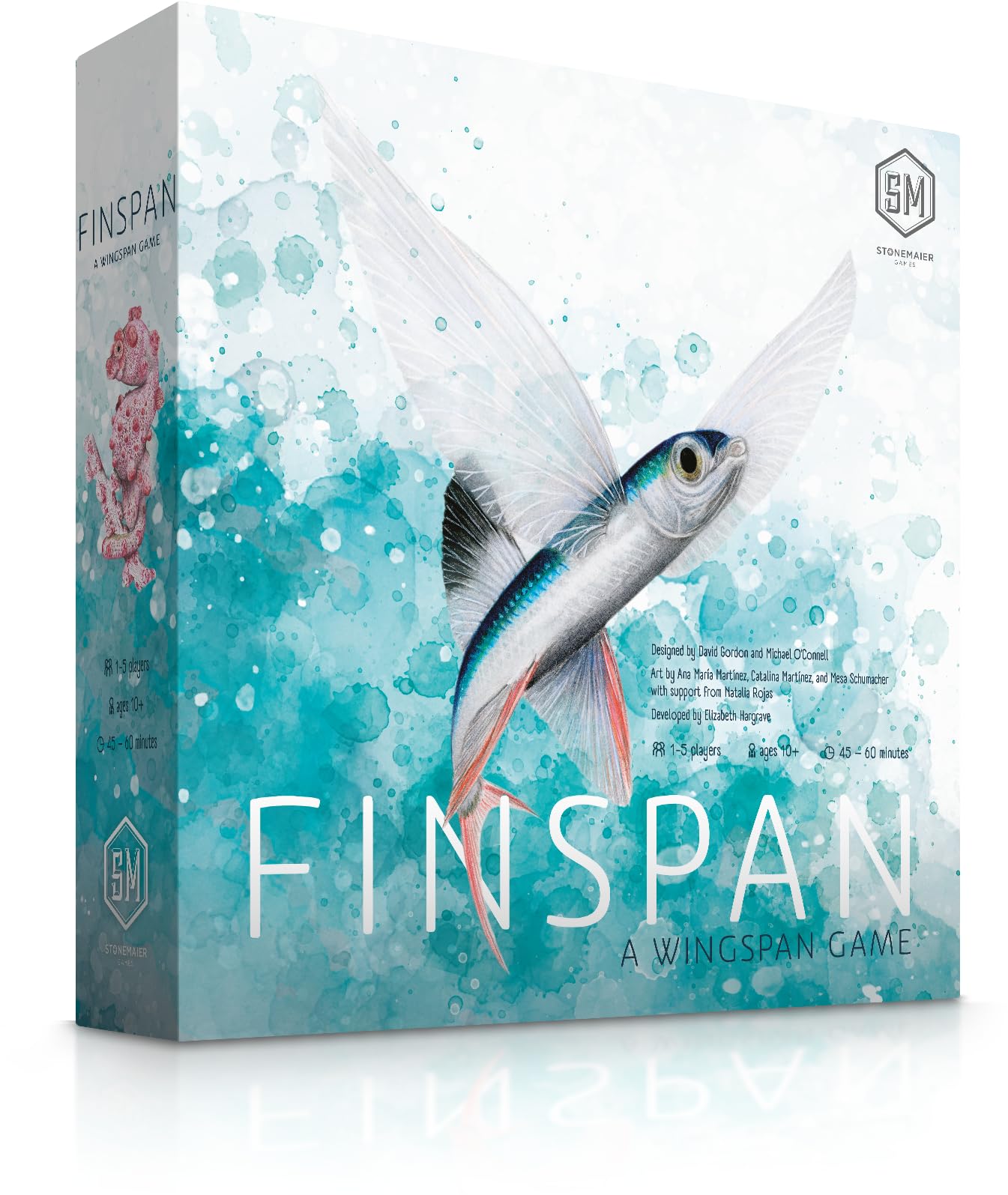
Stonemaier Games has a reputation for producing polished, nature-themed board games, and Finspan continues that tradition as a standalone game set in the same universe as Wingspan. Designed by David Gordon and Michael O’Connell, this title shifts the focus from birds to fish and ocean diving, offering a relaxing strategy experience for 1 to 5 players that typically runs around 60 minutes. It’s not a direct sequel or expansion, but rather a reimagining of the core mechanics with a marine twist.
In practice, Finspan plays very similarly to Wingspan. Players collect fish cards, manage a personal aquarium board, and take actions like diving to discover new species or feeding your collection to gain points. The game uses a dice-based resource system, where dice represent different ocean zones and determine what actions are available. The overall pace is calm and methodical, with little direct conflict between players—making it a solid choice for a relaxed game night where you want to think without feeling rushed.
Key functional features include:
- Card-driven gameplay with over 150 unique fish species, each with special abilities that trigger when placed in your aquarium.
- Dice allocation system that determines which actions (like diving, feeding, or scoring) are available each round.
- End-of-round goals that encourage specific strategies, such as collecting fish from certain depths or focusing on size.
- Solo mode that works well, with an automa opponent that simulates a second player without adding much complexity.
- High-quality components including a custom dice tray, detailed cards, and a sturdy board that fits nicely on a table.
One limitation worth noting is that Finspan does not introduce many new mechanics compared to Wingspan. If you already own Wingspan and play it regularly, Finspan may feel like a reskin with a different theme rather than a fresh experience. The core loop of collecting cards, managing resources, and triggering abilities is nearly identical. The ocean theme is charming, but the gameplay depth doesn’t increase significantly. Additionally, the rulebook can be a bit dense for new players, especially when explaining how dice interact with the action board—expect a learning curve of about 15–20 minutes.
Compared to other family strategy games like Everdell or Parks, Finspan occupies a similar niche: it’s accessible but not simplistic, with enough variety to sustain multiple plays. However, Everdell offers more worker-placement complexity, while Parks focuses on hiking and photography. Finspan leans harder into set collection and engine building, which appeals to players who enjoy optimizing combos. It’s less confrontational than games like Scythe or Terraforming Mars, making it a better fit for groups that prefer cooperative or parallel play.
Who is this game for? It’s suitable for families with older children (ages 10 and up) who can handle moderate strategic thinking, as well as adults who enjoy themed, low-stress strategy games. It works well for couples or small groups, and the solo mode is a nice bonus for those who play alone. Who might not enjoy it? If you’re looking for high interaction, direct competition, or a game that breaks new ground mechanically, Finspan may feel too derivative. Also, if you dislike luck-based elements from dice rolling, the randomness in resource availability could frustrate you—though there are ways to mitigate this through card abilities.
Realistically, Finspan is a solid addition to the Stonemaier catalog, but it’s not a must-buy if you already have Wingspan. The production quality is excellent, and the theme is well-executed, but the gameplay familiarity might not justify the price unless you’re a collector or a big fan of ocean life. For a relaxed evening with friends who enjoy nature and strategy, it delivers a pleasant experience without demanding too much mental energy. Just don’t expect it to revolutionize your game shelf.