
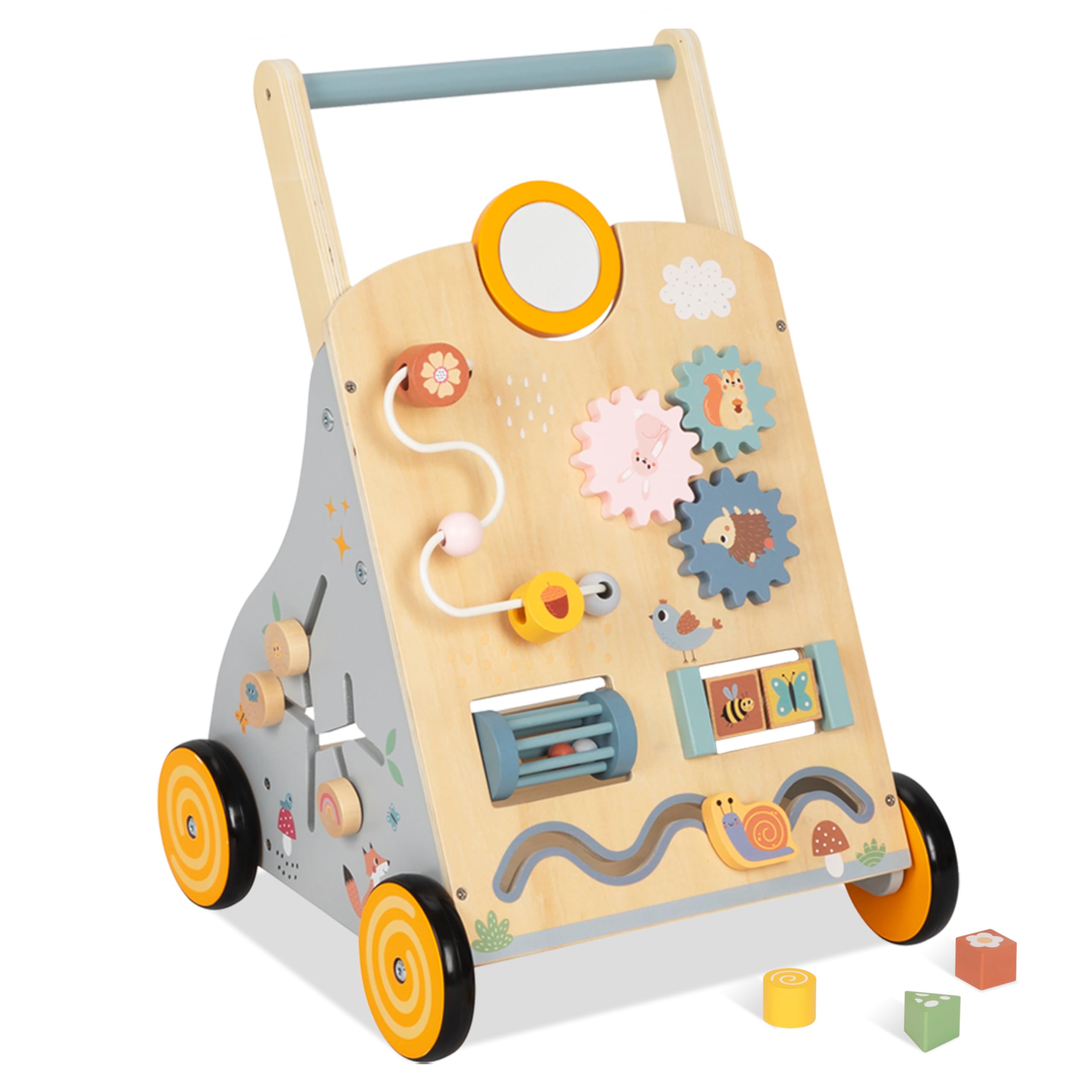
The wooden baby walker and push toy from this brand is a solid entry in the crowded market of toddler mobility aids. Designed for children aged 1 to 3 years, it aims to combine walking practice with Montessori-style play. After spending a few weeks with this product in a home with a 14-month-old, here is how it held up in real-world use.
Right out of the box, the assembly is straightforward. The instructions are clear, and you only need a screwdriver for a few steps. The wood feels smooth to the touch, with no rough edges or splinters, which is a relief given how much toddlers put their hands on everything. The natural wood finish and muted colors give it a more classic look compared to the plastic, battery-operated walkers that dominate store shelves.
The adjustable height mechanism is a practical feature. It offers three positions, which means the walker can adapt as the child grows. In our testing, it accommodated a shorter 12-month-old and a taller 2-year-old without issue. The wheels have a rubber ring that provides some resistance on hardwood floors, preventing the walker from shooting out too fast. This is a genuine safety consideration, though it is not a complete brake system—it still requires adult supervision on slopes or uneven surfaces.
The activity center on the front includes a bead maze, spinning gears, a shape sorter, and a few sliding elements. These keep a toddler engaged for short periods, but they are not as elaborate as standalone activity tables. The shape sorter pieces are small and can be lost if not stored properly. The bead maze is the most durable part; the beads slide smoothly along the wire. However, the spinning gears are somewhat stiff out of the box and may require a bit of use to loosen up.
One limitation worth noting is the weight. At just under 5 pounds, it is light enough for a toddler to push, but it can tip if the child leans heavily on one side or tries to climb on it. This is common with most push walkers, but it is more noticeable here because the base is not as wide as some plastic alternatives. On carpet, the wheels roll less easily, which can frustrate a child who is just getting the hang of walking. It performs best on hard, flat surfaces like laminate or tile.
Compared to a standard plastic walker with lights and sounds, this wooden version is quieter and more visually subtle. It does not encourage passive entertainment; instead, it relies on the child’s own movement and curiosity to engage with the activities. For parents who prefer a less stimulating toy, this is a plus. But if your child is used to electronic toys, they might initially find this one less exciting.
This product is suitable for parents who want a simple, durable walker that focuses on motor skills and does not rely on batteries. It is also a good fit for households that prefer natural materials over plastic. It is not ideal for children who are very heavy or tall for their age, as the walker may feel small. It is also not the best choice for homes with thick carpet, as the wheels struggle there. Additionally, the shape sorter pieces are a choking hazard if the child is still mouthing objects, so supervision is necessary.
In terms of longevity, the wooden construction holds up well to daily use. After a month of regular play, there are no cracks or splinters, and the paint has not chipped. The wheels still roll smoothly, though the rubber rings show slight wear. The activity center elements remain functional, though the shape sorter lid can be tricky for small hands to open independently.
Overall, this wooden baby walker does what it sets out to do. It provides a stable platform for early walking practice and offers some interactive play. It is not a miracle product—it will not teach your child to walk overnight, and it has its quirks. But for families looking for a non-electronic, adjustable walker with a classic design, it is a reasonable choice that delivers on its basic promises.