
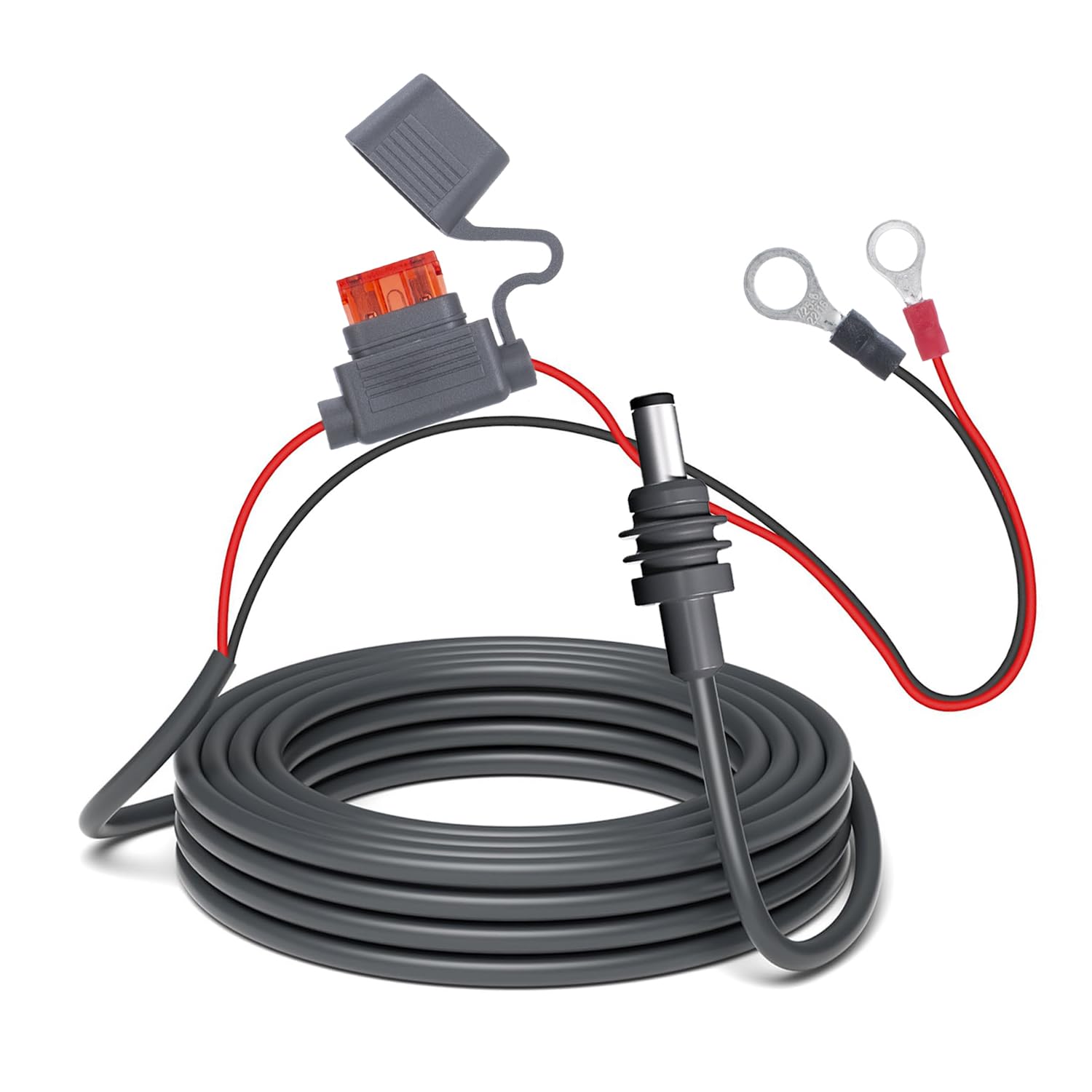
Powering a Starlink Mini from a 12V or 24V battery bank usually means dealing with an inverter or a proprietary power supply. The Direct Battery Power Cable from rvicees offers a more straightforward approach: a 3-meter (10-foot) 18AWG DC cable with a built-in fuse holder and ring terminals that connect directly to battery posts. It’s a niche product aimed at RVers, boaters, and off-grid solar users who want to run their Starlink Mini without relying on AC power. But does it deliver on the promise of simple, efficient DC-to-DC power? We took a closer look at the specs and real-world implications.
First, a quick note on compatibility. The cable is designed specifically for the Starlink Mini, which accepts a DC input range of 12V to 48V. The rvicees cable supports that same range, so it can work with a variety of battery systems: a standard 12V lead-acid, a 24V lithium bank, or even a 48V solar setup. The ring terminals are sized for typical battery posts, though you may need to check the stud size on your particular battery – they’re not universal. The 18AWG wire is a bit on the thin side for higher currents, but since the Starlink Mini draws around 25-40 watts typical (peaking higher during startup), the current at 12V is roughly 2-3.5 amps. 18AWG is rated for up to 16 amps in chassis wiring, so it’s within spec, but there’s minimal headroom. If you’re running a long cable run or higher voltages, voltage drop could become a factor.
One of the more practical features is the integrated fuse holder. It accepts a standard blade fuse (not included, which is a minor annoyance – you’ll need to supply your own, typically a 5A or 7.5A). Having a fuse right at the battery end is good practice, protecting the wire and the Starlink from short circuits. The holder is a simple inline design with a screw-on cap, which is weather-resistant but not fully waterproof. For an RV or boat installation, you’ll want to mount it in a dry location or add extra protection.
In real-world use, this cable shines for semi-permanent installations. Imagine you have a camper van with a 12V house battery and you want to power your Starlink Mini without turning on an inverter. You bolt the ring terminals to the battery, route the cable through a window or existing gland, and plug the other end into the Starlink Mini’s DC input. The 10-foot length is generous enough for many small to mid-size rigs, but in a larger RV or boat, you might find it limiting – you may need an extension, which adds resistance and potential voltage drop. Also, the cable is not shielded, so in sensitive RF environments, it could pick up noise, though we haven’t seen reports of that affecting Starlink performance.
Compared to using the Starlink Mini’s included AC adapter with a small inverter, this cable eliminates the inverter’s idle draw and conversion losses. Inverters typically waste 10-15% of power as heat, so for off-grid solar users, every watt counts. However, the trade-off is that you’re limited to battery voltages within the 12-48V range. If your system is 48V nominal, the Starlink Mini can accept that directly, but you’ll need to ensure the cable’s insulation and connectors are rated for the higher voltage – they are, according to the specs. Another alternative is a DC-DC converter that steps up or down to a stable 48V, which can be more efficient if your battery voltage varies widely (e.g., lead-acid from 11V to 14.5V). The rvicees cable relies on the Starlink Mini’s internal regulator to handle voltage fluctuations, which it does, but extreme lows or highs might cause the dish to shut down or underperform.
Build quality is acceptable for the price point. The wire is stranded copper, which is good for flexibility, and the ring terminals are crimped and soldered, which adds durability. The fuse holder is plastic and feels a bit brittle, so handle it with care during installation. The cable jacket is PVC and rated for typical automotive temperatures, but it’s not as abrasion-resistant as silicone or rubber. In an off-grid solar setup where the cable might be exposed to sunlight, UV degradation could be a concern over time – consider conduit or cable loom if routing outdoors.
Who is this for? It’s best suited for DIYers and outdoor enthusiasts who already have a 12V, 24V, or 48V battery system and want a plug-and-play solution for their Starlink Mini. It’s ideal for RVers who boondock frequently, boaters who want to avoid running a generator, and off-grid cabin owners with a solar battery bank. It’s also a good fit for those who want a backup power option for their Starlink Mini during emergencies. On the other hand, it’s not for someone who needs a longer cable run (over 10 feet) without adding an extension, nor for those who want a waterproof, marine-grade cable – this is more of a fair-weather or protected installation. If you’re not comfortable crimping or connecting to battery terminals, you might prefer a ready-made adapter that plugs into a 12V socket, though those are limited to 12V systems and often have lower power ratings.
Performance-wise, expect the cable to do its job without drama. It won’t boost your Starlink’s speed or reliability; it simply provides power. Voltage drop over 3 meters at 3 amps is negligible (about 0.3V for 18AWG), so the dish receives adequate voltage. However, if you’re using a 12V battery that’s deeply discharged (below 11V), the Starlink Mini may struggle to start, as it needs a minimum voltage. That’s a limitation of the dish, not the cable, but worth noting.
Overall, the rvicees Direct Battery Power Cable is a functional, no-frills solution for a specific need. It’s not the most robust cable on the market, and the lack of included fuse is a small oversight, but it gets the job done for those who understand its limitations. If you’re looking to simplify your off-grid Starlink setup, this cable is worth considering – just be prepared to supply your own fuse and possibly add protection for harsh environments.