
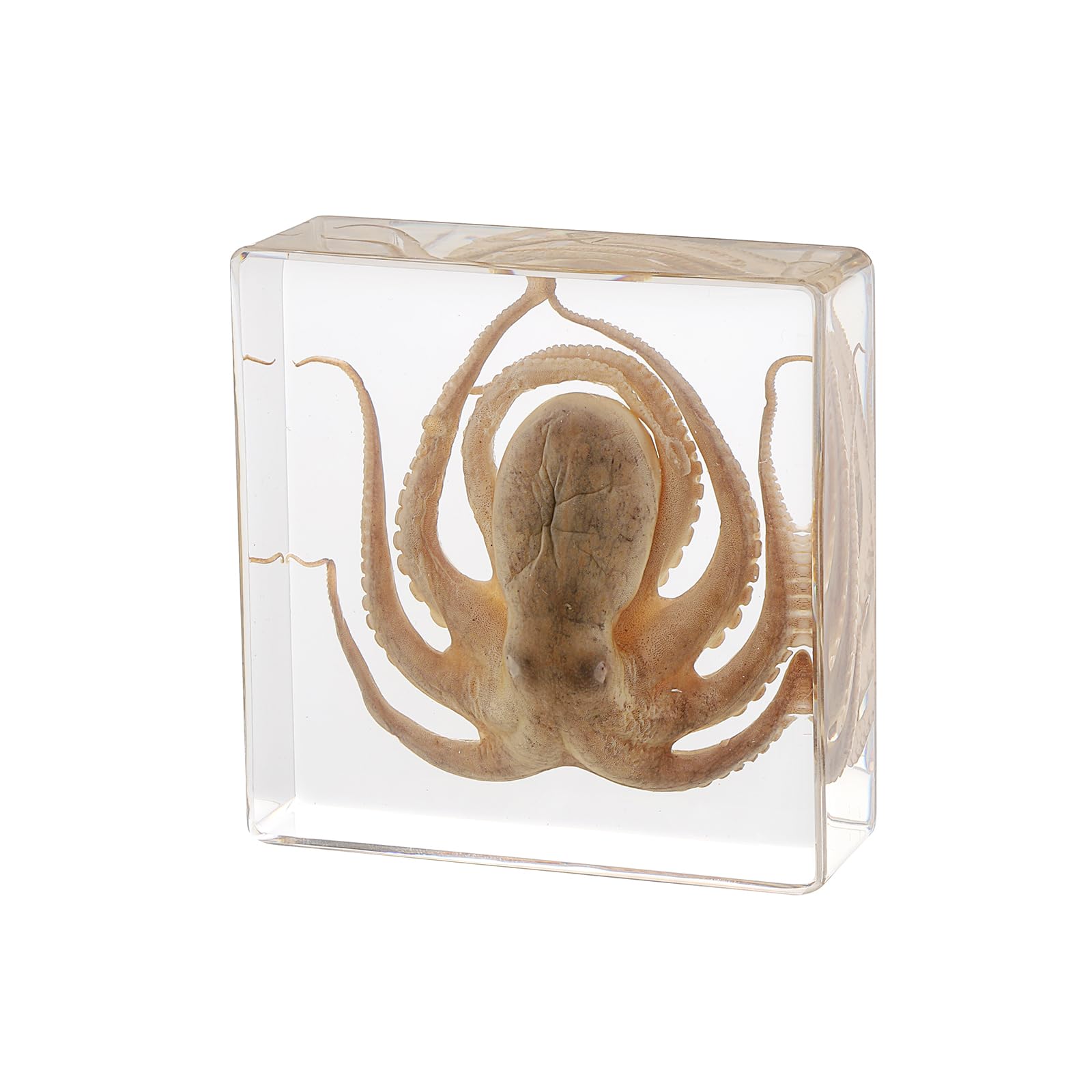
Specimen preservation has long been a staple of biology classrooms and natural history collections. The Taxidermy Octopus, Real Octopus Specimens Animal Specimen in Resin, is a small, resin-encased octopus intended for science education and as a curiosity for enthusiasts. At 3 x 3 x 1 inches, it’s a compact piece that can be handled, passed around, and examined up close without the fragility of traditional wet specimens.
The octopus is embedded in clear resin, which serves both to protect the specimen and to allow viewing from multiple angles. The resin block is solid and free of bubbles in most cases, though some units may have minor imperfections. The octopus itself is a real specimen, likely a small species or a juvenile, and its details—tentacles, suckers, and eye—are visible, though the preservation process can make colors appear muted or altered. It’s not a lifelike taxidermy mount but a scientific specimen, so expect a more subdued, formalin-fixed appearance.
In a classroom setting, this specimen shines as a hands-on teaching tool. Students can observe the anatomy of an octopus without the mess of dissection or the ethical concerns some may have with wet specimens. It’s durable enough to be passed around, though dropping it on a hard surface could crack the resin. For homeschool families or science clubs, it offers a tangible way to discuss marine biology, adaptation, and preservation techniques. It’s also a popular item among collectors of oddities and curiosities, who might display it on a shelf alongside skulls, insects, and other natural history artifacts.
Functionally, the resin block is inert and requires no maintenance. Unlike wet specimens that need periodic fluid changes, this can be left out indefinitely. However, the resin can yellow over time if exposed to UV light, so keeping it out of direct sunlight is advisable. The size is a limitation: at 3 inches across, it’s smaller than many might expect, and the octopus inside is correspondingly small. For detailed anatomical study, a larger specimen or a model would be more appropriate. Also, because it’s a real animal, each piece is unique—there will be variations in pose, size, and clarity.
Compared to other educational specimens, such as plastic models or diagrams, this offers the advantage of being a real organism. Plastic models are often larger and more detailed, but they lack the authenticity of a real specimen. Wet specimens, while excellent for study, require more care and are messier. This resin-embedded octopus strikes a balance between durability and authenticity, though it sacrifices some detail due to the resin and the small size.
Who is this for? It’s well-suited for science teachers, especially those covering marine biology or zoology, who want a durable, low-maintenance specimen for the classroom. It’s also a good fit for collectors of natural history curiosities, or as a gift for someone interested in biology and oddities. It is not for those seeking a large, highly detailed anatomical model, nor for anyone expecting a colorful, lifelike display piece. It’s also not a toy; it’s a real specimen and should be handled with care, though it’s more robust than glass.
In terms of value, the price is reasonable for a real specimen in resin. Similar items can be found from various sellers, with quality varying. This particular one is on the smaller side, so if size is a priority, consider a larger option. The craftsmanship is generally good, but as with any natural specimen, there can be slight flaws. It’s a niche product, but for its intended audience, it serves its purpose well.