
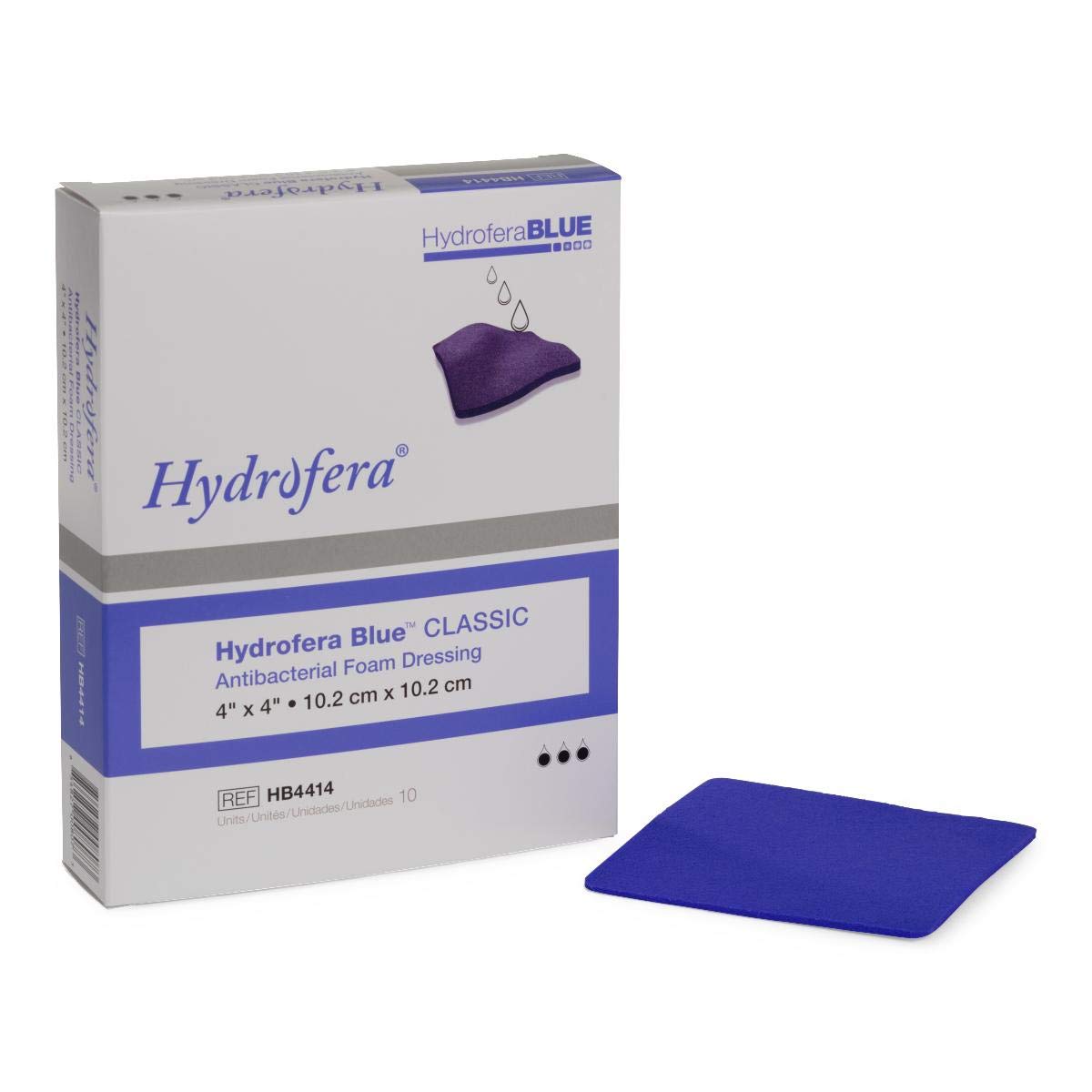
Hydrofera Blue is a bacteriostatic foam dressing that has carved out a niche in wound care, particularly for wounds at risk of infection or those already showing signs of bacterial burden. This review examines the 4″x4″ size, sold as a box of 10 dressings, with a total of 20 in this two-pack configuration. It’s a product that often gets recommended by wound care nurses and used in outpatient settings, but it’s not without its quirks.
In real-world use, Hydrofera Blue is typically applied to pressure ulcers, diabetic foot ulcers, venous leg ulcers, and surgical wounds. It’s also used on donor sites and occasionally on burns. The dressing is designed to manage exudate while providing a bacteriostatic effect, meaning it inhibits bacterial growth without necessarily killing bacteria outright. The 4″x4″ size is versatile—it can be cut to fit smaller wounds or used whole on moderate-sized ones. It’s often secured with a secondary dressing like a transparent film or hydrocolloid, and it can stay in place for up to three days, depending on exudate levels.
What sets Hydrofera Blue apart from standard foam dressings is its composition. It’s a polyurethane foam that has been treated with methylene blue and gentian violet, two agents that give it its distinctive blue color and provide the bacteriostatic action. These agents are also known for their ability to reduce pain and itching, which can be a plus for patients with sensitive wounds. The foam itself is highly absorbent, and it maintains a moist wound environment, which is crucial for healing. It’s also conformable, so it can be used on irregular wound shapes without causing pressure points.
One of the key functional features is its ability to handle moderate to heavy exudate. The foam wicks fluid away from the wound bed, and the blue color helps mask the appearance of blood or exudate, which can be less alarming for patients and caregivers. It’s also latex-free and sterile, reducing the risk of allergic reactions. The dressing is not adhesive, so it requires a secondary fixation, which is a common trade-off for foam dressings that need to conform closely to the wound.
However, there are limitations. The 4″x4″ size is not ideal for very large wounds, and while it can be cut, doing so may compromise the bacteriostatic properties along the cut edge. Also, Hydrofera Blue is not designed for dry wounds or those with minimal exudate—it needs moisture to function effectively. In very wet wounds, it may need to be changed daily, which can be costly. And while it’s bacteriostatic, it’s not a substitute for systemic antibiotics in cases of active infection. Some clinicians note that the blue color can stain clothing or bedding if not properly secured, and the dressing can have a slight odor when removed, which is normal but worth knowing.
Compared to other foam dressings like Mepilex or Allevyn, Hydrofera Blue is more expensive. Mepilex, for instance, is a silicone foam that’s known for its gentle adhesion and is often used on fragile skin. Hydrofera Blue doesn’t have an adhesive border, so it’s less convenient for quick application. However, the bacteriostatic property is a distinct advantage for wounds that are prone to infection, and some studies suggest it can reduce the need for antibiotics. In comparison to silver dressings, Hydrofera Blue may be less cytotoxic and doesn’t cause the same level of staining, but silver dressings may offer a broader antimicrobial spectrum.
Who is this for? It’s suitable for healthcare professionals managing wounds with moderate exudate and a risk of infection, particularly in settings where infection control is a priority. It’s also good for home health nurses who need a dressing that can stay in place for a few days. It’s not for patients with dry wounds, those with known allergies to methylene blue or gentian violet, or for those who need a self-adhesive dressing for convenience. It’s also not the most cost-effective option for simple, non-infected wounds.
In terms of value, the 20-pack (two boxes of 10) is a reasonable supply for a clinic or a patient with multiple wounds. The shelf life is typically three years, so it’s not a product that expires quickly. But because it’s not adhesive, you’ll also need to budget for secondary dressings, which adds to the overall cost.
Overall, Hydrofera Blue is a solid choice for specific wound care scenarios. It’s not a one-size-fits-all solution, and its higher price point may be a barrier for some. But for wounds where infection is a concern, the bacteriostatic properties and exudate management make it a valuable tool in the wound care arsenal. Just be aware of its limitations and the need for proper secondary fixation.