
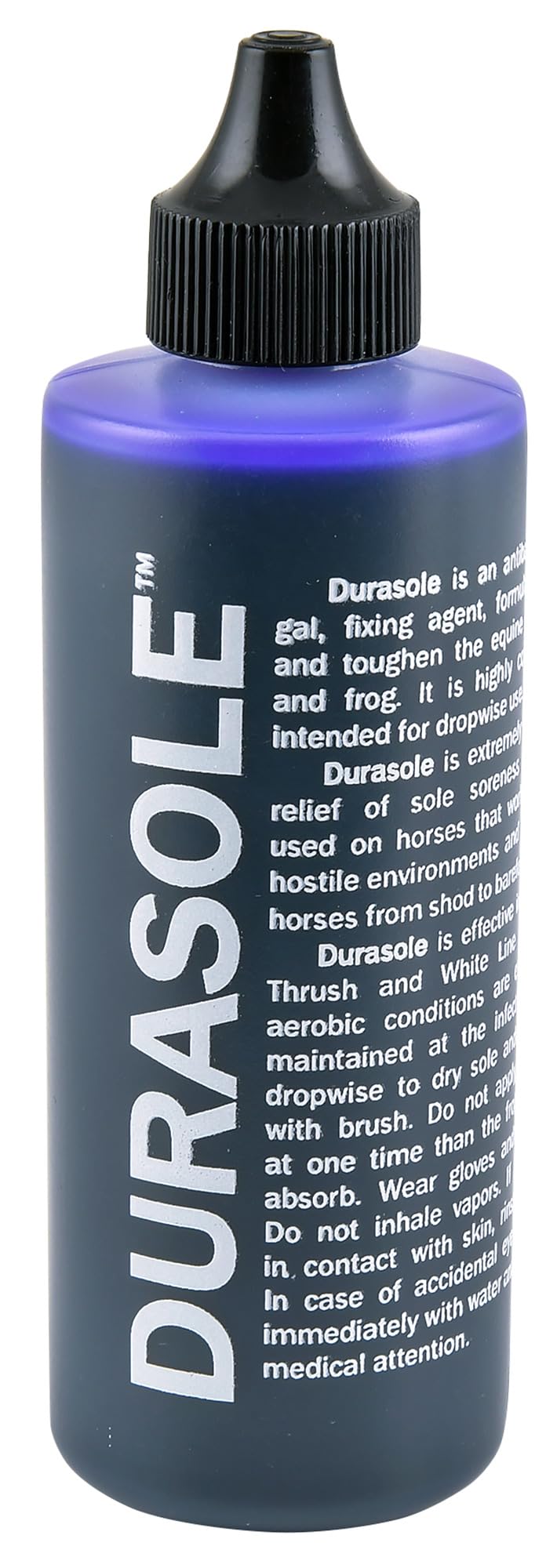
Durasole is a topical hoof hardener marketed for cattle, horses, and other livestock. It’s not a new product, but it has a dedicated following among farmers and farriers who deal with hoof issues in wet or abrasive environments. The premise is straightforward: apply it to the sole and walls of the hoof to create a tougher, more resistant surface. We looked at how it’s actually used, what it does well, and where it falls short.
In real-world use, Durasole is typically applied with a brush to clean, dry hooves. It goes on as a thin liquid and dries fairly quickly, leaving a slightly tacky film that eventually hardens. Dairy farmers often use it on cows that spend a lot of time standing on concrete, where hooves can wear down or become soft. Horse owners might reach for it when a horse is prone to sole bruises or has thin soles. It’s also used in areas with muddy, wet conditions that can soften hooves and make them more susceptible to damage.
Functionally, Durasole works by penetrating the hoof horn and depositing a resin-like substance that reinforces the structure. It’s not a treatment for active infections like thrush or abscesses; it’s more of a preventative and supportive measure. The key ingredients include formaldehyde and phenol, which are antiseptic and hardening agents. That means it has a strong, medicinal smell, and you should use it in a well-ventilated area. It’s also flammable until dry, so storage and application require some care.
One of the main limitations is that it’s not a quick fix. You need consistent application over weeks to see results, and if the hoof is already severely damaged or infected, Durasole alone won’t solve the problem. It’s also not cheap, and a small bottle doesn’t cover many hooves. Some users report that it can cause irritation on sensitive skin or if applied too thickly. And because it contains formaldehyde, there are health and environmental considerations—gloves and eye protection are advisable.
Compared to alternative hoof care products, Durasole sits in a niche. There are milder hardeners like Keratex that use different chemistry, and there are also simple iodine or copper sulfate solutions that cost less but may not provide the same level of hardening. Durasole is more aggressive, which can be an advantage in tough conditions but also means it’s less forgiving if misused. It’s not a substitute for proper hoof trimming, nutrition, or hygiene—those remain the foundation of hoof health.
So who is Durasole for? It’s best suited for livestock owners who have already addressed basic hoof care and need extra protection in challenging environments. If you’re dealing with soft hooves, frequent stone bruises, or excessive wear, it might be worth trying. It’s also popular among farriers who want a reliable hardener for their clients’ horses. On the other hand, it’s not for someone looking for an instant cure for hoof rot or a product to use on minor cracks without addressing underlying issues. It’s also not ideal for those who prefer gentler, more natural approaches, given its chemical composition.
In terms of performance, expectations should be realistic. Durasole can help toughen hooves, but it won’t make a weak hoof bulletproof. Results vary based on the animal’s diet, living conditions, and genetics. Some users see improvement within a few weeks; others may need months. It’s also worth noting that overuse can lead to brittle hooves, so following label directions is important.
Overall, Durasole is a tool in the hoof care toolbox, not a miracle worker. It has a loyal user base for a reason—it does what it claims when used correctly. But it’s not without drawbacks, and it’s not the right choice for every situation. If you’re considering it, weigh the cost, the chemical exposure, and the commitment to regular application. For the right user, it can be a valuable addition to a hoof care routine.