
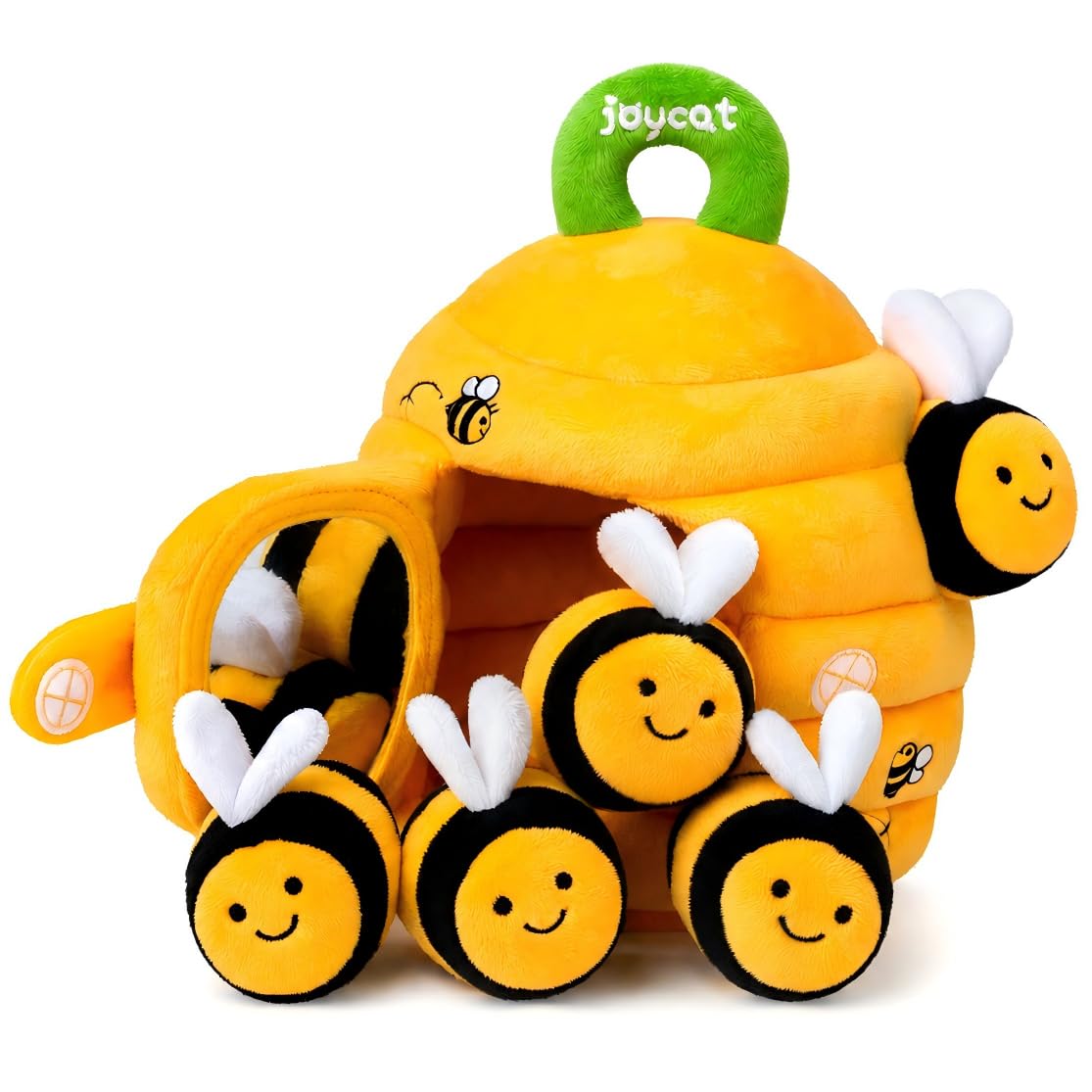
The JoyCat Beehive Toy is one of those infant toys that looks simpler than it is. The set pairs a beehive-shaped container with five sensory bees, each built with a different combination of textures, colors, and rattle or crinkle elements. It sits in the familiar “put in, take out” category of baby toys, but the variety among the bees gives it more replay value than a basic bucket-and-blocks set. For a toy aimed at the 6–12 month window, that difference matters, because this is the age when object permanence is developing and a baby’s interest in hiding and retrieving things is at its peak.
In practice, the toy gets used in a few predictable ways. Younger babies, around six or seven months, tend to grab the bees individually and mouth them, since the shapes are sized for small hands and the fabric or textured surfaces are easy to chew. As they approach nine or ten months, the beehive itself becomes the draw: dropping bees in, tipping the hive over, and fishing them back out. Parents often use it during floor play or as a quiet distraction during diaper changes. It is not a toy that holds attention for long stretches on its own, but it works well as part of a rotation.
The functional design is straightforward. The hive has an opening large enough for the bees but not so large that they fall out on their own, so retrieval requires some effort, which is the point. The five bees are not identical, and that is the set’s main strength. Some rattle, some crinkle, and the surface textures vary enough that a baby can tell them apart by touch as well as sight. This kind of variation supports sensory exploration without overstimulating, and it means the toy can be used for simple matching or naming games as a child gets older, though that is a stretch for the youngest end of the range.
There are trade-offs worth knowing. The hive is lightweight, which makes it easy for a baby to knock over but also means it slides across hard floors and can tip during enthusiastic play. The bees are small enough to be a choking concern if a seam ever gives way, so the usual supervision applies, and it is worth checking the stitching periodically. The sensory elements are also fairly subtle: the rattles are soft rather than loud, and the crinkle is gentle. Some babies who are used to more stimulating light-and-sound toys may lose interest quickly. And because the set is fabric-heavy, it does not wipe clean as easily as hard plastic toys; most versions need spot cleaning or hand washing, which is less convenient than a quick wipe-down.
Compared with a standard shape sorter or stacking cups, the JoyCat set leans more toward open-ended sensory play than toward teaching a specific skill. A shape sorter gives clearer feedback and a defined goal, while this toy is more about exploration and cause-and-effect. Families who want a toy that clearly “does something” may find it underwhelming. Families who prefer quieter, screen-free play with room for imagination will likely get more out of it. It also compares reasonably to fabric activity cubes, though it is more focused and less bulky.
As a gift, it is a sensible choice for a first birthday or a six-month milestone, largely because it does not require batteries and does not make noise that parents will regret. The presentation is simple, and the set is easy to store. It is not a standout heirloom piece, and the materials feel adequate rather than premium, which is consistent with the price point.
Who it suits:
- Babies in the 6–12 month range who are working on grasping, transferring, and retrieving objects
- Parents looking for a battery-free, relatively quiet toy for floor play
- Buyers who want a gift that encourages sensory exploration without a lot of setup
Who it may not suit:
- Babies who are already strongly drawn to light-and-sound toys and need more stimulation
- Caregivers who prefer toys that can be wiped clean after every use
- Families looking for a toy with a clear developmental goal, like a shape sorter
Overall, the JoyCat beehive set is a modest, well-conceived toy that does what it claims without much fuss. It is unlikely to become a child’s single favorite object, but it fills a useful role in the six-to-twelve-month stretch, when simple hiding and retrieving games are exactly the right level of challenge.