
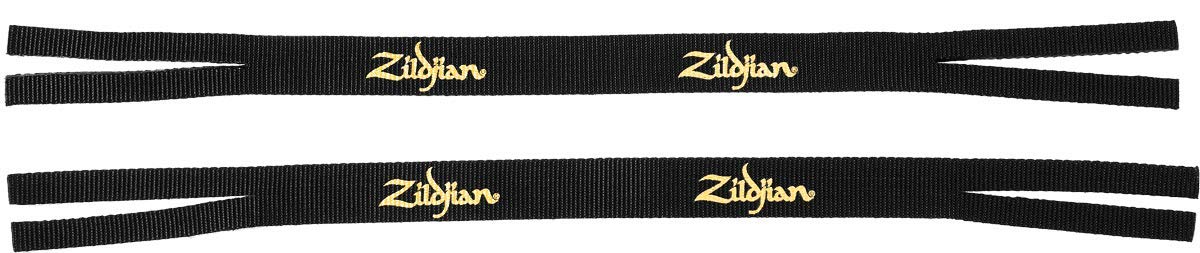
Cymbal straps are the kind of component most drummers ignore until something goes wrong mid-set. The Zildjian P0754 is a pair of nylon straps intended to replace the worn, stretched, or missing straps on a standard acoustic kit. They are inexpensive, widely available, and simple by design, which is both the appeal and the limitation. This is not a product that transforms a kit; it is a consumable part that needs to do one job reliably.
The straps are sold as a pair, which matters because cymbals tend to wear at similar rates. Each strap is a flat strip of woven nylon with a reinforced hole at one end for the cymbal stand’s tilter post and a slotted or pre-punched section at the other for threading through the cymbal’s bell hole. The nylon is stiffer than leather out of the package, and that stiffness is the first thing a player will notice during installation. Threading a new strap through a cymbal requires a bit of patience, particularly on heavier cymbals where the bell hole is tight. Once seated, the material holds its shape and does not stretch the way cheaper woven straps often do after a few weeks of play.
In real use, these straps live on the cymbal stand’s post, held in place by the wing nut and felt. The strap’s job is to isolate the cymbal from metal-on-metal contact while allowing it to swing naturally. The P0754 does this without drama. The nylon is thin enough to pass through standard bell holes and wide enough to avoid the fraying that thin cord-style straps suffer from. Players who hit hard or use large rides will find the material holds up reasonably well, though the hole at the post end is the first place to show wear. That is a normal failure point for any strap, and it is worth checking periodically rather than assuming the pair will last indefinitely.
One limitation worth stating plainly: nylon is not leather. It does not breathe, it does not soften with age in the same way, and it can feel slightly slick against the cymbal felt. Some players report that the stiffness affects how freely a cymbal swings compared with a broken-in leather strap, particularly on thinner crash cymbals where subtle movement matters. The difference is small and many drummers will never notice it, but it is real. The straps also come in a single length, so drummers using unusually deep bells or non-standard mounting hardware may find the fit less than ideal.
Compared with leather cymbal straps, which are the traditional alternative, the P0754 trades suppleness and long-term break-in for consistency and lower cost. Leather straps tend to conform to the cymbal and stand over time and are often preferred by jazz players who want maximum cymbal movement. Nylon straps like these are more common in rock and general-purpose setups where durability and predictable replacement matter more than feel. Compared with the cheapest no-name nylon straps sold in bulk, the Zildjian pair offers more consistent hole placement and cleaner edges, though the difference is modest and not a reason to pay a large premium.
Who is this for? Drummers maintaining a working kit, school programs, rehearsal spaces, and anyone who needs a straightforward replacement pair without hunting for a specific brand. It is also a sensible spare to keep in a gig bag, since a snapped strap can end a song. Who is it not for? Players who are particular about cymbal swing and have settled on leather will likely find nylon a step down in feel. Drummers with vintage or unusual cymbal stands should check the post diameter and bell depth before buying, since the single length and hole placement assume standard hardware.
The honest summary is that the P0754 is a competent, unremarkable part. It installs with some effort, holds up under normal playing, and costs little. It will not improve the sound of a kit, and it will eventually wear at the post hole like every strap does. Treat it as a consumable, inspect it now and then, and it will do its job without drawing attention, which is exactly what a cymbal strap should do.