
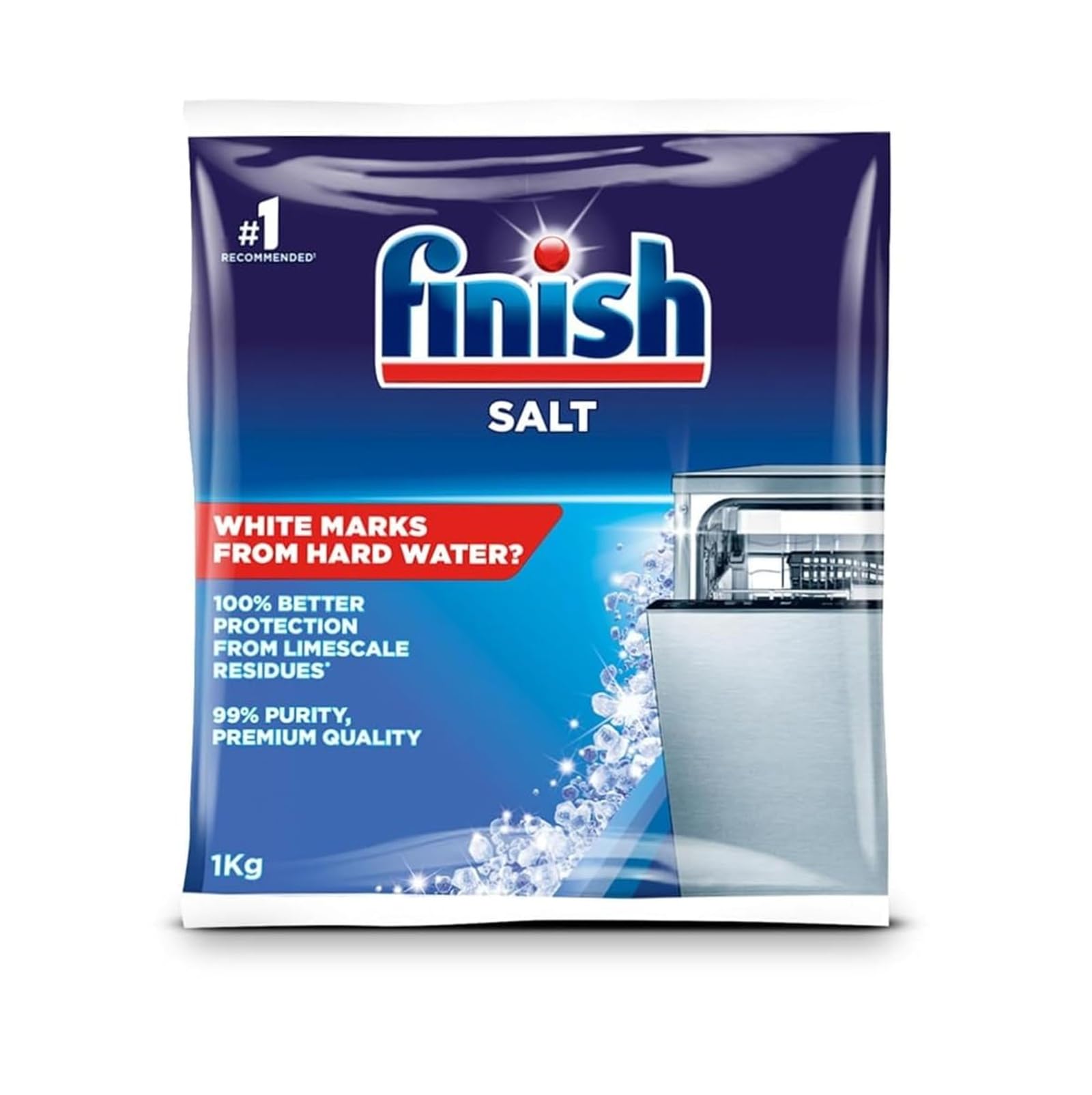
Dishwasher salt is one of those consumables that most people ignore until a machine starts leaving cloudy film on glasses or a repair technician mentions limescale. Finish’s 1 kg bag is a straightforward entry point into that category: a single bag of coarse-grained sodium chloride intended for the salt reservoir built into most dishwashers. It is not a detergent, not a rinse aid, and not something that improves cleaning on its own. Understanding that distinction is the whole review.
The salt’s job is to regenerate the ion-exchange resin inside the dishwasher’s built-in water softener. In hard-water areas, calcium and magnesium ions cause scale to build up on heating elements and glassware. The softener swaps those minerals for sodium, and the salt is what recharges that resin during the regeneration cycle. Finish’s product is formulated for this purpose, with coarse grains designed to dissolve at the right rate and a purity level that avoids the insoluble impurities found in table salt or cheap rock salt. That last point matters more than the branding: ordinary cooking salt contains anti-caking agents and fine particles that can clog the reservoir or fail to dissolve properly.
In real use, the bag is poured into the salt compartment, usually located under the bottom rack or in the base of the tub, often through a funnel that comes with the machine. Most dishwashers hold roughly 1 to 2 kg, so a 1 kg bag is a partial fill for many models rather than a full refill. The salt indicator light on the panel tells you when to top up, and a full reservoir typically lasts anywhere from a few weeks to several months depending on water hardness and how often the machine runs. That variability is worth flagging: households in soft-water areas may find they rarely need to add salt at all, while hard-water households will go through bags noticeably faster.
Functionally, there is little to critique about the product itself. The grain size is appropriate, the purity is consistent with what dishwasher manufacturers specify, and the packaging reseals well enough for storage between refills. It dissolves without leaving residue in the compartment, and it does not clump in the way fine salt can in humid conditions. These are modest virtues, but they are the ones that matter for a consumable like this.
The main trade-off is cost and packaging. A 1 kg bag is a small quantity, and buying it as a single pack means frequent repurchasing if your machine is a heavy user. Compared with bulk dishwasher salt sold in 4 kg or 5 kg bags, or with generic supermarket own-brand dishwasher salt, Finish’s small format works out more expensive per kilogram and generates more plastic waste over time. The brand does not offer a meaningful performance advantage that is easy to verify; the specification that matters is purity and grain size, and several cheaper alternatives meet it. Where Finish has an edge is availability and consistency—it is stocked almost everywhere, and the formulation is reliably within spec, which is not always guaranteed with the cheapest no-name salt.
There is also a misconception worth addressing: some people buy dishwasher salt believing it improves wash results or replaces rinse aid. It does neither. If your water is soft, adding salt provides no benefit and the softener may not even be active. If your machine has no salt reservoir—many compact and some American-style models do not—the product is simply irrelevant. Checking the manual before buying is the sensible step, and it is surprising how many people skip it.
Who is this for? Primarily households in medium-to-hard water areas with a dishwasher that has a salt compartment and a working softener. It suits people who want a reliable, widely available option and do not mind paying a small premium for convenience. It is also a reasonable choice for anyone unsure which salt to buy, since it is hard to get wrong.
Who is it not for? Those in soft-water regions, owners of dishwashers without salt reservoirs, and anyone willing to buy larger bags or supermarket own-brand salt to save money. For heavy users, a 4–5 kg bag from a reputable brand is the more practical purchase. The 1 kg Finish bag is fine as a starter or a stopgap, but it is not the economical long-term choice, and the review should say so plainly.
Overall, this is a competent, unremarkable consumable that does exactly what it claims. The limitations are about format and price rather than performance, and the decision comes down to whether convenience is worth the per-kilogram premium. For many shoppers it will be; for careful ones, it probably will not.