
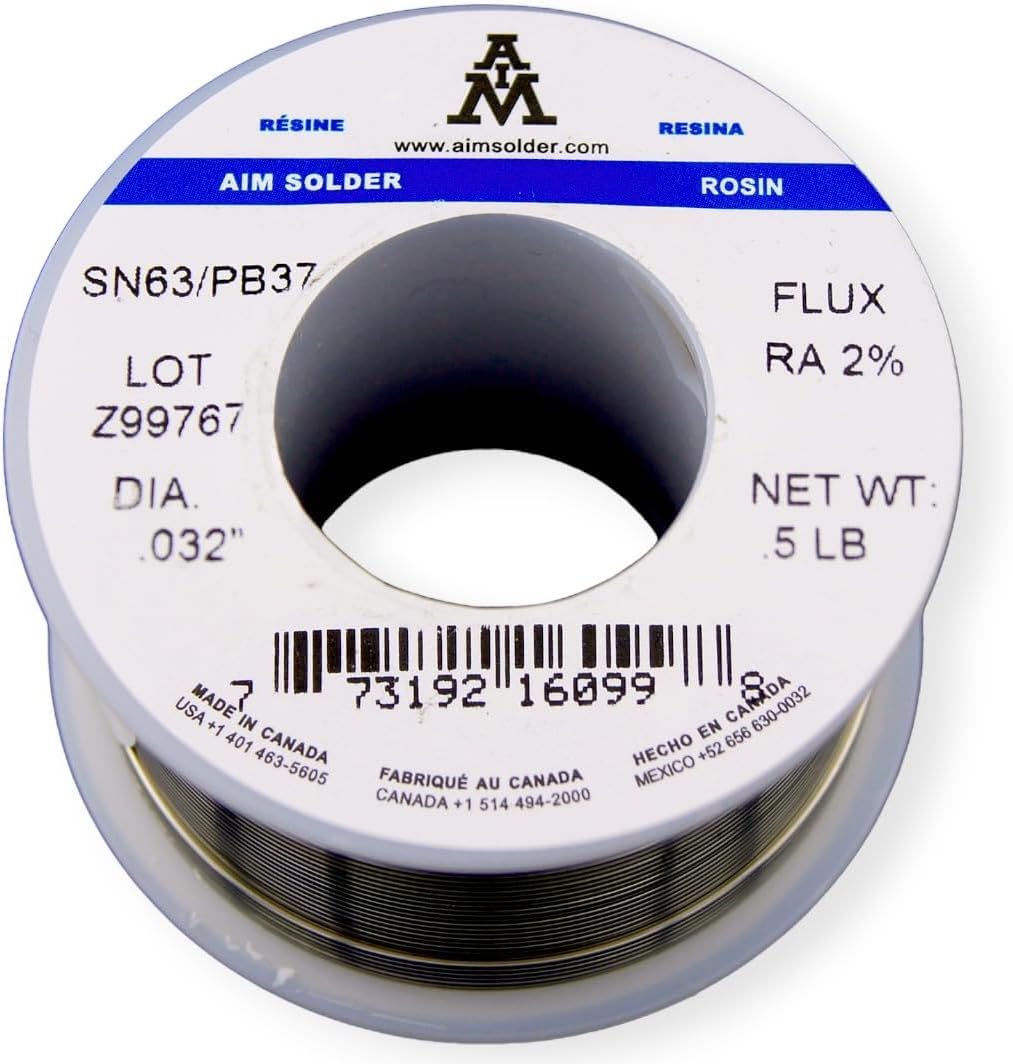
For electronics work that doesn’t require lead-free compliance, the AIM Solder 63-37 tin-lead rosin core wire is a familiar option. This 0.5 lb spool of 0.032-inch (0.8mm) solder is aimed at technicians, hobbyists, and repair shops that still use the eutectic 63/37 alloy. It’s not a new or innovative product, but it fills a specific role for those who prefer the working characteristics of leaded solder.
In real-world use, this solder shows up in through-hole prototyping, cable repairs, and older equipment restoration. The 0.032-inch diameter is a middle ground: thick enough for quick joints on larger pads, yet thin enough for moderate-density boards. The rosin core is classified as RMA (rosin mildly activated), which offers a balance between flux activity and residue corrosivity. For many standard soldering tasks, it provides adequate wetting without requiring extra flux, though heavily oxidized surfaces may still need assistance.
The eutectic 63/37 alloy is the standout feature. Unlike 60/40, which has a plastic range between solid and liquid states, 63/37 transitions sharply at 183°C. This reduces the chance of disturbed joints if the board moves during cooling. The solder melts quickly with a 60-80W iron and flows smoothly, producing shiny, well-formed fillets. The rosin core is consistent, leaving a amber residue that is generally non-corrosive but should be cleaned for high-reliability applications.
However, there are trade-offs. Leaded solder is increasingly restricted; it’s not RoHS compliant, so it can’t be used in products sold in many markets. For home hobbyists, the main concern is toxicity: lead accumulates in the body, so proper ventilation and hand washing are essential. The residue, while mild, can be sticky and may need removal with isopropyl alcohol or a dedicated cleaner. Additionally, the 0.5 lb spool is relatively small for frequent users; those who solder daily may find themselves reordering often.
Compared to lead-free alternatives like SAC305, this solder is easier to work with. Lead-free alloys have higher melting points and often require more flux and higher temperatures, which can be challenging for beginners or for use on heat-sensitive components. However, lead-free is mandatory for commercial products in many regions, and some users prefer to avoid lead entirely for health or environmental reasons. For those who can use leaded solder, the 63/37 alloy is often considered more forgiving.
This solder is suitable for electronics technicians, hobbyists, and repair personnel who work with leaded solder and need a reliable, consistent alloy. It’s also a good choice for those learning to solder, as the eutectic behavior helps produce good joints with less practice. It is not suitable for anyone requiring RoHS compliance, for those uncomfortable with lead exposure, or for high-volume production where larger spools are more economical. If you’re soldering plumbing or jewelry, this isn’t the right product; those applications require different alloys and fluxes.
In summary, the AIM Solder 63-37 rosin core wire is a competent, no-frills option for leaded soldering. It performs as expected, with the predictable behavior of a eutectic alloy. The limitations are inherent to the material, not defects of this particular brand. For its intended audience, it’s a practical choice.