
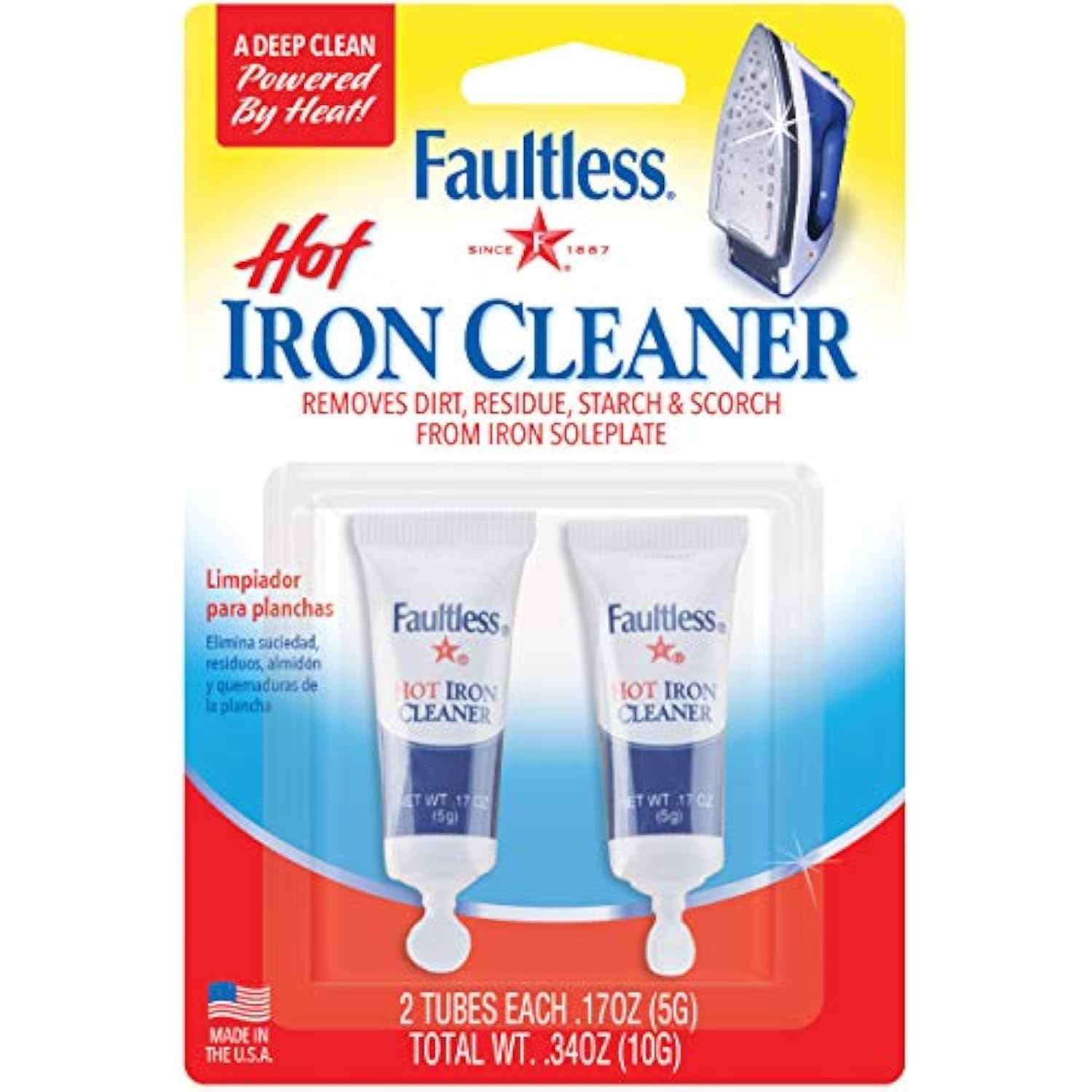
Iron maintenance is one of those chores most people ignore until the soleplate starts dragging across a shirt or leaving faint brown streaks on a white blouse. The Faultless Hot Iron Cleaner is a small, targeted product aimed at that exact moment of frustration. It comes as two 0.17 oz blister-packed tubes of a paste-like cleaner, intended to strip away the residue that builds up on a hot iron over months of use.
The product is designed to address a fairly specific set of problems: melted synthetic fabrics that have fused to the soleplate, adhesive residue from iron-on patches or hem tape, hard water and lime deposits from steam use, and starch buildup from spray sizing. These are real issues, and anyone who irons regularly—especially quilters, sewers, or people who press dress shirts—has likely encountered at least one of them.
How it is actually used
The application process is straightforward but requires some care. The iron is heated to a moderate temperature, and the contents of one tube are squeezed onto a cloth or directly onto the warm soleplate, depending on the instructions followed. The paste is then worked over the surface with a cloth or rag, and the residue is wiped away. Because the cleaner works on a warm iron, there is an inherent timing element—too hot and the paste can bake on, too cool and it does not lift the grime effectively. Users generally need to work in a ventilated space, as the cleaner has a noticeable odor despite being marketed as non-toxic.
Each tube is small, at 0.17 oz, which is enough for roughly one thorough cleaning session. The two-tube pack therefore provides about two cleanings, which is worth noting for anyone expecting a long-term supply. For heavy users, this translates to a recurring purchase rather than a one-time fix.
What the product actually does well
The paste formulation is effective on the types of residue that are hardest to remove with home remedies. Melted polyester or fusible interfacing, which can be stubbornly bonded to a soleplate, tends to soften and lift with the cleaner’s solvent action. Starch and spray sizing, which accumulate as a hazy film, also come off fairly readily. The small tube format makes it easy to store in a sewing drawer or laundry cabinet, and the blister packaging keeps the paste from drying out between uses.
Compared with generic alternatives, the Faultless cleaner sits somewhere between DIY methods and professional servicing. A common household approach is to run a hot iron over a sheet of newspaper or a dryer sheet, or to scrub the soleplate with vinegar and baking soda. Those methods can work for light film but struggle with fused synthetics and hardened glue. Sending an iron in for service is more thorough but costly and inconvenient. The Faultless tubes occupy a middle ground: more targeted than home remedies, less expensive than professional repair, but limited in quantity.
Where it falls short
The most significant trade-off is the volume. Two small tubes do not go far, and the per-cleaning cost is higher than a bottle of dedicated soleplate cleaner or a DIY approach. The paste also requires some technique—applying it to a surface that is warm but not scorching—and impatient users may find that residue returns if the soleplate is not wiped thoroughly afterward. The odor is another consideration; it is not overpowering, but it is present, and the non-toxic label should not be read as fragrance-free or entirely benign if ingested.
There is also the question of the steam vents. The paste is primarily for the flat soleplate surface, and cleaning inside the steam holes is fiddly. Users with heavily scaled irons may find that the cleaner addresses surface grime but does not descale the internal water chamber, which is a separate maintenance task typically handled with a vinegar-and-water flush.
Who it suits and who it does not
This product makes the most sense for people who iron frequently and have encountered specific residue problems—quilters dealing with fusible web, sewers working with interfacing, or households with hard water that leaves deposits on the soleplate. It is also a reasonable item for someone who has just noticed scorch marks and wants a targeted fix without replacing the iron.
It is less suitable for casual ironers who rarely encounter buildup, since the tubes may dry out before they are needed. Anyone looking for a bulk solution or a routine descaling product should look elsewhere. And those sensitive to odors or preferring fragrance-free cleaning products may want to test in a small area first. Overall, the Faultless Hot Iron Cleaner is a practical, narrowly focused tool—effective within its limits, but not a substitute for regular iron maintenance or a more comprehensive cleaning regimen.